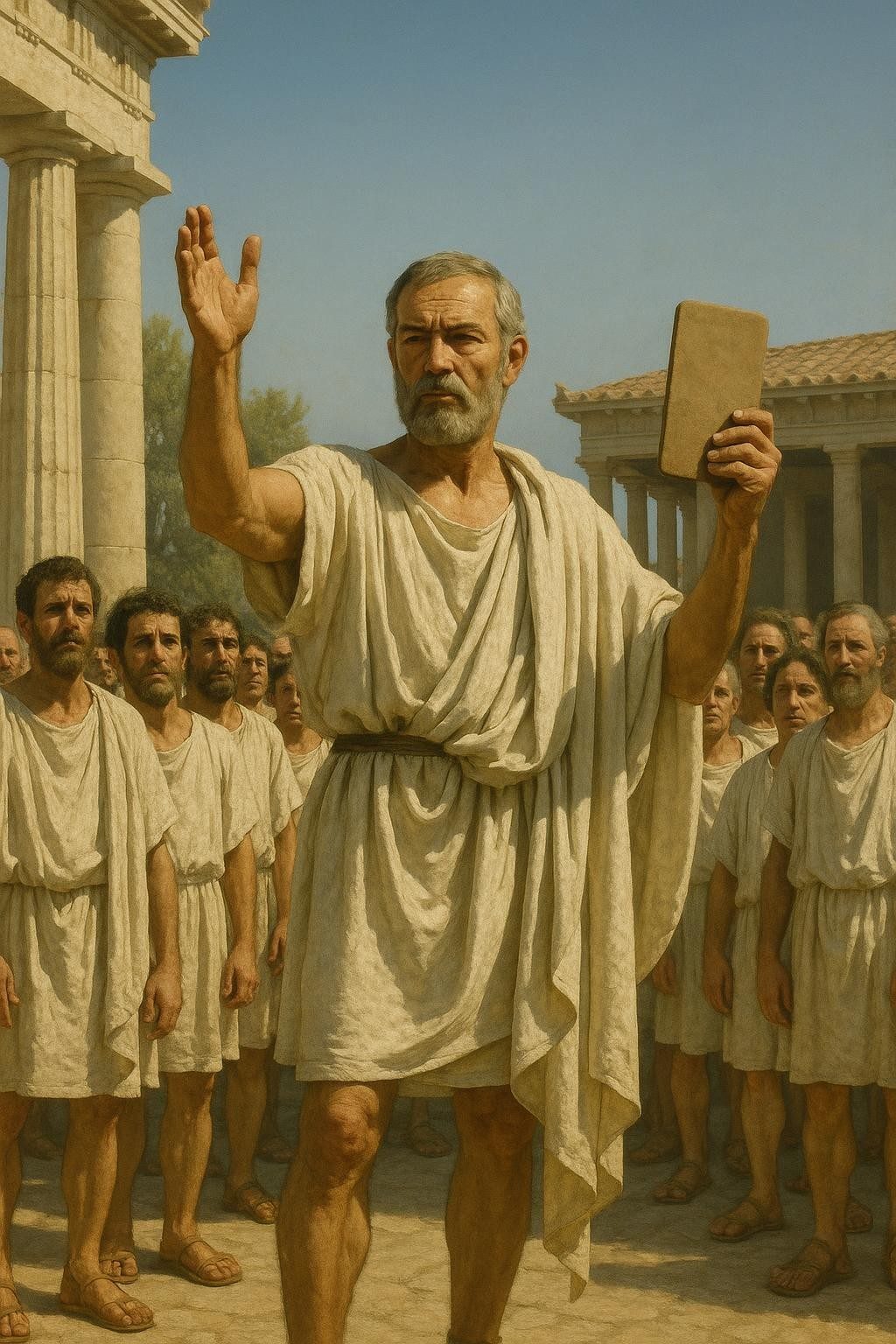
The crowd hushed as the olive-skinned man with piercing eyes addressed them, his voice carrying over the rustling leaves of the Agora. Solon stood firm on the polished stones of Athens, the weight of the city-state resting squarely on his shoulders, the future of an entire civilization in the balance. In that charged silence, one could almost hear the trembling of invisible chains as he resolved to unbind them. Athens was torn, like a ship caught in a storm, and Solon was its captain, tasked with steering clear of the rocks.
The Deepening Crisis
Athens, 594 BC. The city was in turmoil, an elegant diadem encircled by strife and inequality. The society was split as fault lines widened between the opulent few and the indebted many. Wealthy aristocrats basked in the sunlit halls of their expansive estates, while the hungry cries of debt-ridden Athenians cut through the air like a bitter winter wind. Mortgaged fields stood silent as hunger and disillusionment echoed across the city-state, a powder keg in the making.
The grip of debt slavery tightened, a shadow stretching across the sunlit Acropolis, darkening homes and lives. Many Athenians lived under the threat of enslavement, their lives bound to the whims of their creditors. This state of desperate inequality could not long endure without the tremors of rebellion. In these desperate times, with the foundation of the city trembling underfoot, the people turned to one man—Solon, a philosopher with the heart of a statesman and the will of a reformer.
Revolution Through Reform
Every step toward the Pnyx, where Athenian leaders convened, seemed to echo the demands of the masses pressing for change. Solon was no ordinary leader; he was a poet, a thinker who understood that the threadbinding society was frayed but also how it could be rewoven into a tapestry of equity and justice. The plan he outlined was revolutionary yet grounded in pragmatism.
Solon enacted the Seisachtheia, or "shaking off of burdens," a sweeping decree that eradicated the suffocating sands of debt from the shivering backs of Athens' citizens. He canceled the debts that turned freemen into servants and removed the markers that staked the land of the poor. He restored to debt slaves the dignity of freedom. With one stroke of philosophical insight, Solon severed the chains that bound his fellow citizens to their lenders.
A New Foundation for the Polis
Having neutralized the immediate threat of civil discord, Solon's reforms did not stop at momentary relief. His vision stretched further, planting seeds for what Athens could become—a city where laws were not merely inked for the privileged few but framed for all. He established new legal codes that formed the bones of a burgeoning democracy, nurturing the sapling of fairness in an arid landscape of oppression.
Solon crafted laws with precision, mechanisms to blend merit with morality, ensuring that wealth was no longer a bulwark but a vehicle of responsibility. He created a council with broader representation, giving rise to the idea that governance should not be the exclusive preserve of the aristocracy. He invited every tier of society to partake in governance, laying the fertile ground for the democracy Athens would one day be renowned for.
An Unlikely Exit
Power. The elixir that many savor but so few willingly relinquish. Solon held it in his grasp, a chalice brimming with the potential to rule, to impose a tyranny under the guise of reform. Yet, Solon defied historical precedents. With his mission fulfilled, he did something unheard of—he stepped effortlessly away from power.
As the murmurs of discontent morphed into the hopeful whispers of possibility, Solon voluntarily detached himself from the reins of leadership. The very act of giving up control was perhaps his most profound statement. He ensured that his vision, not his personal ambition, guided Athens towards a brighter horizon. Solon’s departure was as calculated and deliberate as his reforms, a true testament to the wisdom of fostering a nation’s empowerment, not subjugation.
Why Solon's Choices Still Resonate
The stone path Solon tread is long worn with history, but the echoes of his choices resound through the annals of time, whispering into the present. In choosing reform over revolution, dialogue over division, and altruism over autocracy, Solon bestowed a rare gift upon his city—a legacy of possibility. His actions were a break from the historical cycle of tyranny that not only altered his own time but crafted the words in the scripts of future governments, teaching us the profound lesson of leadership rooted in principle over power. In history's grand narrative, Solon's deeds remind us that true progress is born not from the chains we maintain, but from the ones we decide to dissolve.