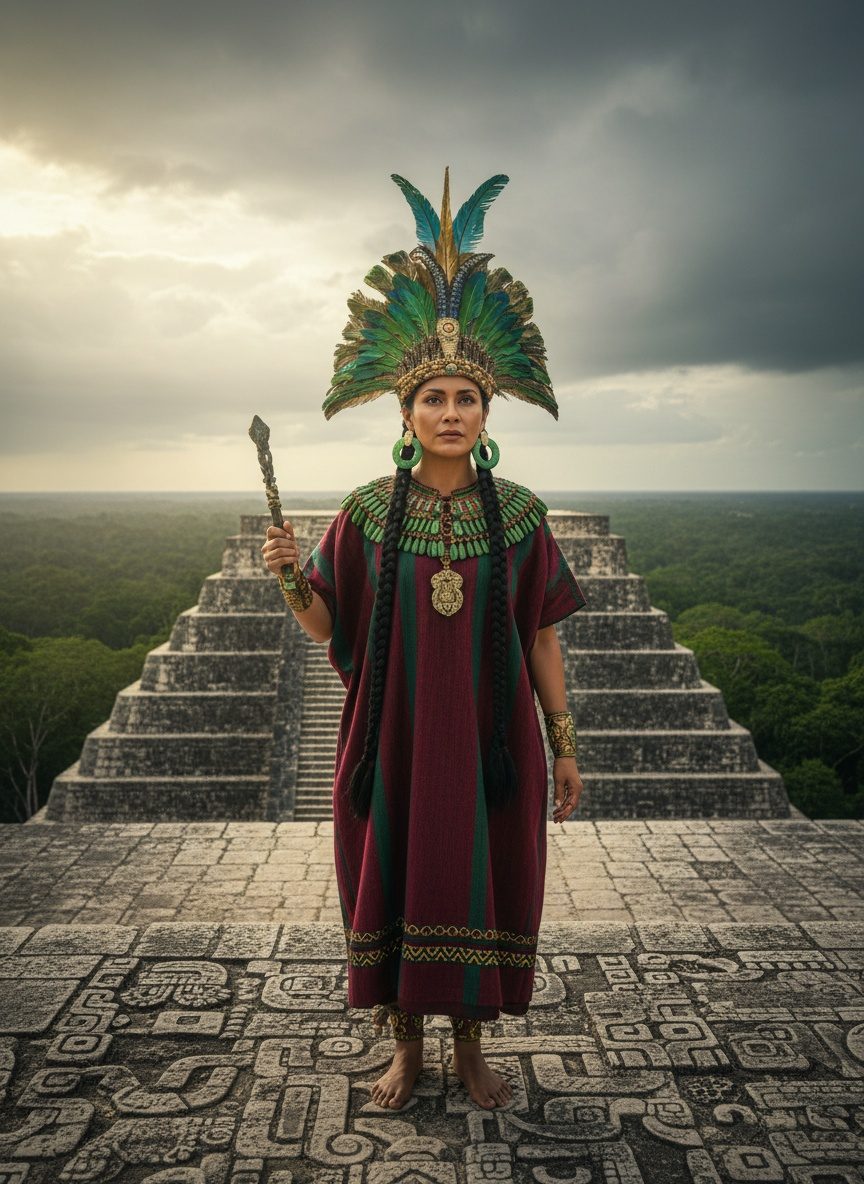
The dense jungle envelops the ancient ruins of El Peru-Waka, casting a shadowy tapestry of greens and browns through which only the boldest rays of sunlight dare penetrate. The cacophony of howler monkeys and the distant screech of parrots punctuate the continuous thrum of unseen insects. Somewhere beneath this living canopy lies a remnant of the past—a reminder of a time when this place was a thriving hub of power and intrigue. Nestled below a pyramid, the stone-encased remains of Lady K'abel silently hold the keys to the past—an era when she not only communed with the gods but sculpted a city from the very clay of its foundations.
As the sun dipped beneath the horizon, casting long shadows over the sprawling city, Lady K'abel stood above her people, her presence as formidable as the stone monuments erected in her honor. She was no ordinary figurehead, and in an age when the divine and temporal spheres danced a delicate tango, K'abel's sacred duties extended far beyond the gilded confines of her court. As the Kaloomte, or Supreme Warrior, she wielded a power unparalleled among her peers, commanding armies with the deftness of one chosen by the gods themselves. Her name was whispered with reverence throughout the streets and marketplaces, a promise of protection, strength, and prosperity.
The Maya city of El Peru-Waka was not just a center of political and military might; it was an epicenter of cultural and spiritual life. Nestled amidst the Guatemalan jungle, the city thrived during the Classic Maya Period, with its population bustling along the white limestone roads called sacbeob, which connected temples, plazas, and ball courts. Artisans and scribes busied themselves, creating intricate pottery and stone stelae that chronicled the feats of their rulers. It was into this world—a world of stone and ceremony—that K'abel was born and would come to claim her place atop the societal hierarchy.
K'abel's ascension to power was no mere accident of birth. Her union with the king—a marriage of both strategy and statehood—placed her at the heart of Waka's ruling dynasty. However, it was her sheer capability and vision that propelled her to heights unthinkable for a woman of her time. She was granted the title of Kaloomte, a position that conferred supreme command of Waka's military force and religious rites, outranking even her king husband in matters of war and spirituality. As Kaloomte, she was both a warrior and a conduit to the divine, her decisions steered by a hand that seemed guided by destiny itself.
Under K'abel's rulership, Waka experienced unprecedented prosperity, forging alliances that expanded its influence far beyond the city walls. The city's architecture, a testament to her reign, rose in formidable shapes across the landscape. Temples reached toward the heavens, and plazas echoed with the orations of scribes chronicling her reign. Ceremonial rites, led by K'abel, intertwined the earthly and ethereal, and her devotees believed she walked the thin line between mortal and god, carrying the city's fortunes as she did.
Despite her robust presence, Lady K'abel's mortal form would eventually yield to time. Yet, her story did not disappear with her; it merely transformed, etched into the stone tablets that lined her tomb. Found sealed beneath one of Waka's pyramids, her resting place is both metaphor and testament—a reminder of her formidable role in Maya history and the enduring mystery of her disappearance. The ancients had prophesied such an end, a return to the stone, though likely not even they could have fathomed the lasting potency of her legacy.
Tales of her life continue to intrigue historians and archaeologists alike. Discoveries of intricately painted pottery and hieroglyphic texts further unravel the enigma of her rule—a queen, yes, but more than that, a leader of formidable talent and resolve who shaped the destiny of her people. Unlike many of her contemporaries, who have been lost to the sands of time, K'abel remains a vibrant part of Maya history, woven into the fabric of the city she so loved.
In examining Lady K'abel's life and reign, we glimpse a world where courage and coalitions could transcend even the most deeply ingrained social boundaries. Her command of the spiritual and political spheres defies modern assumptions about gender and leadership in ancient societies. The title Kaloomte bestowed upon her was more than a coronation; it was a testament to the extraordinary breadth of her influence and her unique ability to govern both the seen and unseen realms.
Lady K'abel's story invites us to reconsider the narratives of history, to seek out those untold accounts nestled within the jungles of the distant past. Her life, though shrouded in mystery, offers a beacon—a reminder of the countless figures whose names whisper through the stone corridors of history, urging us to listen for their stories before they fade into the wilderness. In this way, she speaks loudest, not with words, but with the indomitable silence of stone, asking us to learn from an era where leadership was defined by more than crowns or titles, but by an unwavering commitment to safeguarding one's city and people.