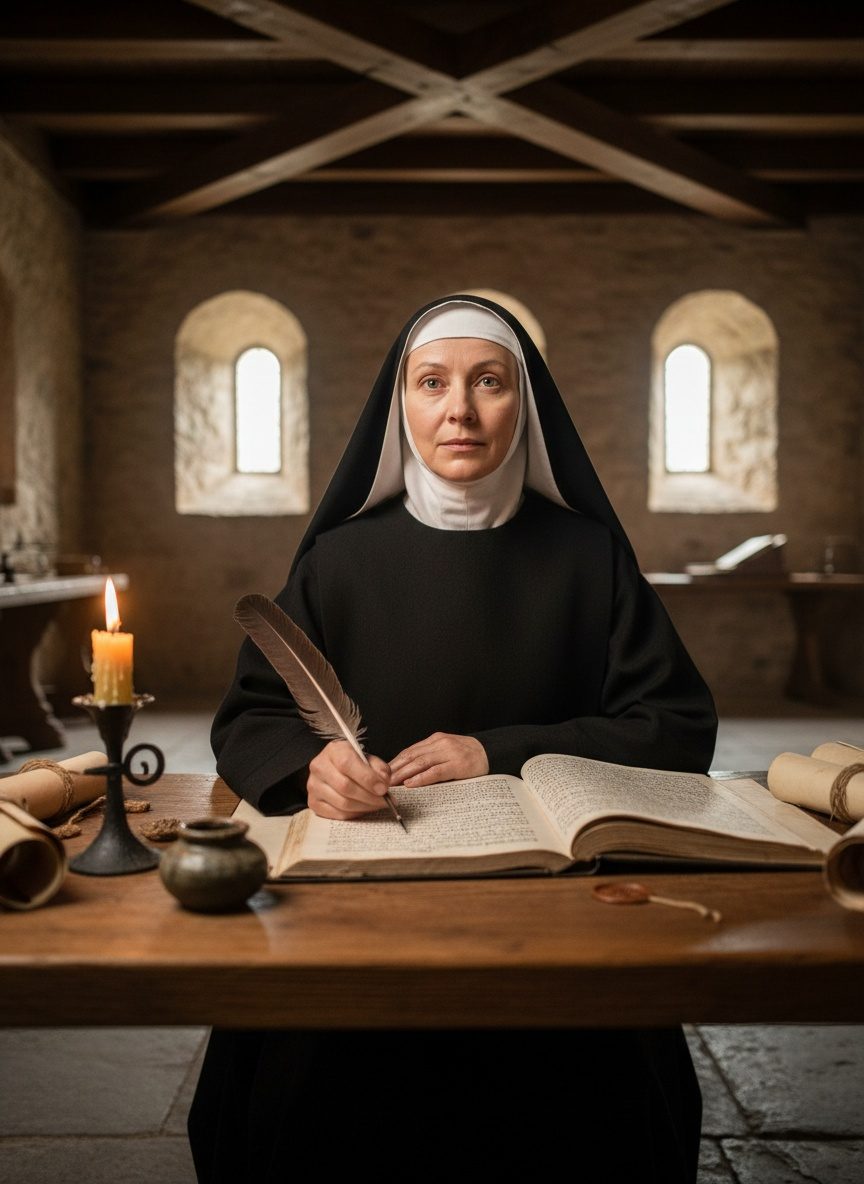
She was a nun who had never taken a public stage. Her words moved emperors and unsettled the pontiff himself.
The Unlikely Voice of Authority
In the hushed corridors of a medieval monastery, a voice emerged that would defy expectations of its time. Born into a world where women were often seen rather than heard, Hildegard of Bingen stood as an anomaly. Her rise began in the cloistered confines of the Disibodenberg Monastery in the Rhineland. Though a nun—expected to live a quiet life of obedience and devotion—Hildegard's existence would be anything but silent.
Despite lacking formal education, which was a rarity for women in her era, Hildegard captivated Europe with her writing and ideas. It was within the constrained scriptorium that she began documenting her visions. These visions, she claimed, were divine and provided her with insight into theology and the natural world. Skeptics might have snorted at the notion of a wispy nun challenging theological dogma, but Hildegard's words compelled attention. In a letter to Bernard of Clairvaux, a leading ecclesiastical figure, she sought validation for her visions. His measured support catalyzed her prominence, enabling her to communicate directly with Europe's most powerful figures.
Even Pope Eugenius III could not ignore her. Soon, Hildegard was writing to emperors, speaking with authority that transcended gender and status. Her correspondences were not mere polite exchanges—they were directives, laden with unapologetic critique and spiritual fervor. She did not mince words, confronting those in power with the courage afforded by her convictions. It was a radical position for a nun, yet Hildegard spoke as though it were her calling.
Sacred Intelligence
The cloistered abbey may have been Hildegard's home, but her influence stretched far beyond its walls. She was a polymath with an insatiable curiosity. Music, medicine, botany—no field was too vast for her exploration. Her compositions, such as the liturgical chants collected in "Symphonia armoniae celestium revelationum," were infused with ethereal beauty, stepping boldly away from traditional ecclesiastical music. These compositions are considered some of the most exquisite of the medieval period, embodying a celestial journey through sound.
In her writings on science and medicine, such as the "Physica" and "Causae et Curae," she cataloged the natural world with precision, providing insights that were centuries ahead of their time. Her manuscripts did not simply describe plants and elements; they dissected their spiritual and physical properties, presenting them as parts of a divine tapestry. This tapestry was not just an academic exercise but a testament to how closely Hildegard intertwined science with spirituality.
Yet it was her theological treatises that shook foundations. The "Scivias," a formidable volume of visionary theology, dared to redefine the understanding of God and the cosmos. Through intricate imagery and layered prose, Hildegard described the divine as an omnipotent source of all creation—a worldview both radical and deeply personal. Her assertion of a feminine aspect of the divine further pushed the boundaries set by a male-dominated church, challenging its leaders to rethink established dogma.
Challenging Ecclesiastical Thrones
In the pantheon of medieval power, few could rival the pope's supremacy, yet even he faced the unwavering voice of Hildegard of Bingen. When Pope Adrian IV demanded her nunnery be placed under the control of a nearby male monastery, her response was as swift as it was sharp. Rejecting this attempt to curtail her autonomy, Hildegard fiercely protected her community's independence. To the pope's chagrin, she won this battle—for Hildegard wielded the power of her convictions, reinforced by a growing network of influential supporters.
Her influence and defiance echoed across Europe, where kings received her counsel and censure in equal measure. Frederick Barbarossa, the Holy Roman Emperor, was among those Hildegard did not shy away from advising. Her correspondence reveals a blend of respect and stern advisement, underscoring her expertise in matters both temporal and spiritual. She lived in an era when women were often kept at the fringes of power, yet Hildegard navigated this landscape with deftness and determination.
Hildegard of Bingen's life was a testament to the power of conviction against constrained societal roles. She offered no apologies for her gender, choices, or messages. Instead, she forged an indelible legacy that foreshadowed many later debates on the intersection of gender, authority, and knowledge. That she dared to confront the pope, the highest ecclesiastical throne, only underscores the extraordinary nature of her journey.
In remembering Hildegard of Bingen, one considers the silent voices lost to history and the stories unsung. Her legacy poses an enduring question: how many voices, if given the chance, could change the course of history? In a monastery amidst the rolling hills of the Rhineland, one voice did just that—reminding us of the influence and power of words, no matter the source.