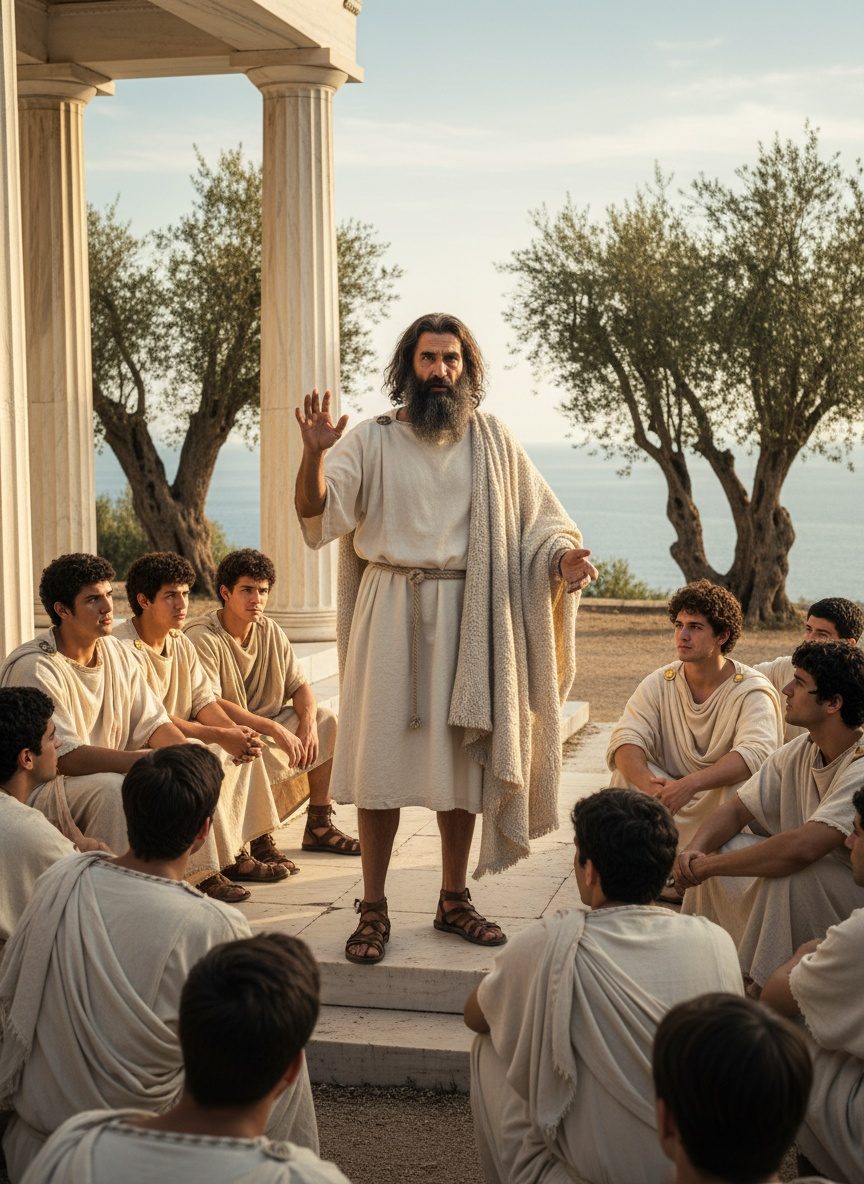
The air was thick with anticipation as Pythagoras stepped onto the streets of Croton. Around him, bustling vendors hawked their wares and the salty wind from the Ionian Sea whipped his cloak, but his thoughts were elsewhere. It was the throng of curious faces closing in that he focused on. Here, among strangers, he would plant the seeds of philosophies that had taken root within his exile’s heart.
Exile and Odyssey: A Philosopher's Journey Begins
Driven from Samos by the tyrant Polycrates, Pythagoras found himself adrift in the Mediterranean world. The political upheaval that forced him from his homeland was a bitter reminder of the volatility of the times. But it was in the crucible of this hardship that Pythagoras forged a new path, setting sail for Southern Italy with little more than his name and ideas—a currency unseen but profoundly powerful.
With every step he took in the bustling streets of Croton, the memory of his homeland faded, replaced by an urge to share his vision. The city, known for its intellectual curiosity, was fertile ground for his revolutionary ideas. It wouldn’t be long before Pythagoras gathered a following of those eager to grasp the mysteries of the universe as he saw them.
The Enigma of the Pythagorean Community
In Croton, Pythagoras’ voice became his strongest asset. He spoke not of wealth or conquest, but of mathematics, music, and harmony—concepts that resonated like a symphony to the ears eager for enlightenment. What began as small gatherings in modest courtyards swelled into a dedicated community. This was more than just a school; it was a brotherhood of thinkers, bound by a shared quest for knowledge.
Within this community, every member took an oath of secrecy, ensuring that the teachings of Pythagoras remained cloaked in mystery. They were as much a religious sect as an academic circle, blending rigorous study with spiritual discipline. The very structure of the Pythagorean community challenged the conventional norms of society, making it a beacon of intellectual emancipation.
The Symphony of Knowledge: Mathematics and Music
Central to Pythagoras’ teachings was the belief in the fundamental relationship between mathematics and the cosmos. It’s said he discovered the numerical ratios that underpin harmonious musical intervals, a realization that convinced him numbers were the language of the universe.
This concept echoed through every facet of Pythagorean study. His followers delved into the geometric underpinnings of reality, uncovering principles that later scholars would cement in the annals of mathematics. This was the birthplace of numerous mathematical theories, including the Pythagorean theorem, which even today forms a cornerstone of modern geometry.
Their explorations were more than academic exercises; they were spiritual pursuits that promised understanding of the divine order. For Pythagoras and his acolytes, mathematics was a bridge between the earthly and the divine—a harmonious striving toward perfection.
Resistance and Reinvention: The Trials of Legacy
As influential as the Pythagorean community became, it wasn’t immune to the tides of political and social change. Their radical departure from traditional thought and tight-knit secrecy began to sow seeds of suspicion among Croton’s leaders. Resistance brewed as local powers perceived the group’s autonomy as a threat, leading to conflicts that tested the resilience of Pythagoras' followers.
Despite these challenges, the core tenets of Pythagorean philosophy persevered. Driven underground, these teachings clandestinely shaped the future of Western thought. The spiritual connection between mathematics, philosophy, and the metaphysical endured, weaving through the tapestry of history, inspiring philosophers and scientists alike centuries later.
A Revolution Written in the Stars
Pythagoras arrived in Croton as an exile, yet his legacy transcended the constraints of his time. He demonstrated an extraordinary truth: that ideas alone can precipitate change, even when cast against the forces of exile, skepticism, and obstruction. His journey from a landless philosopher to the founder of a movement that merged the scientific and spiritual realms provides an enduring lesson on the power of intellectual courage.
The echoes of this ancient thinker remind us that the pursuit of knowledge, particularly the kind that challenges the norm, holds the power to transform societies. Pythagoras may have returned a legend, but he also left a profound reminder that the harmony he sought between numbers, nature, and the divine continues to shape the human understanding of the universe—one equation, one discovery, one harmonious note at a time.