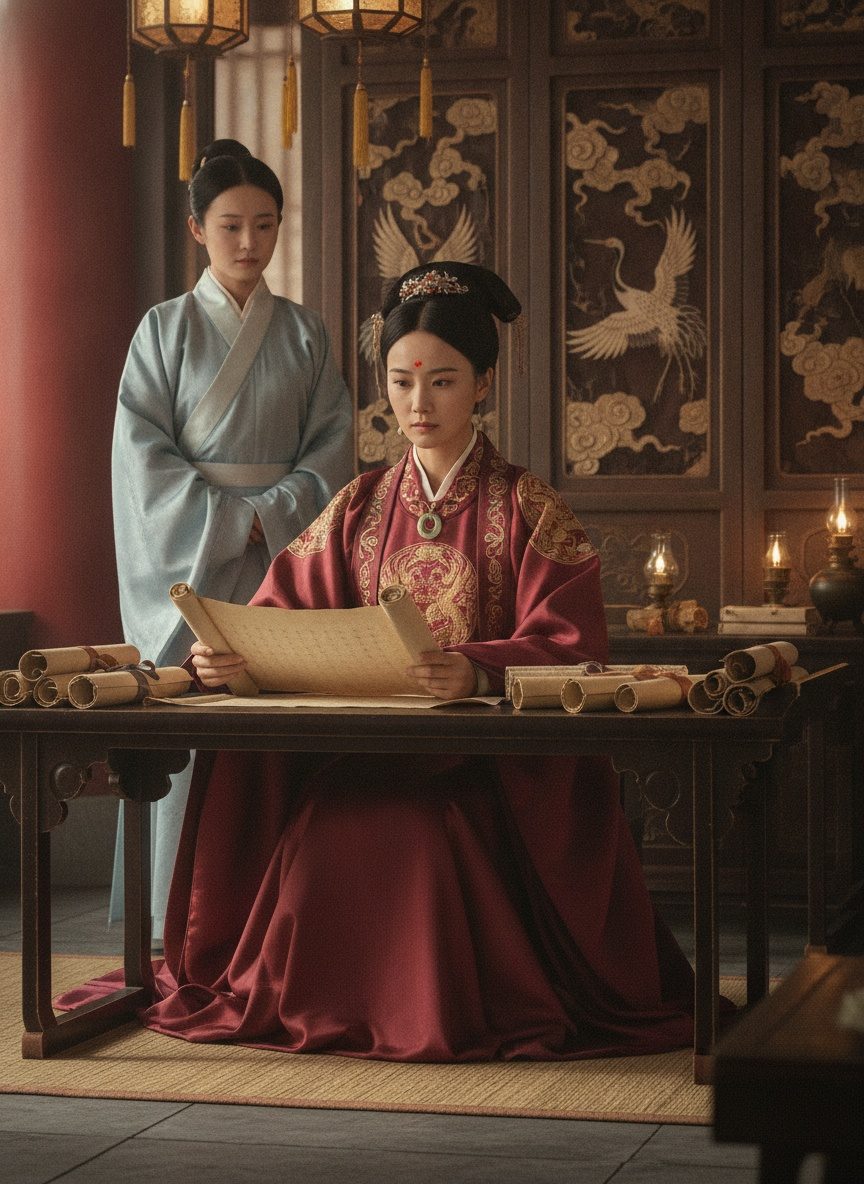
Her fingers traced the silk threads as the Imperial edict unfurled before her. The whispers of silk against ink-stained wood were drowned by the murmurs in the palace halls. A young woman, barely out of childhood, stood within the pulsating heart of the Tang Dynasty's grandiose maze—an unlikely keeper of Imperial words. Her name was Wu Zetian, and each stroke of her brush would bind her fate to the tapestry of an empire.
The Scholar Behind the Curtain
In the bustling heart of the Tang Dynasty's capital, Chang'an, the air was thick with the scent of incense, the kind which clung to the silk robes of court officials. But beneath the grandeur, there existed shadows. Shadows which Wu Zetian navigated, silently and unnoticed. At fourteen, she had entered these hallowed halls as one among many concubines—a mere ornament of the Emperor's court. Yet, within her lay a tenacity that neither time nor tradition could quench.
Emperor Taizong, known for his discerning eye and intellect, sought those qualities which could support an empire's foundation: wisdom, loyalty, and the capacity to absorb and retain knowledge. Against societal expectations, he found these traits in Wu. Hidden from the court's gaze, she became the silent scholar behind the Emperor's decisions, memorizing every decree, edict, and memorial that passed through the Imperial court.
In this era, where colossal wooden gates concealed the chaos and intrigue of Imperial politics, Wu's mind was both vault and vehicle. Each word committed to memory, she transformed into the beating pulse of governance, crafting an intimate bond with the bureaucratic heart of the Tang Dynasty. Her understated brilliance granted her access to the complexities of an empire, making her not just a silent witness but an active participant in the shaping of its destiny.
The Ascent of the Phoenix
Time, like the river that coursed through the capital, did not stand still. Emperor Taizong's reign ebbed, giving way to his son, Gaozong. The transition of power, a delicate dance of allegiance and ambition, saw Wu rise unexpectedly from the mist of the court's peripheral vision. Her marriage to Gaozong brought her from the cloisters of scholarly servitude to the forefront of the Imperial court, not merely as Empress but later as the ruler in her own right.
The corridors of the palace resounded with cautious whispers of doubt and anticipation. Could a woman hold the reins of the Middle Kingdom? Wu Zetian, deftly weaving her knowledge into power, began to defy the whispers. She discarded the ceremonial veil, systematically constructing alliances, and dismantling the traditional patriarchal constraints that shackled her predecessors. Her ascent was not marked by mere ambition, but by a profound understanding of governance, honed in the crucible of her early years.
In a society which revered Confucian ideals, where women were expected to remain in the shadow of their male counterparts, Wu's every move was revolutionary. Unfazed by the skepticism of courtiers who oft dismissed her intellect as a woman's folly, she wielded her authority with deft precision. Policies she initiated mirrored her strategic brilliance—advancing agricultural practices, endorsing meritocracy, and promoting education—a testament to her vision for a robust empire.
The Empress Who Became Emperor
The decade that followed saw Wu Zetian at the zenith of power, adopting the hitherto unthinkable title of Emperor, a feat without precedence in millennia of Chinese history. She established her own dynasty within the Tang, her reign characterized by economic prosperity and significant cultural advancements. Yet, it was her grip on the intricate web of court politics that secured her position. Wu Zetian wielded the Imperial edicts she once read like arrows, targeting opposition with strategic finesse.
Her regime, though formidable, was not without controversy. Its longevity was threatened by intrigue and resistance from aristocrats reluctant to accept her unprecedented rule. Despite forming factions against her, they found her intellect unassailable. Her policies were aimed not solely at consolidation of her power but at sustaining the empire's prosperity. Under her guidance, the Tang Dynasty became synonymous with stability and wealth, despite the turbulent machinations of internal dissent.
In the twilight of her reign, Wu Zetian's legacy was etched across the landscape of Chinese history. Her transformation from concubine to Empress, then to Emperor, challenged the rigid hierarchies of her time, leaving behind a narrative of resilience and reform. Long after her grip on the Dragon Throne had waned, her story lingered, a reminder of the indomitable human spirit's capacity to shatter ceilings and redefine paradigms. It was a story not just of power, but of the relentless pursuit of knowledge and excellence—a narrative that continues to resonate in the corridors of history, inviting reflection on the role of women in shaping both the past and the future.