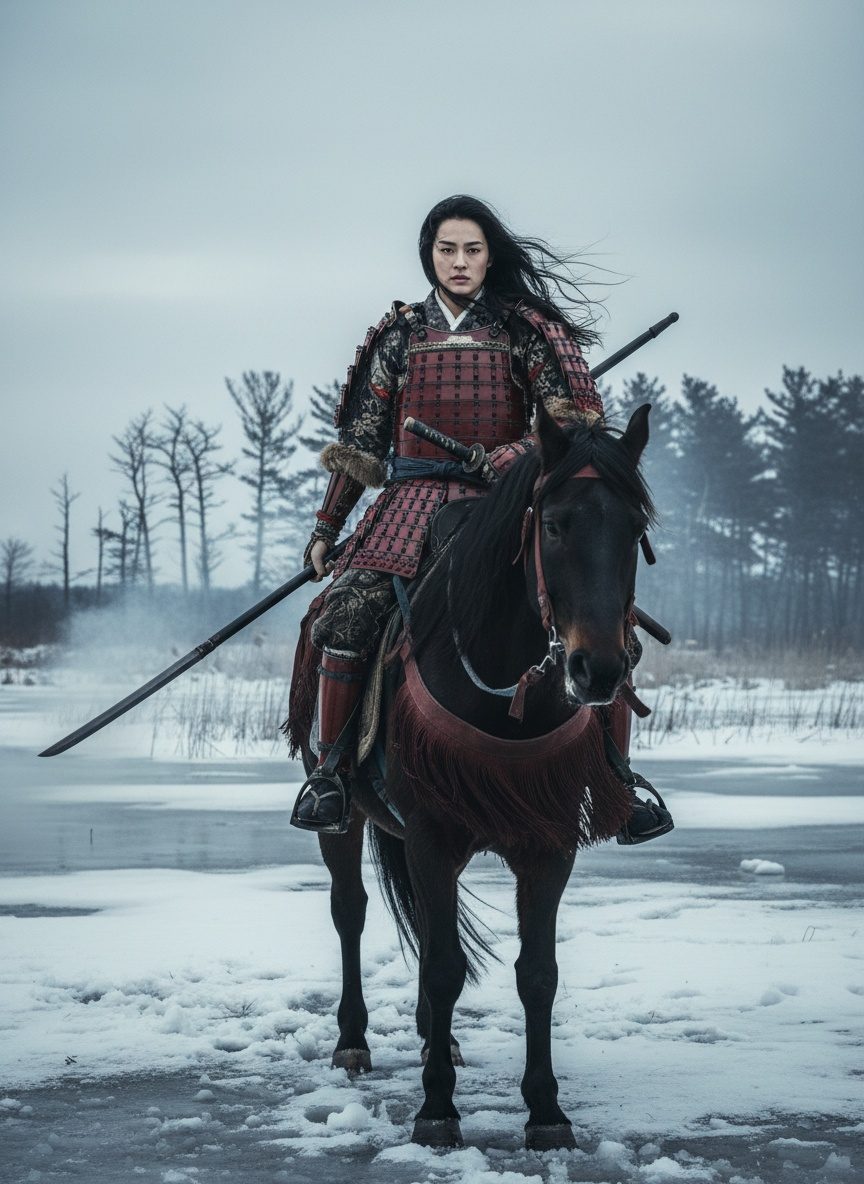
February 21, 1184. A thin crust of snow coated the fields of Awazu.
The Battle of Awazu: A Spectacle of Chaos and Courage
The morning air was sharp and the battlefield near Awazu lay cloaked in a silent tension punctuated only by the distant clamor of clashing steel. The forces of the Genpei War, a struggle for supremacy between the Minamoto and Taira clans, were winding down to decisive and desperate battles. It was here, amid this swirling chaos, that Tomoe Gozen, a woman warrior unmatched in skill and fearlessness, prepared to etch her name into the annals of history.
Tomoe was not just a rare woman on these blood-soaked fields; she was a legend in her own right. Known for her unparalleled beauty and extraordinary strength, her name instilled fear and admiration alike. Her participation in the warfare of this era, traditionally a male domain, was both extraordinary and perilously ignored by historians later bound to patriarchal narratives. Yet, for those who knew her, there was no doubt of her prowess—she could handle a sword as fiercely as any man and could outmatch all but the most formidable warriors.
As the battle reached its crescendo, Tomoe found herself outnumbered and the forces dwindling. Her commander and possibly lover, General Yoshinaka, lay dying amidst the chaos, leaving her with a choice that went beyond life and death—honor and eternal fame, or an ignominious survival. She charged, her vision narrowing to a single enemy rider, determined to leave a final mark of defiance. A flash of steel, a spray of blood—and then Tomoe was gone into history's shadow.
A Warrior Woman Beyond Compare
Tomoe Gozen’s story is not just remarkable for her gender but for her martial ability and esteemed position among Minamoto Yoshinaka’s ranks. During the Genpei War, she commanded and fought alongside the samurai, a cohort that was the living embodiment of the bushido honor code. Her feats in battle were not fantasy but feared fact to those who encountered her. Engaging in vicious, up-close combat was common during this period, and Tomoe's alleged might—including the capacity to defeat both male and horse-bound opponents single-handedly—was testament to her skills.
Japanese accounts from the Heike Monogatari, the epic that recounts the events of the Genpei War, speak of Tomoe Gozen in awe, describing her as beautiful and fearless, capable of feats that seemed to surpass even her male counterparts. Her tale is, in many ways, a counter-narrative to the oft-romanticized view of the female protector at home, instead depicting her as an active agent inscribed in the vein of mythical heroes.
The Vanishing Act: Tomoe’s Mysterious Disappearance
Despite her legendary exploit at the Battle of Awazu, history records little more than a whisper of Tomoe post-battle. Some legends state she became a nun devoted to the quiet reflection far removed from the drums of war. Others suggest she took another path, leaving behind the realm of samurai to forge anew illicitly. Her disappearance from historical records leaves ample room for speculation—was this the intentional omission of a patriarchal historiography, or did Tomoe herself choose anonymity over a life in perpetual conflict?
The ambiguity surrounding her fate adds layers to her enigma. In a time when women's roles were largely confined to the household, Tomoe's legacy breaks these bonds, offering a complex narrative that defies simple categorization. She remains less a figure defined by her gender and more by her actions, casting a long shadow that echoes questions of societal norms and the roles enforced upon women across cultures and centuries.
Lessons from a Warrior's Legend
The story of Tomoe Gozen is as much an ode to martial valor as it is a reflection on the narrative gaps within history. Her life's brief yet impactful spark speaks to the stories untold, voices muffled by the passage of time. Tomoe stands unique in an age of male dominance, illustrating that even in eras defined by strictly regimented gender roles, there were women who transcended these boundaries, shaping the course of history with their agency.
Tomoe Gozen represents a potent reminder of the unseen hands that have turned the wheels of history, and her legacy prompts us to question how many other stories remain hidden beneath the surface of accolades traditionally reserved for men. Whether through choice or by the dictates of historical bias, Tomoe's life stands as a vivid tapestry of courage and complexity, urging us to delve deeper for a more complete understanding of the past, one that honors all those who forged it.