2500 BC. The Nile's gentle flow mirrored the unwavering gaze of a woman whose work would echo through history long after the sands of Egypt had concealed most of her world. Peseshet, a name overshadowed by the grandiosity of Pharaohs and the mystique of gods, wore an unusual title for her time: Lady Overseer of Female Physicians. In an era where thrones and temple hierarchies defined status and power, Peseshet's authority was derived not from divinity or lineage, but from expertise in healing the sick. Her realm was neither the kingdom's court nor the hallowed temples, but the bustling halls of a medical school where the next generation of female healers was cultivated.
Indeed, much of what we attribute to Ancient Egyptian medicine today owes a silent nod to Peseshet's groundbreaking work. This pinnacle of female achievement predates the world’s earliest known male physicians by centuries, shattering any preconceived notion that women were sidelined to silent roles in ancient society. Rather, in a world dictated by cycles of the sun and inundations of the river, it was Peseshet who held the knowledge of life and death in her hands, personifying a reality where the heart’s pulse could rival the drumbeat of ceremonial praise.
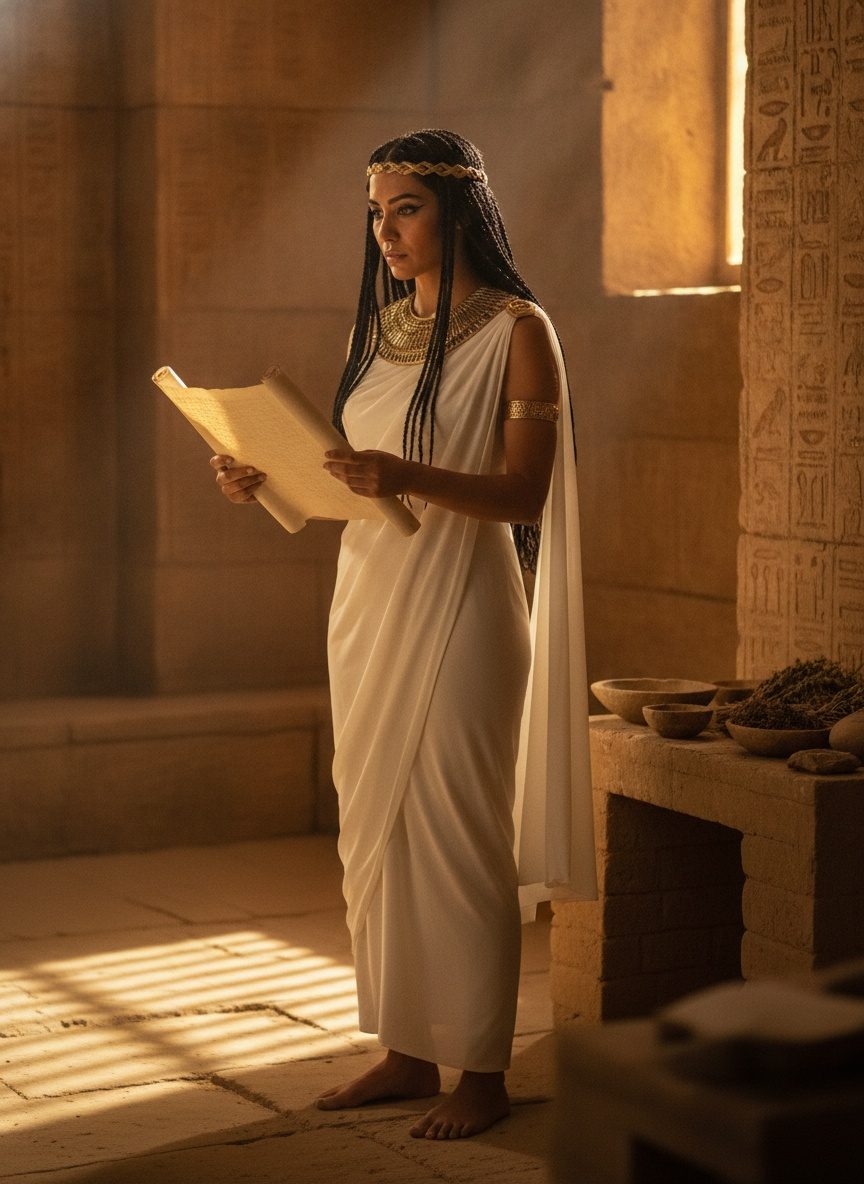
Imagine the bustling environment of the ancient medical school Peseshet oversaw. The aroma of herbal concoctions mixing with the desert air, students in linen garments sat close, their eyes intent on scrolls detailing remedies and the properties of various herbs. The structure around them was likely a simple, sturdy masterpiece of brick and stone, reflecting an architectural era kindred to the grandeur of pyramidal monuments standing guard along the Giza Plateau. Each lesson delivered by Peseshet carried the promise of transforming ancient lines of papyri into lifelines for countless Egyptians.
Daily life for Peseshet was far removed from the courtly displays of opulence and divine rituals. Hers was a world defined by the rush of daily patient care and the mentorship of budding healers. It was a grueling commitment, requiring her not only to manage and impart medical knowledge but to continuously learn from an ever-innovative medicine field. Under her supervision, Egyptian female physicians became adept at treating wounds, delivering babies, and performing rudimentary surgeries, showcasing an understanding of human anatomy that was sophisticated for its time. The methodologies they honed rivaled those found in surviving records from China and Mesopotamia, typically credited with early medical advancements.
Her title, 'Lady Overseer of Female Physicians', provides a glimpse into another layer of Peseshet's influence--Emphasizing women played integral roles in Egyptian medical practices. These women, often overshadowed by grander historical narratives or simplified into stereo-typed archetypes, were, in fact, pillars of their communities, treating ailments that ranged from physical to spiritual. In many ways, Peseshet's leadership was as monumental as the pyramids themselves, albeit on a smaller scale. She was a fixture not of stone, but of human advancement, lighting the path for those who would continue the search for healing through millennia.
The soil along the banks of the Nile is famed for its fertility, yet it equally bore a cycle of harshness and difficulty. Similarly, life for Egyptian women was a duality: dictated on one side by societal limits, but given room, albeit rare, to flourish in others. Peseshet exemplified this duality. While much of her personal life is lost to history, her lack of aristocratic title within the royal framework does not diminish her accomplishment. She was recognized by her professional merit, her approach to medicine, and her stewardship in education.
Personifying wisdom and skill, Peseshet's legacy in medicine was a delicate echo that resonated through sparse records, yet it importantly provided a rubric for understanding the complex roles women played in the past. Her presence illuminates questions rather than answers about gender roles and the distribution of knowledge. Why did such a system allow women like Peseshet to rise in stature, when other contemporary civilizations remained fixed rigidly against such possibilities? It underscores a nuanced understanding of gender dynamics that evolved independently from doctrine or elect narratives.
As history often does, the sands of Egypt ultimately betrayed her memory until modern discoveries and scholarly deciphering resurrected her achievements. Yet, her story remains incomplete. In deciphering fragments of what Egyptian medicine entailed through Peseshet's work, human understanding of the past expands, acknowledging that in the vast timeline of human endeavor, women have always been integral participants, their voices resounding more robustly after centuries of careful excavation.
In recalling Peseshet's life and work, we are reminded of a crucial piece of humanity's tapestry where healing, knowledge, and the unyielding pursuit of excellence transcend societal constraints and royal accolades. It is a reminder of an ancient realm where mastery over the body and spirit was equally a domain for women—a story less told, yet vitally relevant. She may not have been called queen, but Peseshet's influence over Egypt's healers proved regal in its legacy. Even now, standing at the intersection of the ancient and the modern, her life's work invites introspective dialogue about how history recognizes the complexities of gendered contributions. Here, Peseshet's chronicle offers not only a glimpse into the past but also a resonant echo challenging how we might envision the contributions of women in fields where they have been conspicuously absent from historical retellings.