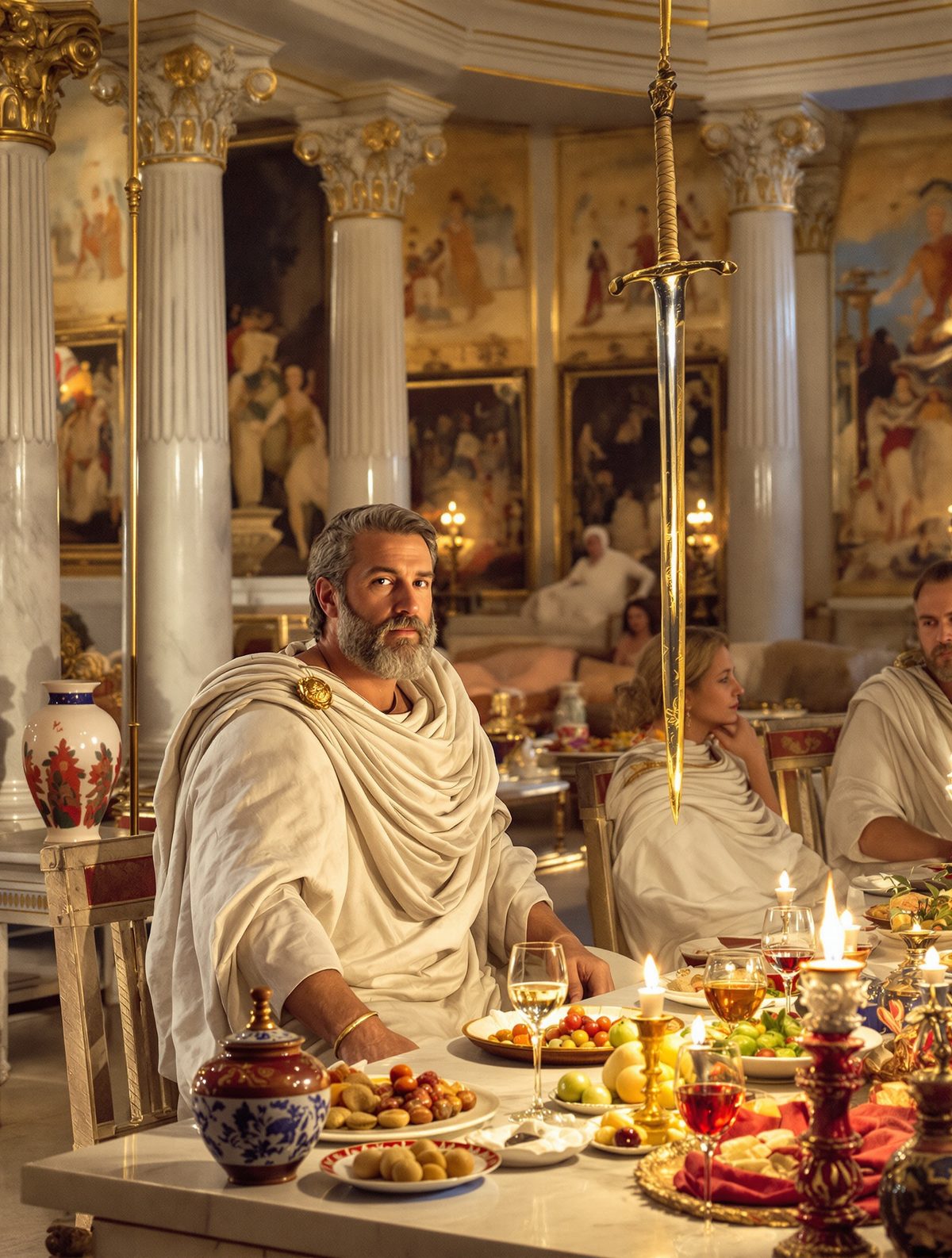
The year was 1622, and the ornate reception hall in Portuguese-controlled Luanda buzzed with tension. Governor João Correia de Sousa had arranged his chair prominently at the center of the room, surrounded by lesser seats for his officials. But when Queen Nzinga of Ndongo entered—draped in royal cloth and radiating the confidence of someone who had never bowed to anyone—the Europeans noticed something curious. Every chair except the governor's had mysteriously disappeared.
It was a calculated insult, designed to force Africa's most formidable female ruler to stand like a supplicant while negotiating for her kingdom's survival. The Portuguese officials exchanged smug glances, certain they had gained the psychological upper hand before talks even began.
They had no idea they were about to witness one of history's most legendary displays of royal dominance.
The Power Play That Backfired Spectacularly
Queen Nzinga surveyed the room with the practiced eye of someone who had outmaneuvered enemies since childhood. At around forty years old, she had already survived palace coups, Portuguese invasion attempts, and the complexities of ruling in a region where European slave traders were reshaping the political landscape. This petty slight wasn't going to rattle her.
Without hesitation, she snapped her fingers. The sharp sound echoed through the suddenly silent hall.
Immediately, one of her generals—a man who commanded thousands of warriors—dropped to his hands and knees beside her. Nzinga gathered her royal robes and settled onto his back as if he were the finest European furniture. She arranged herself with deliberate care, ensuring her posture conveyed exactly what she intended: that she was so powerful, her subjects would literally become furniture to preserve her dignity.
The Portuguese officials sat frozen, their clever trap turned into a demonstration of absolute authority that none of their European etiquette manuals had prepared them to handle.
The Queen Who Refused to Be Anyone's Subject
To understand why this moment was so significant, you need to know who Nzinga really was. Born around 1583 in the kingdom of Ndongo (in present-day Angola), she entered the world during a time of unprecedented upheaval. Portuguese conquistadors had arrived decades earlier, ostensibly to trade and spread Christianity, but their real goal was far more lucrative: capturing people to sell as enslaved laborers in their Brazilian colonies.
Nzinga wasn't supposed to rule. Her brother Ngola Mbandi held the throne, but he was losing the war against Portuguese expansion. By 1622, his kingdom was hemorrhaging territory and people. Desperate, he sent his sister to negotiate—partly because of her legendary intelligence, but also because if the talks failed catastrophically, he could claim a "mere woman" had exceeded her authority.
It was a colossal miscalculation. Nzinga had been preparing for power her entire life, studying military strategy, diplomacy, and the art of psychological warfare. She spoke Portuguese fluently and understood European customs well enough to know exactly how much the chair snub was meant to demean her.
The Art of Diplomatic Warfare
What happened next was a masterclass in negotiation. Seated regally on her human throne, Nzinga proceeded to conduct the meeting as if nothing unusual had occurred. She discussed territorial boundaries, trade agreements, and the return of captured Ndongo citizens with the same calm authority she might have used in her own palace.
The psychological effect was devastating. Every time Governor de Sousa looked at her, he was reminded that she commanded such loyalty that her followers would endure physical discomfort to preserve her honor. Meanwhile, she had turned his attempt to diminish her into a display that made him look petty and cruel by comparison.
But Nzinga wasn't finished. When the meeting ended, she stood gracefully and walked away—leaving her general behind. When the confused Portuguese asked what they should do with the man, she replied with devastating simplicity that she never used the same piece of furniture twice. The general was instructed to remain in Portuguese custody as a "gift."
It was a power move within a power move. She had demonstrated both her wealth (she could afford to give away high-ranking followers) and her strategic thinking (placing a loyal spy in the Portuguese camp while making it look like generosity).
From Negotiator to Revolutionary
The chair incident became legendary, but it was just the beginning of Nzinga's extraordinary story. When her brother died in 1624—possibly by poison, with Nzinga suspected by some—she claimed the throne and immediately proved she had no intention of being Portugal's puppet.
She transformed herself into something Portuguese colonizers had never encountered: an African queen who fought them using their own tactics. She learned European military techniques, acquired firearms through trade networks, and built alliances with Dutch merchants who were happy to undermine Portuguese monopolies.
Most shocking of all, she welcomed escaped enslaved people into her kingdom, promising them freedom and land if they would fight for her. Suddenly, every Portuguese plantation faced the possibility that their forced laborers might flee to join the warrior queen who had turned a general into furniture.
The Legacy of a Royal Revolutionary
For nearly four decades, Queen Nzinga remained the Portuguese Empire's most persistent African adversary. She moved her capital whenever enemies approached, turning all of central Angola into her mobile kingdom. She allegedly disguised herself as a man during battles, fought alongside her warriors, and lived to the age of eighty-one—dying in 1663, undefeated and unconquered.
The chair incident had revealed something crucial about her character: she understood that perception shapes reality in politics. By refusing to accept the role of supplicant that Europeans tried to force on her, she demonstrated to both her own people and her enemies that African rulers could meet Europeans as equals—or superiors.
Today, Nzinga is remembered throughout Angola as a symbol of resistance against colonialism. Her image appears on the country's currency, and her name graces schools, streets, and monuments. But perhaps more importantly, her story challenges the narrative that European colonization was inevitable or that African leaders were simply overwhelmed by superior technology and tactics.
Why This Moment Still Matters
In an age when we're constantly told that representation matters, Queen Nzinga's story feels remarkably modern. She understood that sometimes the most powerful response to disrespect isn't anger or confrontation—it's creativity that exposes your opponent's weakness while highlighting your own strength.
The image of her sitting regally on her general's back while negotiating with European colonizers isn't just a fascinating historical anecdote. It's a reminder that power isn't always about who has the most weapons or money. Sometimes it's about who refuses to accept someone else's definition of their worth.
In 1622, a group of Portuguese officials thought they could humiliate an African queen by denying her a chair. Instead, they gave her the opportunity to demonstrate why she would spend the next forty years making their empire's expansion into central Africa far more difficult than they ever imagined. Sometimes the best throne is the one you create for yourself.