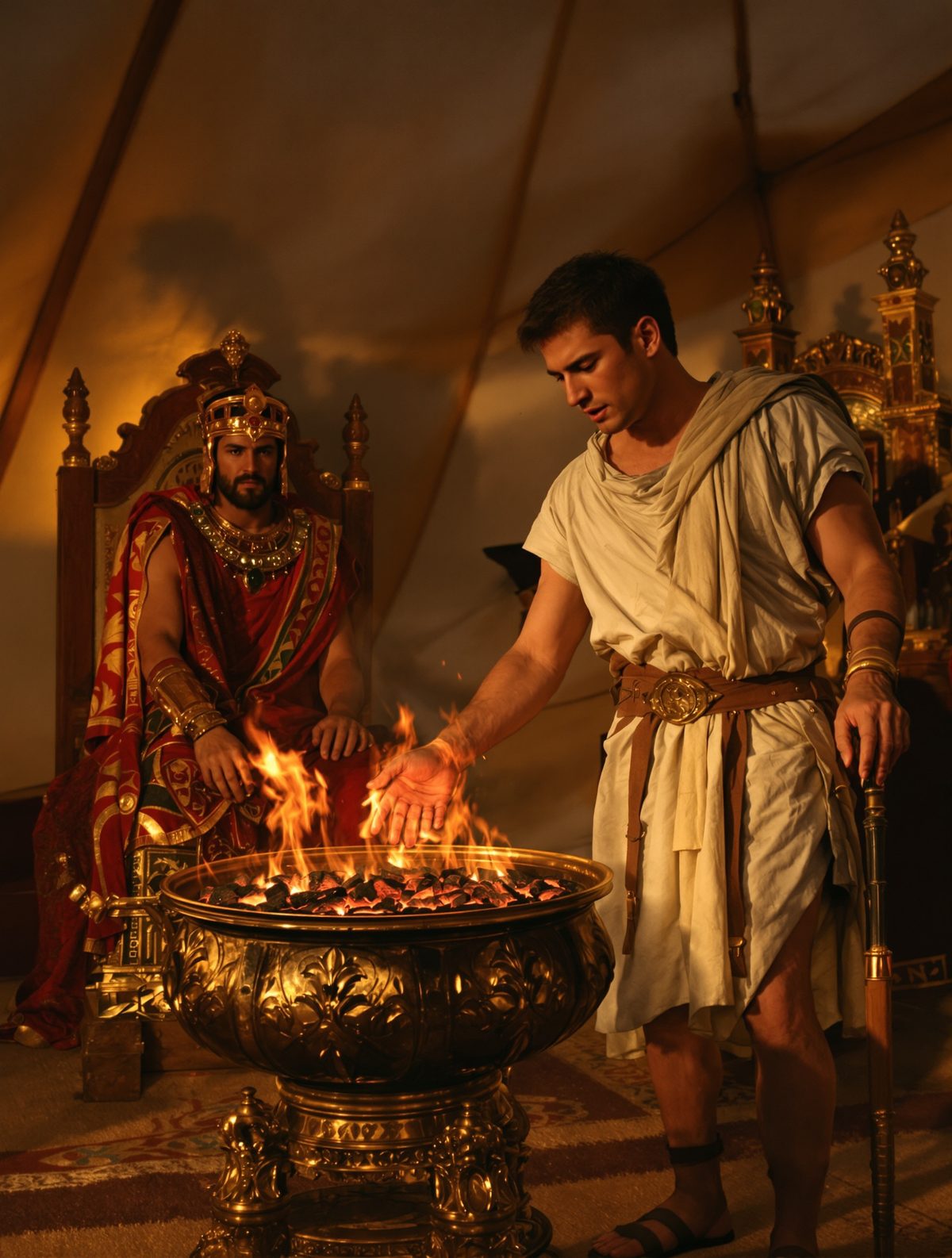
Imagine sitting at the most sumptuous banquet you've ever seen, surrounded by golden plates heaped with delicacies, wine flowing like water, and servants attending to your every whim. Now imagine looking up and seeing a razor-sharp sword suspended directly above your head, held by nothing more than a single horsehair that could snap at any moment. This was the dinner party from hell, orchestrated by one of history's most paranoid rulers to teach his envious courtier a lesson about power that would echo through the ages.
The year was approximately 390 BC, and the most powerful man in the Greek world was about to serve up a meal that would be remembered for over two millennia—not for its food, but for its terrifying lesson about the true nature of absolute power.
The Tyrant Who Ruled Through Fear
Dionysius I of Syracuse wasn't born to power—he seized it with the ruthless efficiency that would define his 38-year reign. Rising from relatively humble beginnings around 430 BC, he had clawed his way to become tyrannos of Syracuse in 405 BC, transforming the wealthy Sicilian city-state into the dominant naval power of the western Mediterranean.
But here's what they don't tell you in most history books: Dionysius lived every single day in absolute terror. His palace on the island of Ortygia was less a royal residence and more a fortress designed by paranoia. He slept in a different room each night, employed food tasters for every meal, and trusted no one completely—not even his own family. The man who could command fleets of 300 ships and armies of 100,000 men was afraid of his own shadow.
His security measures were legendary and bizarre. Dionysius surrounded his bed with a moat, accessible only by a drawbridge that he alone controlled. He shaved with hot walnut shells rather than trust a barber with a razor near his throat. When his own brother made an offhand comment about a dream involving the tyrant's death, Dionysius had him executed on the spot. This wasn't just leadership—this was survival at its most exhausting extreme.
The Golden Prison of Syracuse
Despite his paranoia, Dionysius maintained the façade of a magnificent ruler. His court glittered with wealth extracted from Syracuse's dominance over Mediterranean trade routes. The city's harbor bristled with warships, its walls stretched for miles, and its treasury overflowed with tribute from conquered territories across Sicily and southern Italy.
Syracuse in the 4th century BC was arguably the most powerful Greek city outside of mainland Greece itself. Under Dionysius, it had successfully fought off multiple Carthaginian invasions, expanded its territory across Sicily, and established colonies along the Italian coast. The tyrant had even defeated the mighty Carthaginian general Himilco so thoroughly that the humiliated commander committed suicide rather than return home in disgrace.
Yet for all this success, Dionysius found no peace. Ancient sources tell us he was a man who jumped at sudden noises, who saw assassins in every shadow, and who treated even his closest advisors as potential threats. His court was a glittering cage, beautiful but deadly, where luxury and terror walked hand in hand.
Damocles and the Dinner Invitation
Into this atmosphere of opulent paranoia stepped Damocles, a minor courtier whose name would become immortal for all the wrong reasons. Ancient historians describe Damocles as a typical court flatterer—the sort of man who made his living by telling powerful people exactly what they wanted to hear. And what Damocles told Dionysius was music to the tyrant's ears.
"How blessed you are, great Dionysius!" Damocles would gush during court gatherings. "What happiness must be yours! What pleasure, what abundance, what magnificence surrounds you! No man has ever been more fortunate!" He spoke of the tyrant's power with obvious envy, painting pictures of a life free from worry, surrounded by luxury, feared and respected by all.
But here's what makes this story truly fascinating: Dionysius didn't enjoy these compliments. Instead, they irritated him profoundly. Every word of praise about his "blessed" life reminded him of the terrible reality behind the golden facade. So when Damocles went too far one evening, rhapsodizing about the tyrant's incredible fortune and happiness, Dionysius decided to offer him a gift that would change everything.
"Would you like to taste this happiness yourself, Damocles? Would you care to try my fortune for a day?" The invitation seemed generous, almost casual. Damocles, not understanding the trap he was walking into, eagerly accepted.
The Feast of Terror
The banquet that followed was everything Damocles had imagined and more. He was clothed in royal purple, the color reserved for kings and tyrants. Golden dishes were laid before him, heaped with the finest delicacies from across the Mediterranean—peacock from Greece, exotic spices from distant lands, wines aged in amphorae older than most men's lifespans. Beautiful servants attended his every gesture, musicians played soft melodies, and the air was heavy with expensive incense.
For a brief, intoxicating moment, Damocles experienced the life he had so envied. He reclined on the finest couches, ate from plates worth more than most people's homes, and felt the intoxicating rush of absolute luxury. This was the life of a tyrant—this was what real power looked like.
But then, in a moment that would be burned into human consciousness forever, Damocles looked up.
Suspended directly above his head, its point aimed straight at his heart, hung a massive sword. The weapon—described by some sources as a cavalry sword, heavy enough to split a man in two—was held in place by a single horsehair. One hair. One tiny, fragile thread was all that stood between Damocles and instant death.
In that instant, the magnificent feast turned to ash in his mouth. The wine became bitter, the music discordant, the luxury meaningless. Every tiny breeze that moved the hair sent waves of terror through his body. Every sound made him flinch, every movement of the servants above made him freeze in panic. The sword swayed almost imperceptibly, and with each tiny motion, death seemed to lean closer.
The Lesson That Echoed Through Time
Damocles, according to the ancient historian Cicero who preserved this story for posterity, begged to be released from the "honor" almost immediately. He no longer envied the tyrant's position; he no longer saw power as a blessing. All he wanted was to escape that sword, to return to his simple life where death didn't hang over his head by a thread.
And that, of course, was exactly Dionysius's point. "This," the tyrant reportedly told his terrified guest, "is what it means to be happy as I am happy. This is the true nature of the fortune you so envy." Every moment of a tyrant's life was lived under that sword. Every feast, every pleasure, every triumph was shadowed by the constant knowledge that power made you a target, that enemies surrounded you, that death could strike at any moment without warning.
The historical Damocles learned his lesson and presumably never again spoke enviously of his ruler's "blessed" life. But the story itself took on a life far beyond that single evening in Syracuse. Within a few centuries, "the sword of Damocles" had become a standard metaphor throughout the Greek and Roman world for the terrible burden of power and the constant threat that hangs over those who wield it.
When Ancient Wisdom Cuts Deep Today
More than two millennia later, this story from a Sicilian tyrant's dinner table continues to resonate because it captures a fundamental truth about power and human nature that transcends any particular era. In our age of celebrity culture and social media, when wealth and influence are constantly on display and seemingly always envied, Dionysius's lesson feels remarkably contemporary.
Consider the modern parallels: CEOs who can't sleep without security details, politicians who live in terror of the next scandal, celebrities whose every move is scrutinized and criticized. The sword may no longer be literal, but it still hangs there—in the form of public opinion, market crashes, political rivals, or simple human mortality that no amount of power can defeat.
The true genius of Dionysius's dinner party wasn't just in teaching Damocles about the burden of power—it was in creating a perfect metaphor for the human condition itself. We all live under various swords: the threat of illness, the fragility of relationships, the uncertainty of the future, the inevitability of death. The only difference is that most of us manage to forget about them most of the time. Those in power don't have that luxury.
The next time you find yourself envying someone else's success, wealth, or position, remember Damocles looking up at that swaying sword. Ask yourself: would you really want to trade places if it meant living with their particular version of the blade hanging over your head? Sometimes the most valuable lessons come not from what we gain, but from understanding the true cost of what we think we want.