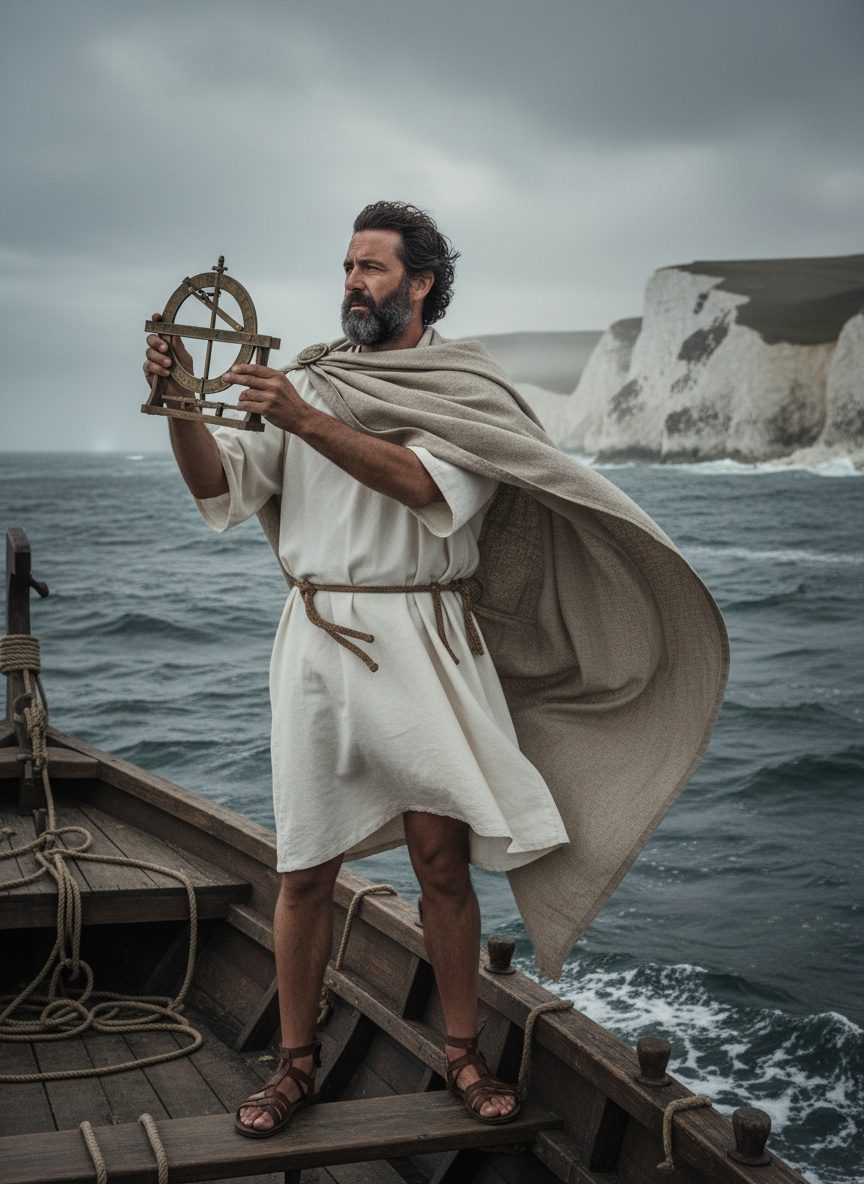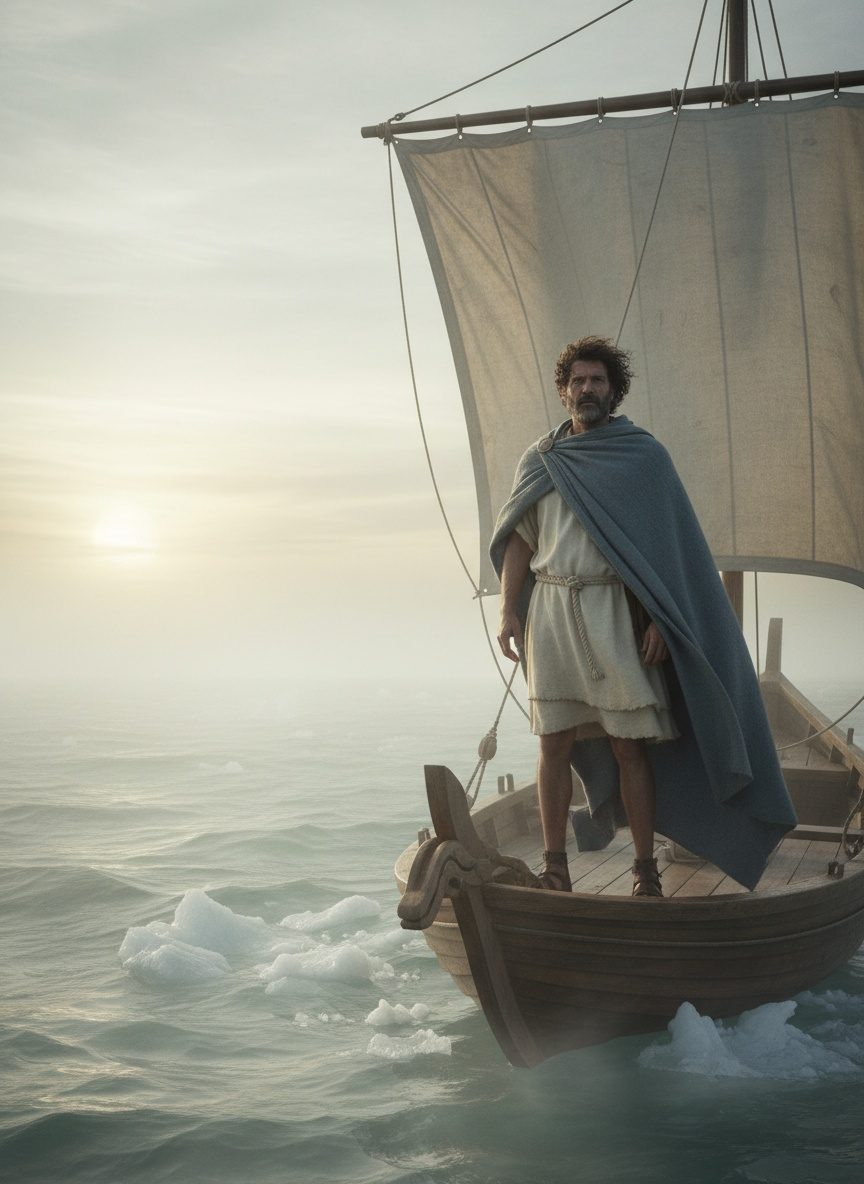
In the summer of 325 BC, a lone Greek ship battled the rolling waves of the North Sea. Onboard, an intrepid explorer named Pytheas of Massalia steered his course into the Arctic unknown. Though his journey was wrapped in the promise of discovery, few could imagine the remarkable realms he would unveil. As Pytheas sailed far past the familiar coastlines of Britain into waters that seemed to freeze around him, he laid eyes upon a land shrouded in legend and mystery — Thule. Yet, upon his return to the Mediterranean world, Pytheas found himself derided as a teller of tales. This is the story of a visionary explorer's brush with the edge of the world, the voyage that rewrote maps, and the skepticism that greeted these alien visions.
The Adventure Begins: Leaving Massalia
Massalia, now known as Marseille, was a thriving Greek colony nestled on France's southern coast. A bustling hub of trade and culture, it was home to Pytheas, a mathematician and astronomer with a yearning to explore beyond the horizon. Around 325 BC, funded by wealthy merchants interested in expanding their trading routes, Pytheas set sail. His aim? To chart the mysterious lands rumored to lie far north, where resources like tin, amber, and furs were lucrative prizes.
Unlike most Greeks of his time, Pytheas was blessed with a curious blend of scientific knowledge and a sailor’s daring spirit. Armed with an astrolabe for navigation and a heart unyielding to uncertainty, he sailed up the Atlantic coast, claiming to traverse 2,000 miles to reach the British Isles. Legends spoke of these lands, but for Mediterranean men like Pytheas, they were enigma wrapped in fog and fable.
Beyond Britain: Into the Arctic Mysteries
After venturing around the sun-dappled shores of modern-day Cornwall, Pytheas pushed further north into uncharted waters. Here, myth transformed into reality. As the climate grew cooler and the days longer, he encountered phenomena unheard of in the sun-baked lands he had left behind.
What Pytheas described defied everything his contemporaries knew. The sun lingered obstinately in the sky, and as he neared the Arctic Circle, he experienced the twilight of the midnight sun. More bewildering was the sea itself. According to accounts from Pytheas, the water became thick, viscous — "like a jelly." Today, we understand this as the presence of sea ice, but for an ancient Greek mariner, it was an otherworldly sight.
He named this realm "Thule." Thought to be the Shetland Islands, Norway, or even Iceland, Thule became a cornerstone of European geographical imagination for centuries. Pytheas claimed it lay six days' sail north of Britain, a place where the air, water, and land converged indistinctly in a freezing mist.
The Enchanted Sky: Auroras and Eternal Light
Pytheas was awed by the natural wonders he encountered. He was likely among the first Greeks to witness the auroras — the dazzling curtains of light that danced in the polar skies. Imagine the awe of a Mediterranean visitor before these surges of green, red, and purple illuminating the night, the skies shimmering as if painted by gods.
The phenomenon of the midnight sun, too, gripped Pytheas’s imagination. For civilizations accustomed to the harsh separation of night and day, a world where days stretched limitless into one another was sensational. Thule's perpetual day and its eerie, luminous nights may have seemed like a divine vision or a cosmic oddity.
The Return and Rejection: A Tale Too Far Fetched
Upon his return to Massalia, Pytheas wrote of his extraordinary voyage in a work known as *On the Ocean*. Unfortunately, this record has not survived intact, existing now only in fragments quoted by others. Pytheas' claims met with skepticism, if not outright derision, from his fellow scholars and the Greco-Roman intelligentsia.
Some accused him of fabricating his journey, while others, like Strabo and Polybius, criticized his geography and marvels as the fruits of exaggeration. It is curious to ponder whether these men of learning refused to believe him due to their own geographical constraints or perhaps envy masked as disbelief.
The Legacy of Pytheas: Bridging Worlds Seen and Unseen
Despite the doubts of his contemporaries, Pytheas's voyage represented an unprecedented leap into the unknown. His observations of tides influenced by the moon were among the first recorded, and his reports of northern temperatures expanded Greek and Roman understanding of the natural world.
While nobody knows exactly where the Thule of Pytheas is, his account has endured in the echoes of exploration throughout history. His chronicles infused Europe's cartographic imagination with a spirit of exploratory curiosity that resonates into the Age of Discovery and beyond.
The tale of Pytheas serves as a reminder of the power of exploration fueled by human curiosity — the drive to see beyond the visible horizon and ask "why not?" rather than "why?" His voyage, dismissed though it was, reminds us that the boundaries of understanding are always shifting, guided by the intrepid steps of those who dare to wander where others will not go.