In a world where myth and history intertwine, the story of Polycrates of Samos stands out like a shimmering pearl in the Aegean Sea. He was the tyrant who outsmarted the mighty, defied the gods, and built an island empire that dominated the waters around him. Yet, in 522 BC, his story took a sudden and mysterious turn. Lured by promises of treasure from a Persian satrap, he sailed away to meet his fate on the mainland of Lydia. Polycrates never returned, and with him, his empire crumbled, becoming fodder for legend and cautionary tales.
The Rise of Polycrates: A Greek Pirate King
Polycrates' ascent to power is as audacious as it is captivating. Born into nobility, he seized control of Samos during a religious festival around 538 BC, overthrowing his rivals with a blend of political cunning and sheer boldness. His rule was that of a quintessential tyrant, albeit a remarkably effective one. With a navy that boasted over a hundred triremes, Polycrates turned Samian waters into lanes of commerce and piracy, striking fear and envy into the hearts of his contemporaries.
His reign was marked by opulence and ambition. The tyrant erected grand edifices, including the Heraion, one of the largest temples of its time. With each victory and enterprise, Polycrates grew in prominence, forging alliances and rivalries that garnered both awe and animosity across the Mediterranean. His reputed fortune was so vast and unyielding that it supposedly drew the wrath of the gods, an ominous sign that foreshadowed his ultimate demise.
A Warning He Ignored: The Oracle’s Prophecy
In the world of ancient Greece, omens and oracles governed decisions of great import. Polycrates, for all his brilliance, chose to disregard what should have been a telling portent. The legend of the ring, famous in antiquity, is often recounted: advised by an oracle to cast away his most treasured possession to avert his blinding fortune, Polycrates flung his emerald-studded ring into the sea. Days later, it reappeared in the belly of a fish served at his table, a harbinger that his luck was an unyielding affliction rather than a blessing.
Friends and allies, among them Pharaoh Amasis of Egypt, warned him of his unavoidable downfall. Amasis, valuing their friendship, ended their alliance to distance himself from the looming disaster foretold by the gods' apparent favour. Polycrates, however, seemed impervious to the deluge of cautionary advice. In his hubris, or perhaps an unabashed belief in destiny, he continued unabated on his imperial path.
The Persian Invitation: Oroetes' Subtle Snare
The political landscape of the era was dominated by the burgeoning might of the Persian Empire under Cambyses II, imposing pressure on smaller states and rulers. Polycrates, despite his island prowess, was but a chess piece in the grand Persian game. Despite his confidence—or arrogance—in his established power, sparks of his eventual demise were ignited by Oroetes, the Persian satrap of Sardis.
Oroetes had his reasons for enmity against Polycrates, be they personal grievances or imperial stratagems. He deftly extended a lure that Polycrates couldn't resist: a supposed conspiracy against Cambyses that required secrecy and Polycrates' assistance. Oroetes' promise of untold wealth acted as honey to his ambitions, persuading him to make the journey to the mainland alone.
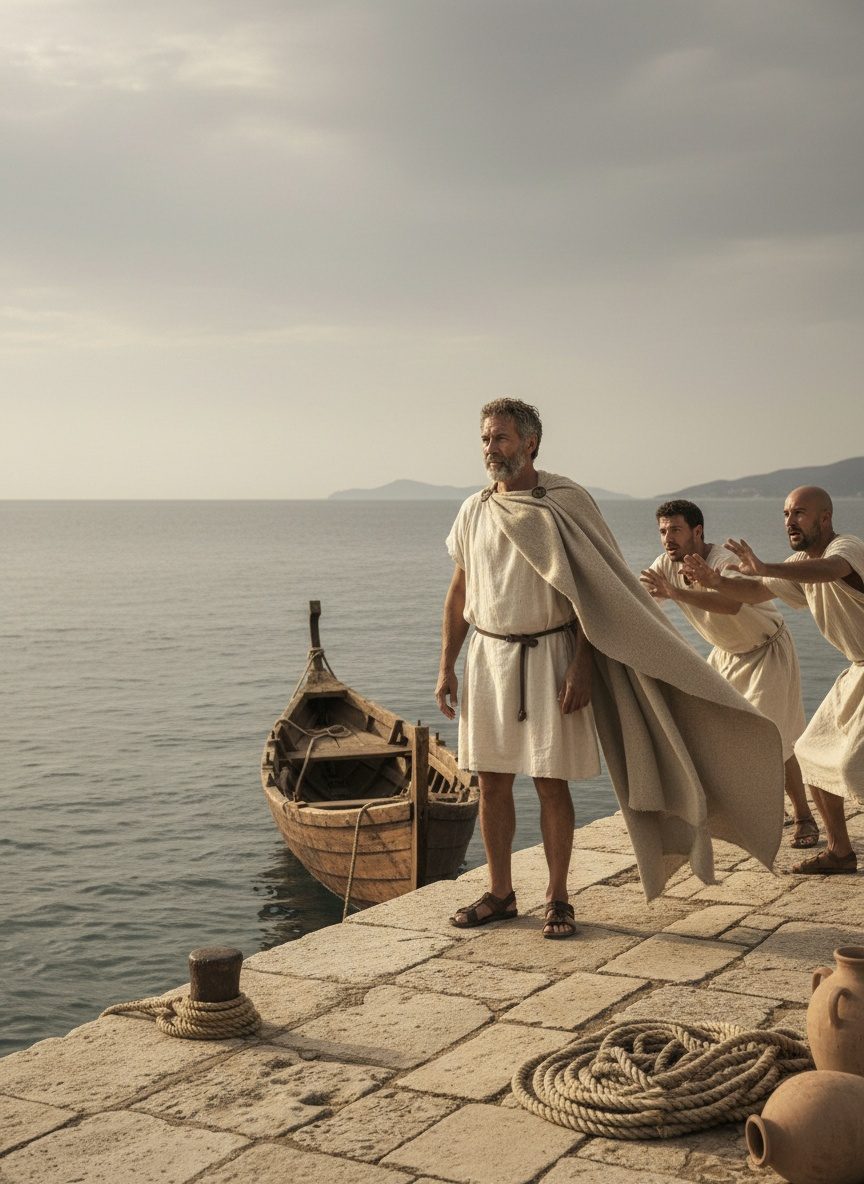
Sceptical advisors implored him to reconsider; the abandoned caution of his friends echoed ominously. Yet, driven by ambition, greed, or destiny, the pirate king sailed unaccompanied to the coast of Lydia. It was a move that would cement his fate as a shadowy tale in the chronicles of history.
The Fall: An Empire Silenced
What transpired upon Polycrates' arrival remains draped in mystery and legend. Oroetes, true to the clandestine nature of Persian politics, had laid an elaborate trap. Accounts suggest that upon landing, Polycrates was seized, and in a cruel twist, impaled—the final act of hubris met with tragic justice. With his disappearance, the fragile and wide-reaching empire, held together by the tyrant's iron grip and charisma, began to unravel swiftly.
The fall of Samos, and indeed the weakening grip of Polycrates’ rule, became emblematic of the greater tides of change. His death was not just the cessation of a life but the end of an era for Greek island rule; one where audacious leaders could build empires by sheer will, and fall prey to the machinations of larger powers.
Legacy and Lessons: Why Polycrates' Story Matters Today
What can be gleaned from the story of Polycrates today? In a world still rife with ambition, power plays, and the enticements of untold riches, the tale resonates as a timeless allegory. It is a reminder of the fragile nature of power and the pitfalls of hubris, a historical rhyme that echoes in modern corridors of power.
Polycrates' dramatic saga speaks to the universal human experience: the thrill of ambition and the hubristic naiveté that often accompanies it. As with many lessons from history, it urges vigilance and humility against the seductive allure of complacency and unchecked dominance. His narrative, at its crux, highlights the persistent struggle between individual prowess and the inexorable currents of greater political forces—a struggle as significant today as it was in the grand tale of the pirate king of Samos.