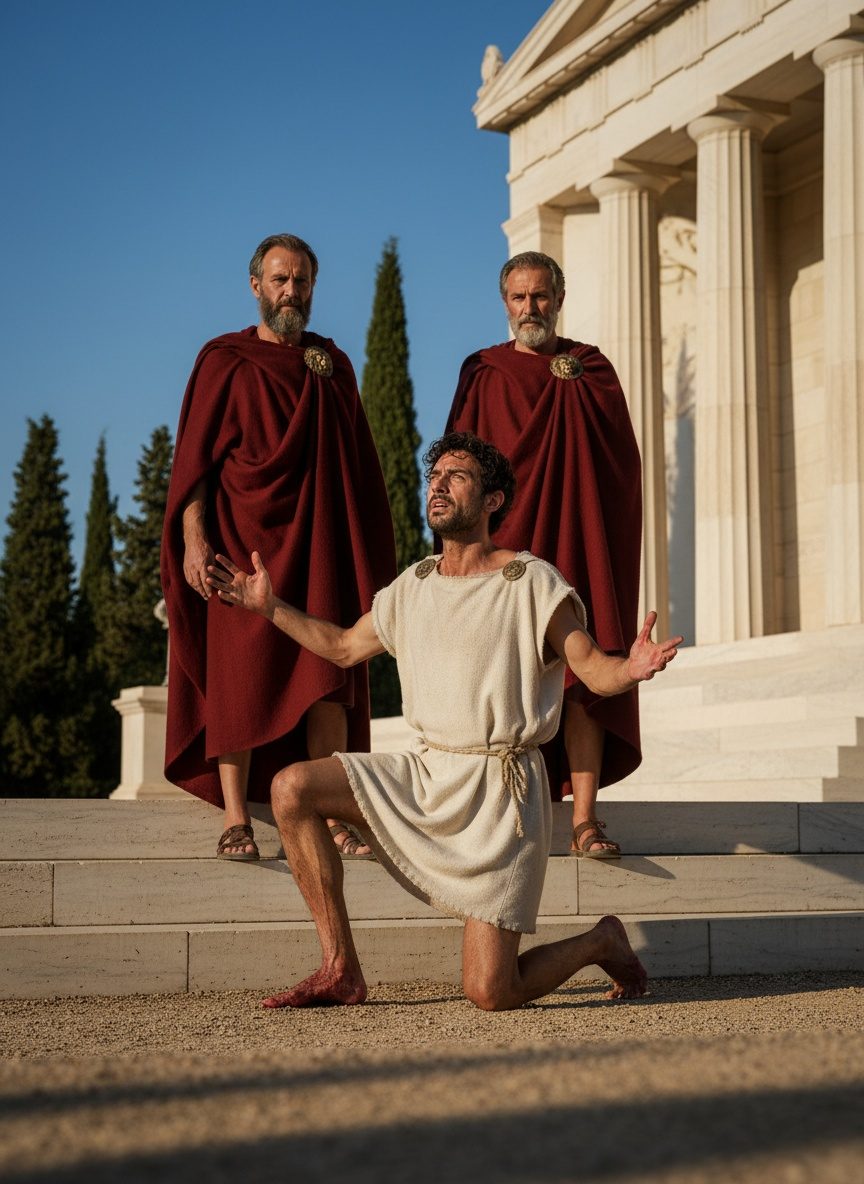
September 490 BC. Dust swirled in the early morning light over a rugged trail.
The Ancient Stakes at Marathon
To understand the gravity behind the impending encounter at Marathon, one must first understand the intricate dynamics between Persia and Greece. The armies poised to unleash their might on the fields of Marathon were not merely combating for power, but for the fate and future of Greece itself. Athenian democracy, an unprecedented experiment of governance, now faced an existential threat—25,000 Persian soldiers had disembarked on Greek soil, poised to press into the heart of Athens.
The Persian Empire, under Darius I, was a vast dominion stretching from Egypt to India, its ambitions ever-hungry. However, Greece, with its patchwork of city-states, stood defiantly opposed to Persian hegemony. In this array of city-states, Sparta was acclaimed for its military prowess. This was a moment in history when unity could have tipped the scales quite decisively towards Greek favor. But unity was precisely what eluded the Greeks at this crucial juncture.
The Marathon of Pheidippides
Enter Pheidippides, an Athenian herald whose name would echo across time, immortalized not only by the distances he conquered but by the urgency carried in his strides. Tasked with an almost Herculean endeavor, Pheidippides set out from Athens with a singular mission: reach Sparta and plead for military assistance. The trek ahead? An astonishing 140 miles, to be covered in less than two days.
No armour, no steed, just a determination fueled by the urgency of his mission, Pheidippides sped through the undulating landscape of Attica. Traversing the mountains and the plains, he grappled not just with the natural elements but the weight of urgency that swelled with each passing mile. As tales of his run have been handed down through history, Pheidippides' journey wasn't just a testament to human endurance; it stood as the embodiment of the indomitable spirit of Athens.
Sparta’s Belief, Pheidippides' Persuasion
With each staggering step, the runner closed the distance between Athens and Sparta. Upon arrival, Pheidippides collapsed before the Spartan assembly, breathlessly recounting the perilous threat looming over Athens. But the response he received was as enigmatic as it was disheartening. The Spartans, firm in their religious adherence, cited that they could not march until the full moon had passed—such was their law.
To the modern observer, the Spartans’ reasoning might seem detached from the urgency of the moment. However, it was a reflection of an era dominated by divine interpretations, where celestial alignments influenced the temporal. In the silence that followed, Pheidippides faced the daunting task of returning, the weight of his unenviable message resting heavily upon his shoulders.
Undeterred by exhaustion, he began retracing his arduous journey back to Athens. His task now was not only to bring news of Sparta's reticence but to rally hope amidst inevitable confrontation. It is said that Pheidippides managed this feat, his feet tirelessly narrating a saga of desperation and determination across the dusty Greek trails.
The Triumph at Marathon
Upon his return, Athens chose to rise alone, daring defiance in the face of adversity. Despite longing for Spartan warriors to bolster their ranks, the Athenians were galvanized by the spirit of resilience that Pheidippides' run inspired. They met the Persians with a bold strategy, utilizing their limited forces with ingenuity that belied their numbers. On the fields of Marathon, sheer willpower and strategic acumen shifted the tides as Athenians momentarily shocked a complacent Persian force.
Remarkably, the Athenian army, significantly outnumbered, won one of history’s pivotal battles, a victory fueled by the indomitable spirit that Pheidippides carried with him. The Athenians' victory not only secured their city but laid the foundations for what would become an enduring beacon of Western civilization.
The story of Pheidippides is a tale of courage that echoes through the corridors of time. It underscores the unpredictability of human spirit and the extraordinary achievements achievable when faced with the seemingly insurmountable. While Sparta waited for the right moon, Athens, inspired by the run and the message carried by Pheidippides, did not wait for the right time to defend its home. And so, their hard-earned triumph at Marathon stands as a reminder—sometimes, the will to endure and the readiness to act can change the course of history.