The summer sun beat relentlessly upon the fields of Plataea, casting a golden glow over the battlefield that had witnessed a monumental clash. Dust lingered in the air, mingling with the scent of sweat and blood, as it settled slowly upon the still bodies of the fallen. In the distance, the mountains stood solemn under the weight of history. At this moment in 479 BCE, Greece was not only surviving but defining its values under the unyielding scrutiny of both its enemies and its own people.
The Battle of Plataea marked more than just a tactical victory for the Greek alliance over the expansive Persian Empire—it was a triumph of resolve and solidarity against the odds. The coalition of Greek city-states, rarely able to put aside their rivalries, had united to repel the might of Persia's imperial ambitions. As the sun's rays drew elongated shadows across the ground, the armies gathered in the aftermath, bracing for what history had taught them to anticipate: vengeance and the desecration of the enemy's remains.
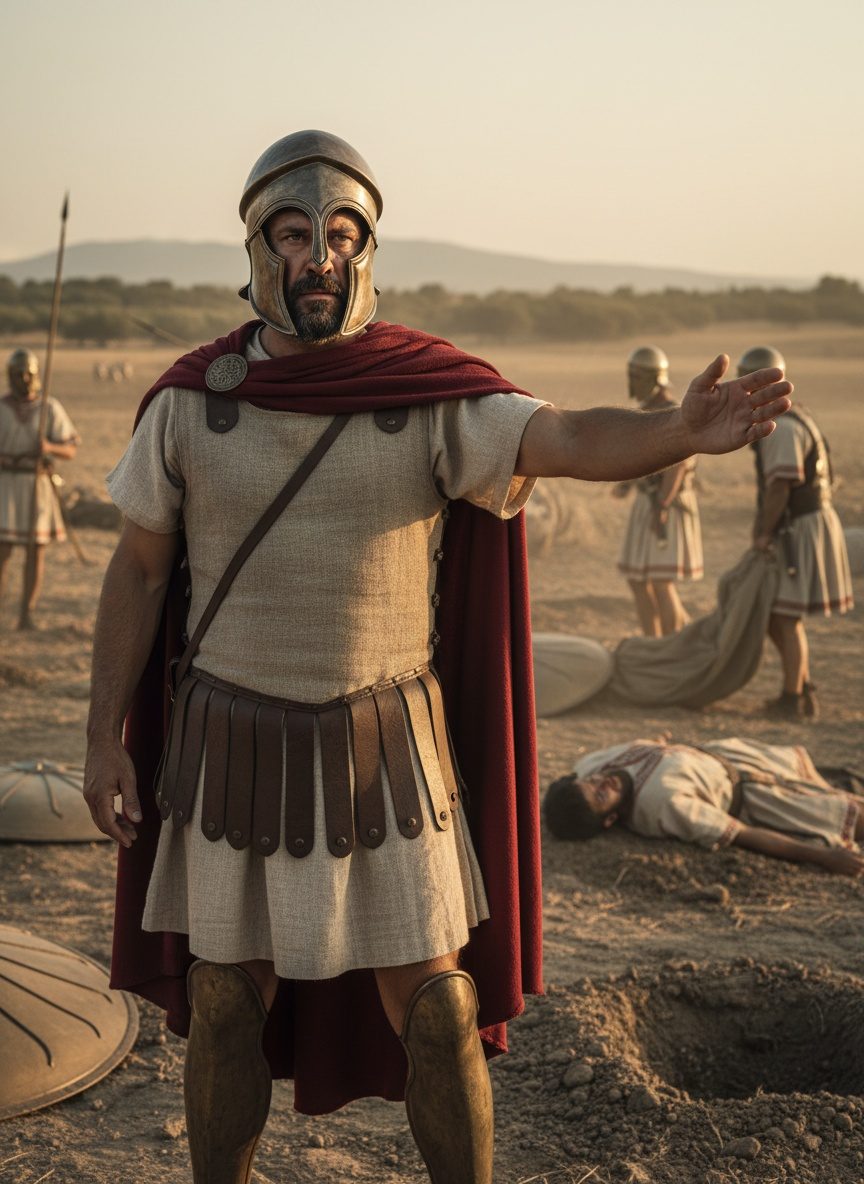
The Spartan general Pausanias stood at the forefront of this paradigm shift. Known for his commanding presence and strategic brilliance, he was the nephew of King Leonidas, the legendary hero of Thermopylae. But as he surveyed the battlefield at Plataea, Pausanias made a decision that would ripple through the annals of time. Pondering the Persian dead who lay before him—men who had moments before been their fiercest enemies—he chose a path of surprising humanity.
With a calm, steady hand, he raised his arm to signal the order: bury them with honors. Silence blanketed the field; even the distant cries of wounded men seemed to fade. The victorious Greek soldiers, expecting orders to mutilate the bodies of the slain as a demonstration of their supremacy, were instead instructed to inter their foes with dignity. This act was unprecedented in Western military history, setting an example of respect for the vanquished that was not borne of fear or necessity but rather a choice that underscored a shared humanity despite the adversity of war.
The soldiers, initially taken aback, found themselves participating in a burial that felt more like a ritual of reflection than a chore of conquest. The clang of their armor and weapons was the only sound amidst the gentle whispers of the wind. Each fallen Persian became a silent testimony to the complexities of war—faceless adversaries now afforded a semblance of grace and reverence. This was in stark contrast to the more common practices of the era, where victors often desecrated corpses to honor their gods or demoralize their foes.
For Pausanias, the decision to honor the dead was a strategic one, a recognition that often times, true strength lies not in brute force but in the wisdom to rise above one's immediate nature. Yet it was also an act deeply rooted in his worldview. To bury the enemy was, in a sense, to render tribute to his own fallen comrades, a reminder that the cycle of violence must one day give way to peace. Pausanias' order was a call to transcend the typical retributions of war and view the Persian soldiers not merely as enemies, but as fellow warriors worthy of respect, ultimately shaping the notions of honor that would ripple through centuries of conflict.
As the final handfuls of earth covered the last of the dead, the collective breath of the Greeks seemed to sigh across the land, an exhalation of ancient hatreds wrapped in newfound insights. The act of burying their enemies not only marked the physical end of battle but symbolized a deeper philosophical victory within themselves. It challenged the narratives of their Eastern adversaries and affirmed the Greeks’ belief in their own societal values—a truth they had fought so dearly to maintain.
The honor bestowed by Pausanias did not go unnoticed by the remaining Persian forces. As news of the burial spread and the reality of defeat sank in, there was a mix of feelings—as if the act, which could have fueled fire, instead doused the embers of animosity. The battle had been brutal, but this moment of benevolence offered a glimmer of acknowledgment that, ultimately, every soldier had fought for what they believed was right.
This decisive yet compassionate moment in 479 BCE reached beyond the immediate scenescape of Plataea. It resonated through Greek society and beyond, introducing a concept of warfare that valued integrity alongside bravery. Pausanias' choice remains a landmark of military ethics, pivotal in shaping the narratives of honor in battle. The field at Plataea, thus transformed, bore witness to an idea that has endured: even in the throes of war, humanity must aspire to respect and understanding.
In an era where history was written by the victors, Pausanias’ command was a narrative written in shared soil, a reminder that even when lines were drawn, they did not separate the fundamental respect due to all who lay upon the field. Here at Plataea, the victors learned a profound truth: that the dignity they accorded to the enemy would echo through the ages, projecting their own greatness far beyond the borders of their own time.