September 19, 1895. A light mist clung stubbornly to the moors of the Scottish Highlands, blurring the divide between the earth and sky.
In the late Victorian era, the Scottish countryside was a refuge for the tired soul, a place where even a queen could find respite from the relentless demands of power and prestige. On this particular day, Queen Victoria, erstwhile ruler of the British Empire, sought solace in the rolling landscapes aboard a humble train. A woman now in the twilight of her reign, the Queen often preferred the simple pleasures of life, among them the solitude offered by the Scottish Highlands. Clad in understated attire and with no retinue by her side, she indulged in this anonymity. For the other passengers aboard, it was a regular journey devoid of pomp and circumstance.
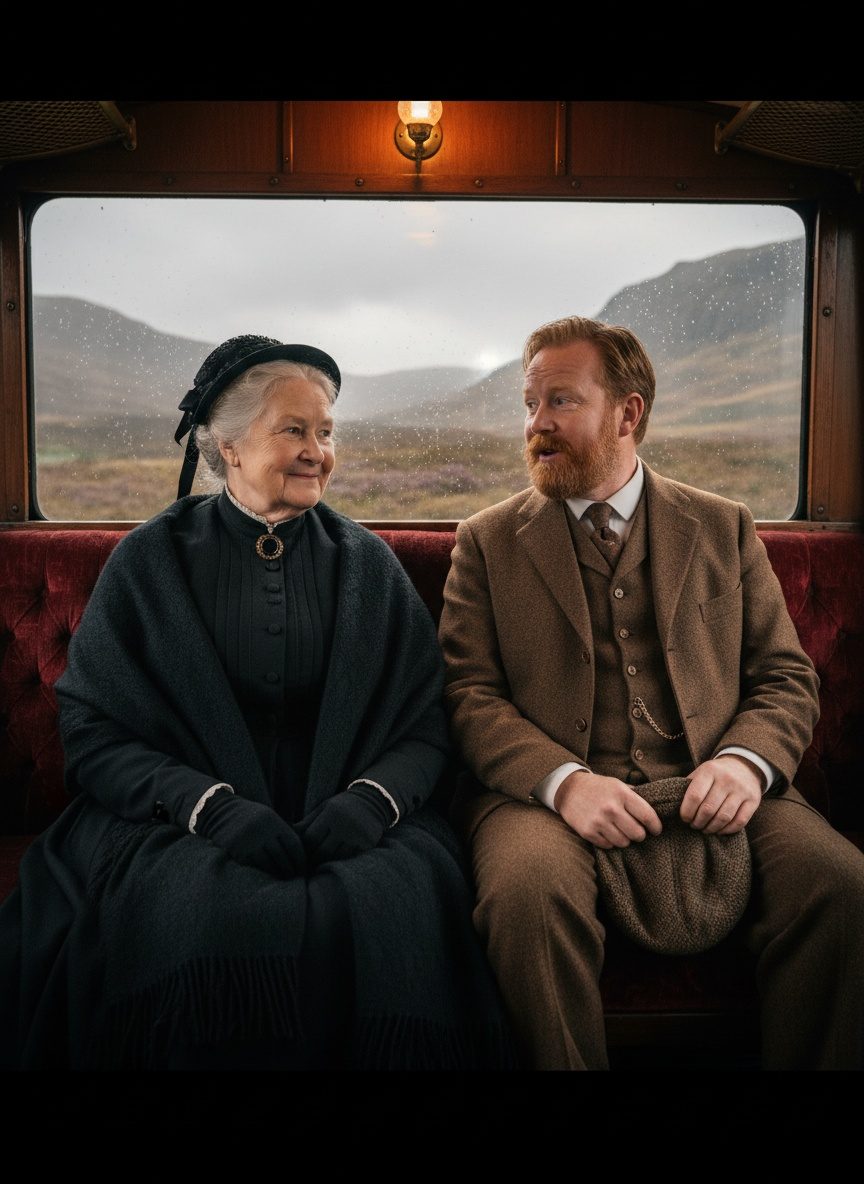
A tale as quaint as the land itself unfolded in one particular carriage where the Queen, incognito, found herself seated next to an unsuspecting traveller. He was, like many, oblivious to the identity of his travel companion. Perhaps there was an ever so slight moment of intrigue, a second glance at her countenance which bore age's imprint yet commanded a remarkable dignity. However, the traveller merely shrugged off these curiosities in favor of a cordial exchange. The openness favored in such spontaneous encounters almost felt timeless, as if fate had whimsically cast this man into a rare moment of history.
The hours passed as miles unfurled beneath the humming wheels of the train. Conversation between them flowed like the rivers that meandered through the Highlands. They shared thoughts on the changing seasons, marvelled at the lush tapestry of nature outside the window, and pondered life's grand absurdities. Without realizing it, the stranger filled those fleeting moments with tales and sentiment, much like one would with an old friend. He spoke of family, shared an anecdote, perhaps he even lamented a trivial woe. In return, the Queen, arguably the most powerful woman of her time, spoke with warmth and grace — attributes that transcended her noble status and touched upon the profoundly human.
For a precious hour, the stranger unwittingly enjoyed the company of a sovereign whom history largely remembers for her ceremonial grandeur and austere presence. Within the intimate confines of the train carriage, she was simply and sincerely a woman listening, engaging. It was this rare, unguarded side of Victoria that few would encounter firsthand, and even fewer would recognize.
As the train approached his stop, the stranger gathered his belongings with a polite farewell, expressing gratitude for the pleasant company. Never once did the Queen offer her name, nor did he press for it, resting in the assumption of just another face in a world of myriad identities. The doors closed, the train lurching forward again into the fog-draped unknown, leaving the traveller with something he would treasure long after — a delightful memory of a journey shared with the mysterious lady who remained, to him, simply nameless.
In the annals of history, this incident could easily be overlooked, a footnote in the relentless march of events that shape our world. Yet, within its simplicity lies an enduring reminder of the art of storytelling and the serendipity of human connection. Behind the veils of power and the symbols of authority, there exists the humanness that binds both the lofty and the ordinary. This poignant vignette of Queen Victoria shines not just as an anecdote of royal secrecy, but as a reflection of the shared humanity that transcends titles and time.
The train ride through the Scottish Highlands that day was not noted in official records, nor did it find its way into the chronicled grandeur of royal biographies. However, the memory persisted in the silence of the traveller's heart, a story told perhaps to just a few, and then quietly settled into oblivion. On paper, it was an uneventful affair, a passing meeting between two strangers. In essence, it hints at the depth and surprise that meeting the unknown can harbor. The Queen’s quiet confidence in anonymity amidst her subjects is a testament to her understanding of the simplest form of human honor — dignity.
As her life drew toward its curtain fall, moments such as these marked the quiet reflections beneath the weighty crown. They remind us, centuries later, how much of history's undercurrents are shaped in whispers and unnoticed glances, moments slipping by, leaving in their wake silent legacies etched in the memory of the everyday lives they touch.
This story matters because it’s a testament to the undercurrents of history that continue to ripple through time — ordinary exchanges that never make the headlines yet shape the tapestry of human experience. It speaks to the connectivity we find in each other when titles and boundaries fall away, dissolved by the pure engagement in shared stories. People seldom know the true measure of their encounters, but in a fleeting random moment on a quiet train through Scotland, history reminds us of the echoing grace in simply listening and speaking as equals.