683 AD. A silent tomb beneath the lush jungles of Chiapas, Mexico.
Unveiling the Underworld
The ancient city of Palenque, surrounded by dense tropical forest, was a vision of resplendence during the Classic Maya Period. Amidst its towering temples and intricate plazas stood the mighty Temple of the Inscriptions, a majestic funeral monument that concealed a secret for almost thirteen centuries. The temple was more than a testament to architectural prowess; it was the gateway to a deeply personal journey into the afterlife, meticulously orchestrated by its revered occupant, K'inich Janaab' Pakal, known posthumously as Pacal the Great.
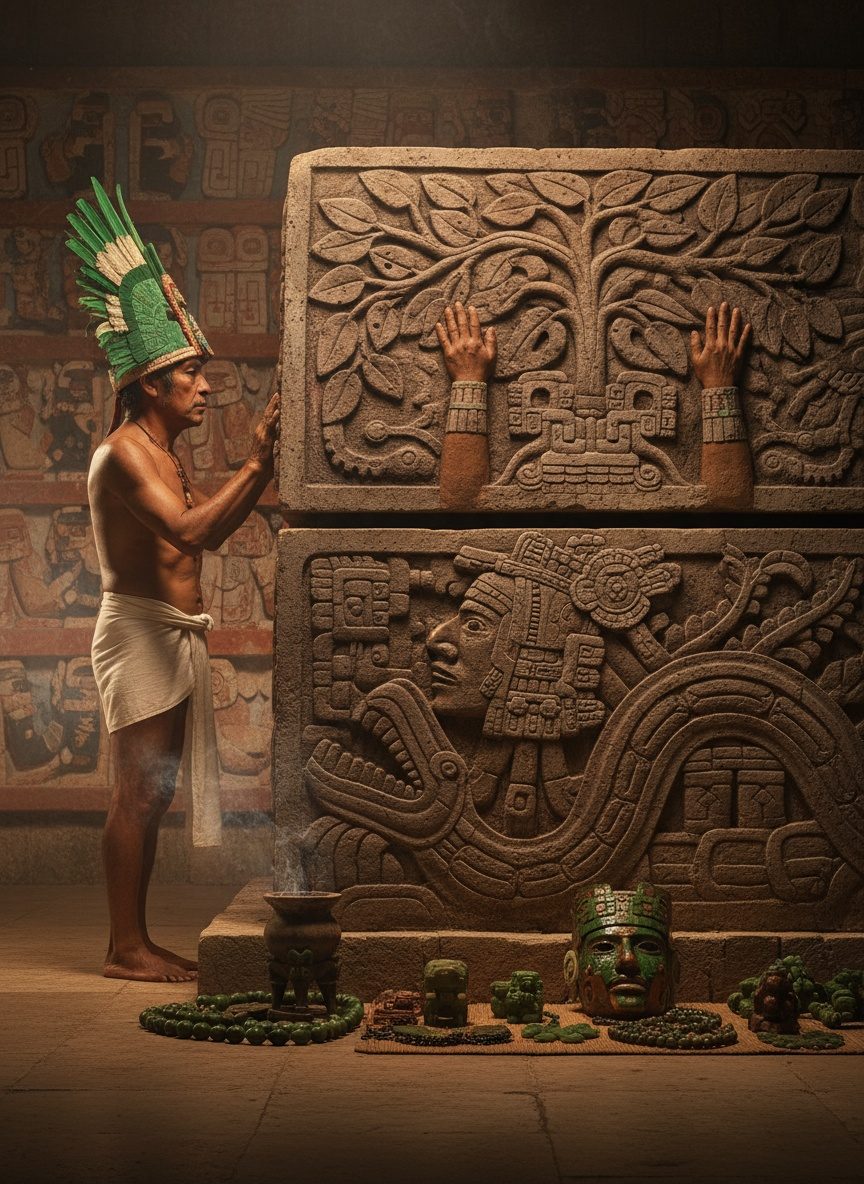
Archaeologists in 1952, led by Alberto Ruz Lhuillier, unearthed a massive limestone lid, adorned with spectacular iconography at the heart of the Temple of the Inscriptions. Beneath it lay the carefully preserved remains of Pacal, a sovereign who reigned for nearly seventy years. Carved into the lid was an awe-inspiring scene: a depiction often misinterpreted but rich in symbolic narratives. It showed a man, seemingly Pacal himself, plummeting into the gaping jaws of the Maya underworld, Xibalba, and simultaneously ascending towards the World Tree. This tableau was more than an image; it was a carefully crafted message meant to transcend time.
Pacal had ascended to the throne at the tender age of twelve and dedicated his life to the prosperity of Palenque. But it was his obsession with the afterlife that became a defining feature of his reign. The Temple of the Inscriptions, conceived decades before his death, was essentially a multi-layered chronicle of his celestial journey, intended to ensure his eternal rebirth. Pacal's progeny continued his lineage, but it was this silent construction project that spoke volumes of his vision. His tomb signified a celestial rebirth, an echo of the Maya belief in the cyclical nature of life and death.
The Hidden Testament of a King
Pacal's tomb, ensconced in the depths of his temple's pyramid, was an archaeological revelation that offered profound insights into Maya beliefs and social hierarchies. The sarcophagus lid, with its intricate carvings, stood as a testament to Pacal's understanding of the cosmos. Its centerpiece—a vivid depiction of Pacal rising above a stylized cross, signifying the World Tree—symbolized his rebirth and eternal journey into divinity. For the Maya, the World Tree was a fundamental symbol connecting the heavens, earth, and the underworld. Pacal's carved figure, framed by celestial bands, was portrayed in a contemplative posture as if poised on the brink of transformation.
For the untrained eye, these complex glyphs and symbols would have been an enigma. However, for a society steeped in metaphysical nuances, the lid was a proverbial roadmap to the afterlife. Carefully arranged on the sides of his sarcophagus, the motifs were not just funerary art; they were deliberate, methodical, and imbued with layers of meaning that underscored Pacal's affinity with divinity. His skeletal remains found within, adorned with jewelry and a resplendent jade mask, affirmed his status and the enduring belief in life beyond death.
Inside the grand sanctum, the passageways and staircases leading down to the burial chamber were not mere architectural features. They were symbolic—narrow portals guiding the soul through its posthumous passage. The number nine often recurs within the space, echoing the Maya's deified underworld orders. In crafting these cryptic passages and symbolic carvings, Pacal's architects immortalized his vision for eternity.
The Eternal Resonance
The discovery of Pacal's tomb not only illuminated the beliefs of a bygone era but reshaped our understanding of the depth and sophistication held by the Maya civilization. Pacal's message, enshrined in intricate stonework, serves as a reminder of the remarkable intellect that once flourished amid the jungles of Mesoamerica. The locked vault containing his remains was, in essence, a time capsule, preserved to communicate with those from future civilizations.
In modern times, the excavation served as a catalyst, inciting fresh interest in Maya culture and its enduring mysteries. It challenged preconceived notions about ancient societies, highlighting their advanced understanding of astronomy, engineering, and spirituality. Every element of Pacal’s tomb challenged us to reconsider simplistic historical narratives. Moreover, it emphasized how ancient cultures, often underestimated, possessed profound wisdom and foresight. Pacal’s story was more than a tale of a king; it was a universal narrative of human curiosity, legacy, and the eternal quest for immortality.
The message Pacal sealed away in darkness, waiting for discovery, speaks to a timeless human desire—to be remembered, to transcend, and to communicate with distant generations. As the dust of his crypt settled back upon the stone, echoes of his vision, immortalized in carved limestone, continue to captivate and inspire. It was his ultimate triumph over oblivion—a message crossing the boundary from then to now, ensuring his eternal ascent in the annals of history.