Nezahualcoyotl was a poet first, a king second. His words inspired awe, but he wielded a power few understood — the art of compassion.
The Ruined Kingdom
In 1430, the city of Texcoco lay in ashes, a stark reminder of the perils of power struggles in pre-Columbian Mesoamerica. Its rightful king, Nezahualcoyotl, had been forced into exile as he witnessed the brutal murder of his father, the former ruler, by vicious usurpers. The kingdom’s fall was swift; it was buried under layers of betrayal and scorched earth, transformed into a ghost of its former self.
For years, Nezahualcoyotl roamed the vast landscapes of the Valley of Mexico, a fugitive with a price on his head. He was hunted like a deer through thick forests and endless cornfields, living a life dictated by the survival instincts of a cornered animal. The usurpers could burn his city and chase him down, but they could not extinguish his spirit or his vision for a better future.
But even in his most desperate moments, Nezahualcoyotl was relentless in his pursuit of knowledge. He observed the world closely, building connections and alliances with those who were also dissatisfied with the tyrannical rule installed over his homeland. It wasn’t only vengeance that fueled his fire; it was an unyielding desire to restore peace and prosperity to Texcoco through the most unexpected of means — compassion.
The Unseen War
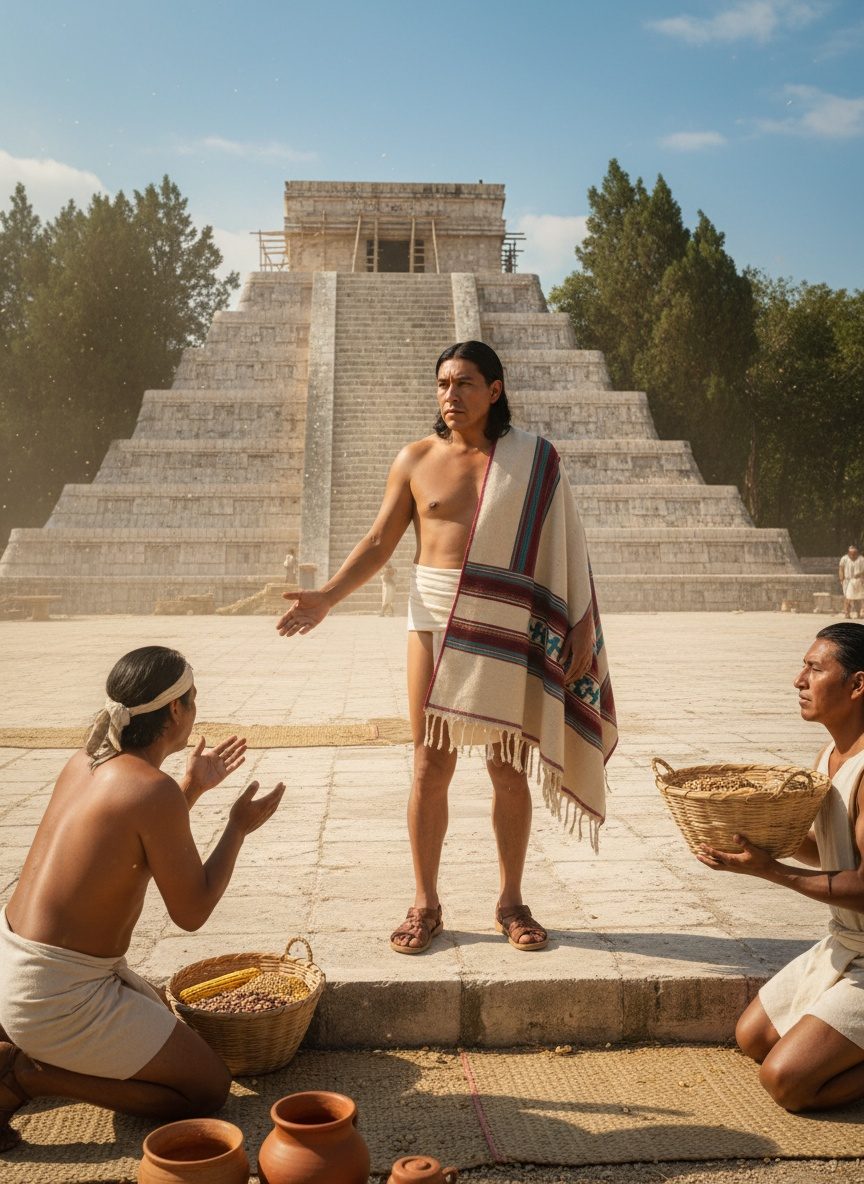
His return wasn’t heralded by the clash of swords or the rumbling of war drums. Nezahualcoyotl preferred a different kind of revolution. He entered the ruins of Texcoco not with an army, but with sacks of grain. His idea was as radical as it was simple — to feed all, even those who had once sought his head.
The impact of this decision was as profound as it was unconventional. Hunger didn’t distinguish between friend and foe, and soon enough, the people saw in Nezahualcoyotl not just a poet king but a savior. The granaries he set up became a symbol of hope. They nourished the people, and the seeds sowed in those fields grew into a new Texcoco, both materially and in spirit.
Instead of temple walls, Nezahualcoyotl offered food and compassion, laying a foundation more resilient than stone. His adversaries, once seeking to quash his existence, found themselves in the protective embrace of his newfound realm. The strategy was not just an appeal to their empty stomachs, but a plea to their humanity.
The Rise of a Cultured Capital
Out of chaos, Nezahualcoyotl built more than a city; he crafted a cultural powerhouse that rivaled even the famed Aztec capital of Tenochtitlan. Under his guidance, Texcoco flourished into an intellectual and artistic haven. Scholars, architects, and artists flocked to this bastion of enlightenment where the arts and sciences were celebrated.
Nezahualcoyotl’s fascination with architecture and engineering transformed the landscape. Grand aqueducts and sophisticated irrigation systems quenched the thirst of the growing populace. Gardens adorned with exotic flora became the focal point of public life, perhaps a nod to the seeds that had once saved his city. Each aspect of the newly constructed Texcoco was a testament to the ruler’s blended vision of practicality and beauty.
The king’s passion for poetry and philosophy, a cornerstone of his identity, created an intellectual renaissance. Nezahualcoyotl invited the brightest minds and nurtured a culture that appreciated wisdom and creativity. His leadership turned Texcoco into a beacon of education and culture, an unexpected yet dazzling outcome of his peaceful conquest.
A Legacy Beyond Borders
Nezahualcoyotl’s story is not merely one of survival and retribution; it is a transformative narrative of what it means to lead. His decision to rebuild a kingdom with acts of kindness rather than brute force is an anomaly in the chronicles of kings and conquests. It compels us to reconsider the traditional tales of power struggles, where might often made right.
The seeds Nezahualcoyotl planted in both soil and soul grew into legacies that transcended the boundaries of his lifetime and domain. Beyond the grandeur of his architectural and cultural achievements, his true monument was the society he molded — one rooted in empathy and enlightenment. His reign demonstrated that even in a world often defined by conflict and dominance, the enduring power of compassion can carve new pathways to peace and prosperity.
Nezahualcoyotl’s reign poses a timeless question: what is the true measure of greatness? In a world still grappling with shadows cast by power and ambition, his story illuminates the promise of a different path — one where seeds of empathy may yet find fertile ground.