Kha's tomb was never meant to be opened. But when it was, what it contained was more astonishing than anyone had imagined.
For over three millennia, Kha's eternal house remained untouched by the hands of time and men. A peculiar fact, given the tumultuous history of grave robbers ravaging these sacred spaces across Egypt. Nestled in the serenity of Deir el-Medina, Kha's resting place retained a sacred privacy that many others were denied. This anomalous event paints a picture of profound reverence and fear that loomed over the lives of ancient Egyptians, particularly when it came to the "master tomb builder" himself.
Kha served as the chief architect under the reign of not one but three pharaohs during Egypt's illustrious 18th Dynasty, around 1400 BCE. These were not just any pharaohs; they were rulers who presided over periods of dynamic change and wealth, commissioning grandiose monuments that have fascinated humanity ever since. Kha was the mastermind behind crafting enduring resting places for the gods of Egypt and the mortal rulers considered to be divine. Yet, despite his illustrious service, history seems to offer him only a whisper amongst the shouts of grand pharaohs and gods.
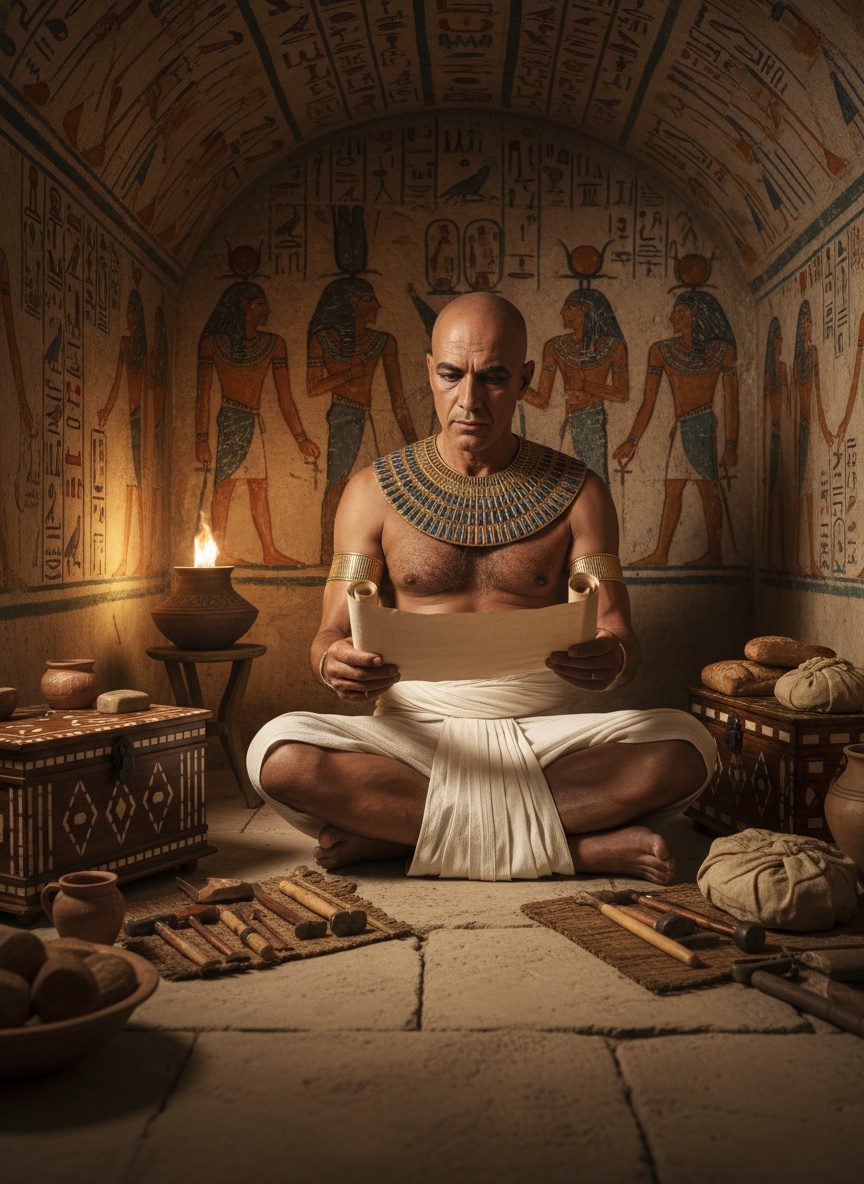
Intriguingly, Kha meticulously packed his own tomb with an unparalleled dedication, much like he did for his royal patrons. This was a man who believed every word he had ever carved into limestone, every guiding principle he had shaped with his chisel. In constructing his tomb, Kha demonstrated his profound understanding and belief in the Egyptian concepts of death and the afterlife. It was, in fact, a calculated preparation for eternity where each item had a distinct role to play.
Inside, archaeologists found a remarkable collection of everyday objects that Kha esteemed in life and deemed necessary for survival in the hereafter. The tomb contained everything from garments and furniture to cosmetics, food, and drink. The oil lamps were full, as if Kha anticipated needing them to light his path in the world beyond. Perhaps the most poignant discovery was the bread left on the table, looking as though it had just been placed there; a simple loaf symbolizing sustenance in the afterlife.
This remarkable preservation can be attributed, in part, to the way the tomb was sealed and hidden away with a sophistication that echoes Kha's engineering prowess. His knowledge of tomb construction, no doubt, imbued his burial chamber with defenses that even death could not breach. No priests looted it to finance grand rituals or satiate demands of the living; no thieves pilfered its riches for earthly aspirations. It simply waited, embraced by the sands of time until its rediscovery.
The story of Kha's undisturbed tomb reached its climax in 1906, when Italian archaeologists — among them Ernesto Schiaparelli, the director of the Egyptian Museum in Turin — stumbled upon its entrance. Breaking through the ancient seal, they unwrapped a world silenced by centuries yet vibrant in its undying whisper of Kha's life and beliefs.
Kha's life, though not extensively documented beyond his special artifacts and dedications, offers us a rich tableau of ancient Egyptian society. As a high-ranking official at Deir el-Medina, he was part of a unique village built to house the workers crafting the tombs in the Valley of the Kings and Queens. This placed Kha at the very heart of ancient Egypt's storied civilization, where art and architecture melded seamlessly with religious rites.
What makes Kha's tale particularly compelling, aside from the mystery of his untouched tomb, is the way it sheds light on the everyday lives of those who weren’t destined for grand temples or royal edifice. Through his belongings, we glimpse the aesthetic values, daily routines, and spiritual beliefs that shaped the world of an ancient Egyptian craftsman. It’s a perspective often overshadowed by the grand figures of history, yet one that resonates with modern audiences seeking to understand the richness of the past.
In Kha's story lies a narrative that connects us with a more personal aspect of history. It dismantles the notion that the ancients were only driven by grand historical events or monumental constructions. Instead, it reveals the relatable, human side of living — the ordinary joys and sorrows that transcended time and mortality.
In contemplating why Kha's tomb remained inviolate for so long, we confront the profound reverence of souls who respected the sanctity of a man who once shaped their sacred spaces. It could very well be that Kha’s impeccable service and the magic of his craftsmanship garnered respect so powerful it defied the temptation of robbery for centuries. Or perhaps this untouched hollow simply thrived under the protective veil of obscurity, shielded first-hand by Kha's architectural genius.
As modern explorers of ancient stories, the fruits of Kha's carefully orchestrated eternity force us to re-evaluate our understanding of civilization. How many more mysteries wait beneath the sands, surrounded by their own timeless whispers? In discovering Kha, we not only found a man but also a bridge that connects us to a shared human condition, an eternal quest to ensure our comforts persist long after we’ve departed this world.