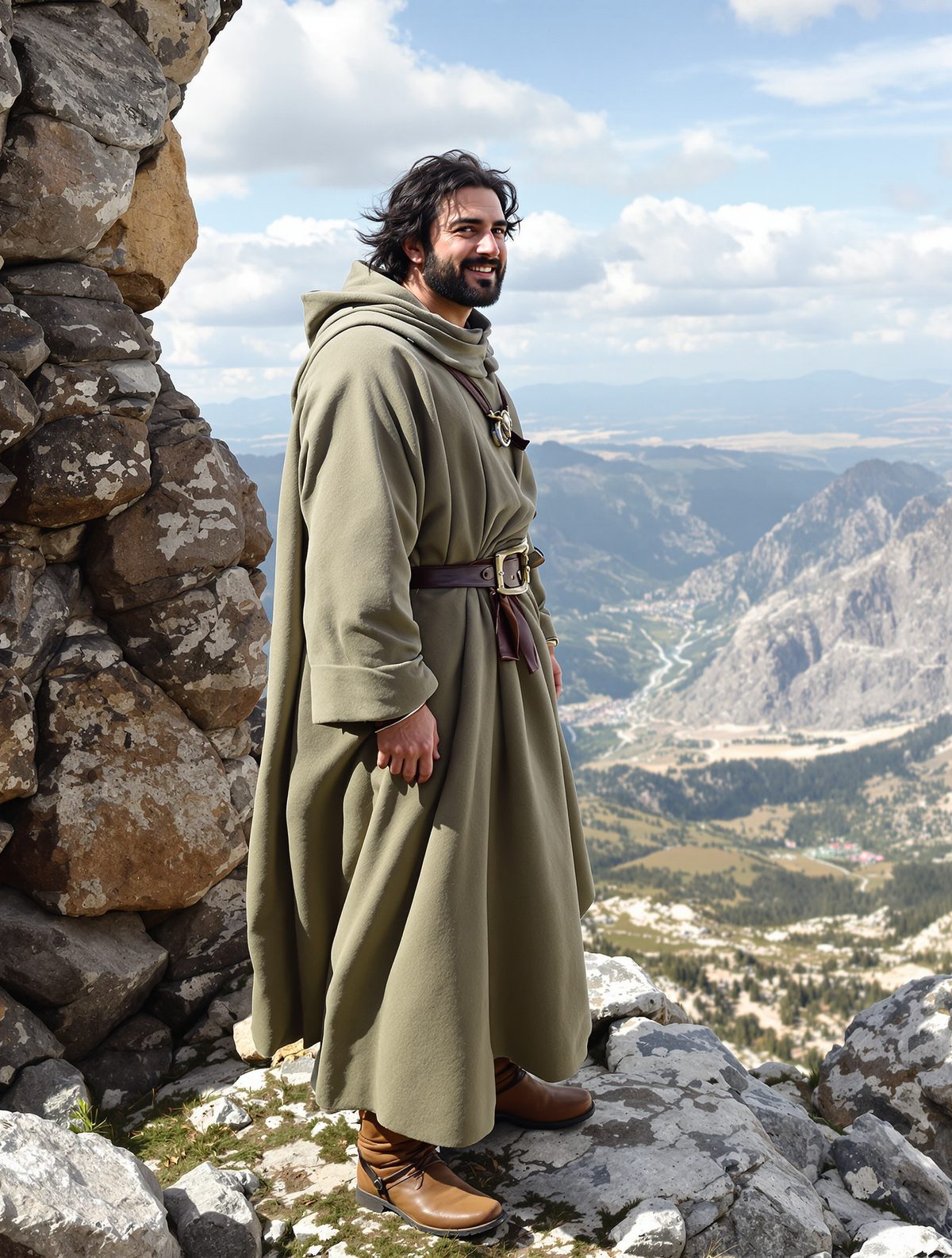
The screams echoing from King Olaf's great hall in Trondheim weren't the usual sounds of Viking revelry. In the winter of 997 AD, they belonged to a Norse chieftain named Raud the Strong, who was having a red-hot iron poker shoved down his throat for refusing to accept Jesus Christ as his savior. When that didn't work, Olaf's men forced a wooden wedge between Raud's jaws and dropped a snake into his mouth. The serpent, seeking escape from the heat of the iron, slithered down the chieftain's throat and ate its way out through his side.
This wasn't the work of some bloodthirsty pagan warlord—this was Christian missionary work, 10th-century style. Meet Olaf Tryggvason, the Viking king who brought the cross to Norway with methods that would make the Spanish Inquisition blush.
The Making of a Holy Warrior
Olaf Tryggvason's path to becoming Norway's most violent evangelist began in the most unlikely place: a slave market in Estonia. Born around 963 AD as the great-grandson of Harald Fairhair (Norway's first king), young Olaf should have grown up in royal halls. Instead, when his father Tryggve was murdered in a power struggle, three-year-old Olaf fled with his mother across the Baltic Sea. Their ship was captured by Estonian pirates, and the future king of Norway was sold into slavery.
For six years, Olaf lived as a thrall until his uncle Sigurd spotted him in a Novgorod marketplace and bought his freedom. The boy then spent his teenage years in the court of Vladimir I of Kiev—ironically, another ruler who would later force Christianity on his people through similarly brutal methods.
But it was in the Scilly Isles, off the coast of Cornwall, that Olaf's destiny took its most crucial turn. According to the Saga of Olaf Tryggvason, a hermit there had a vision that this battle-scarred Viking raider would become "a renowned king" who would "bring many people to faith and baptism." The hermit predicted Olaf's conversion so accurately that the skeptical Viking became a believer on the spot—and was baptized in 994 AD.
What the hermit apparently didn't mention was the ocean of blood that would flow from this holy mission.
Conquest and Conversion
When Olaf seized the Norwegian throne in 995 AD, he inherited a kingdom where Christianity existed mainly as an exotic foreign curiosity. Most Norwegians still sacrificed to Odin at the great temple of Uppsala, carved runes asking Thor for protection, and believed their honored dead feasted in Valhalla. Olaf intended to change all of that—immediately and completely.
Unlike other medieval rulers who might spend decades gradually converting their realms, Olaf treated Christianization like a military campaign. He gave his subjects a stark choice: baptism or death. No middle ground, no time for consideration, no respect for ancestral traditions stretching back centuries.
The king's first major "evangelical" expedition took him to the Trondheim fjord in 997 AD, where he encountered fierce resistance from the local chieftains. These weren't random peasants clinging to old superstitions—they were powerful landowners with their own armed retinues, men who had grown rich and respected serving the old gods.
Olaf's response was as creative as it was cruel. When simple threats failed, he developed what can only be called a theology of torture.
The Art of Holy Terror
Modern estimates suggest that Olaf's conversion campaigns killed more Norwegians than the Black Death would claim from the entire population 350 years later. But it wasn't the scale of the killing that made Olaf's methods so notorious—it was the creativity.
Take the case of Eyvind Kinnrifi, a chieftain who refused to abandon the old gods. Olaf had him tied down and a bowl placed on his stomach. Then the king's men placed a red-hot coal on the bowl's bottom, heating it until it burned through Eyvind's flesh. When the chieftain still wouldn't convert, they poured boiling water on his abdomen until his intestines burst.
The aforementioned Raud the Strong suffered an even more elaborate execution. After the snake-down-the-throat method, Olaf's torturers got creative with geography. They bound Raud to a plank and slowly pushed him into a fire, feet first, asking at each agonizing inch whether he was ready to accept baptism. Raud chose to burn alive rather than betray his gods.
But perhaps Olaf's most psychologically devastating tactic involved targeting entire families. When the chieftain Thorkel Leira refused conversion, Olaf didn't just execute him—he forced Thorkel to watch as his sons were tortured to death one by one, offering to stop the carnage if the father would just kneel before a cross.
The king's men became skilled in the art of religious coercion. They would tie pagan priests to wild horses and drag them across rocky ground until they agreed to be baptized. They forced nobles to eat their own sacred groves by cutting down holy trees and shoving the wood down their throats. They burned entire villages whose inhabitants wouldn't attend mandatory baptism ceremonies.
The Gospel According to Olaf
What makes Olaf's methods even more chilling is that he genuinely believed he was doing God's work. This wasn't cynical politics disguised as religion—surviving accounts suggest the king was a sincere, even fanatical Christian who saw torture and murder as acts of divine mercy.
In Olaf's worldview, every pagan he killed went to hell anyway, so forcing them to convert—even through unimaginable agony—was actually saving their souls. Better to suffer for hours and achieve salvation than to die peacefully in service to false gods and burn for eternity.
This twisted logic led to some truly bizarre scenes. Contemporary chroniclers describe Olaf weeping as he watched his victims die, not from remorse but from what he saw as Christian compassion for souls too stubborn to accept salvation. He would often pray over the corpses of those he'd tortured to death, asking God to forgive them for their spiritual blindness.
The king also believed that dramatic conversions would prove Christianity's power to those who witnessed them. When someone finally broke under torture and agreed to be baptized, Olaf would stage elaborate ceremonies celebrating their spiritual rebirth—sometimes literally over the still-warm bodies of those who had refused to convert.
By 1000 AD, Olaf had essentially eliminated organized paganism from Norway through what modern historians estimate was the murder of between 3,000 and 5,000 people—a staggering number in a country with perhaps 150,000 inhabitants total.
The Ironic End
For all his success at forced conversion, Olaf Tryggvason's reign ended in spectacular failure. In September 1000 AD, he sailed into a trap at the Battle of Svolder, where a coalition of his enemies—including many relatives of his torture victims—surrounded his flagship, the Long Serpent.
Rather than face capture, the king who had denied so many others a warrior's death chose to leap overboard in full armor, disappearing beneath the waves of the Baltic Sea. His body was never recovered, leading to persistent legends that he had somehow survived and lived out his days as a monk in some distant monastery.
The supreme irony is that Olaf's violent evangelism nearly undid itself. His death sparked a massive pagan revival as survivors emerged from hiding and tried to restore the old ways. It took another generation of forced conversion—this time under Olaf II (later Saint Olaf)—to permanently establish Christianity in Norway.
The Uncomfortable Legacy
Today, Olaf Tryggvason is remembered as the king who brought Christianity to Norway, with statues in Trondheim and even a Norwegian naval vessel bearing his name. But his story raises uncomfortable questions about how we remember religious history.
How do we reconcile genuine faith with unconscionable methods? Olaf's Norway did become Christian, and remained so for over a thousand years. Many of his subjects' descendants would find profound meaning, comfort, and moral guidance in the religion he forced upon their ancestors. Does the end ever justify such horrific means?
Perhaps more disturbingly, Olaf's story reminds us how easily people can commit atrocities while believing themselves to be moral actors. His tortures weren't the products of sadism or political calculation, but of religious conviction so absolute that it erased any consideration for human suffering.
In an age when religious extremism still shapes global politics, the tale of Norway's converter king serves as a dark reminder that the most dangerous fanatics are often those who genuinely believe God is on their side. Sometimes the most frightening monsters are the ones who pray over their victims' corpses—and truly believe they're doing holy work.