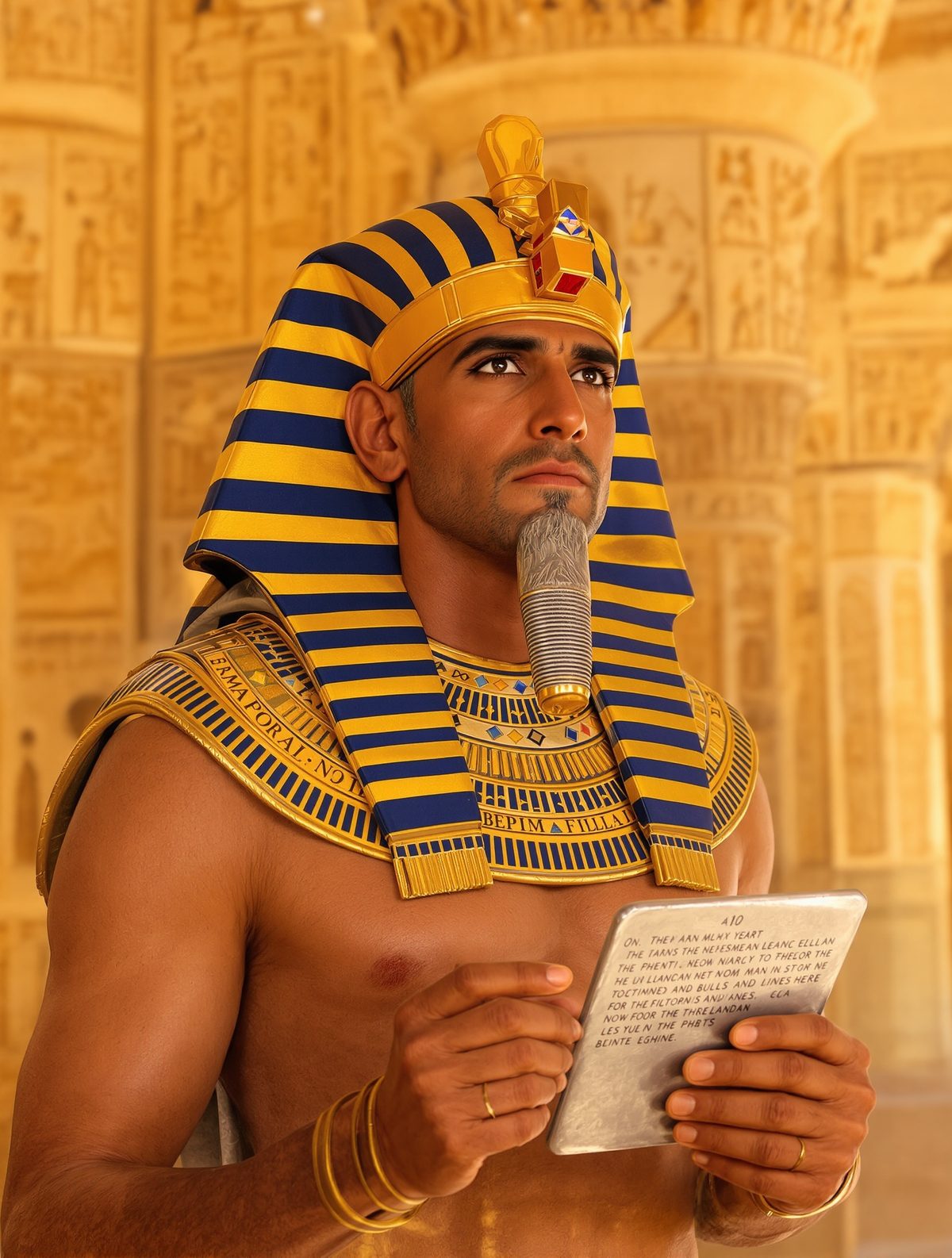
Picture the most powerful man on Earth in 1350 BC, standing in his palace overlooking the Nile River. Gold flows into his treasury from Nubian mines. Tribute pours in from conquered kingdoms stretching from modern-day Sudan to Syria. His armies are unstoppable, his empire vast beyond imagination. Then this pharaoh does something so shocking, so revolutionary, that it nearly destroys the greatest civilization of the ancient world.
His name was Akhenaten, and he was about to commit the ultimate act of religious terrorism against his own people.
In a single decree, this ruler would outlaw every single god that Egyptians had worshipped for over 3,000 years. He would shutter temples, fire priests, and declare that only one deity could exist. The backlash would be swift and brutal—but the story of what happened next reveals one of history's most fascinating experiments in monotheism, artistic revolution, and the dangerous power of absolute rule.
The Golden Empire at Its Peak
When Akhenaten took the throne in 1353 BC, he inherited an empire that was quite literally made of gold. Egypt controlled the richest gold mines in the ancient world, located in the eastern deserts and Nubia. These weren't small operations—archaeologists have discovered over 100 ancient Egyptian gold mines, some with underground galleries stretching for miles.
The wealth was staggering. A single diplomatic letter from this period, found in the archives of Tell el-Amarna, records a Babylonian king complaining that the gold Egypt sent him "is not enough." The pharaoh's casual reply? "In my country, gold is as plentiful as dust."
This golden empire stretched over 1,000 miles from north to south. Egyptian armies controlled fortified cities along the eastern Mediterranean coast. Tribute flowed in from vassal kingdoms—cedar wood from Lebanon, silver from Anatolia, exotic animals from Africa. The capital at Thebes was the New York City of the ancient world, a cosmopolitan center where foreign diplomats, merchants, and craftsmen mingled with Egyptian nobles.
But perhaps most importantly, Egypt's power rested on something even more valuable than gold: a religious system that had remained virtually unchanged for millennia. Over 3,000 gods and goddesses formed an intricate web of beliefs that touched every aspect of Egyptian life. The priests who served these deities weren't just religious figures—they were bankers, administrators, landowners, and political powerbrokers who controlled roughly one-third of all Egyptian wealth.
The Revolutionary Who Renamed Himself
The pharaoh who would shatter this system wasn't born "Akhenaten." He started life as Amenhotep IV, named after the god Amun-Ra, the "King of the Gods." For the first few years of his reign, nothing seemed unusual. He made the traditional offerings, performed the required ceremonies, and kept the vast religious bureaucracy humming along.
Then, around his fifth year as pharaoh, something changed. Amenhotep IV began showing unusual devotion to a relatively minor sun god called the Aten. This wasn't entirely unprecedented—the Aten had been worshipped as one of many aspects of the sun god Ra for generations. But Akhenaten took this devotion to an extreme that no pharaoh had ever attempted.
The transformation was swift and total. The pharaoh changed his name from Amenhotep ("Amun is satisfied") to Akhenaten ("Beneficial to the Aten"). His wife, the famous Queen Nefertiti, became "Nefer-neferu-aten" ("Beautiful is the beauty of the Aten"). Even his daughters received names honoring the Aten.
But the name changes were just the beginning. In a series of increasingly radical decrees, Akhenaten declared that the Aten was not merely the greatest of the gods—it was the only god. Every other deity worshipped by Egyptians for over three millennia was declared false, powerless, non-existent.
The Great Heresy: Outlawing 3,000 Gods
What happened next was unprecedented in human history. Akhenaten didn't just promote his favored god—he launched what can only be described as the world's first organized campaign of religious persecution against polytheism.
Royal agents swept across Egypt with chisels and hammers, systematically destroying the names and images of the old gods. They defaced temple walls that had stood for centuries, chiseled out hieroglyphs, and toppled statues. The name of Amun-Ra, once the most powerful god in Egypt, was literally erased from monuments—even from Akhenaten's own father's tomb.
The economic impact was catastrophic. Imagine if a modern government suddenly shut down one-third of the economy overnight. Thousands of priests lost their jobs. Temple workshops that had employed sculptors, painters, scribes, and craftsmen went dark. The complex system of temple granaries that helped feed the population during bad harvests was dismantled.
Even more shocking was Akhenaten's claim that he alone could communicate with the Aten. In traditional Egyptian religion, priests at temples throughout the kingdom could perform rituals and make offerings to the gods. But Akhenaten declared that only the royal family could worship the Aten directly—everyone else had to worship the pharaoh himself as the god's sole representative on Earth.
This wasn't just religious revolution—it was the ancient world's most extreme experiment in totalitarian thought control.
The City Built for One God
Not content with merely reforming the existing religious system, Akhenaten decided to build an entirely new capital city. In his eighth year as pharaoh, he abandoned Thebes—with its magnificent temples to the old gods—and constructed a brand-new city called Akhetaten ("Horizon of the Aten") at a site now known as Amarna.
The construction of this city was a marvel of ancient urban planning, built in record time through what must have been a massive mobilization of resources. Archaeologists estimate that over 20,000 people lived in Akhetaten at its peak, making it one of the largest cities in the world at the time.
But Akhetaten was unlike any Egyptian city that had come before. Instead of the dark, mysterious temples traditional to Egyptian religion, Akhenaten built open-air sanctuaries where the Aten's rays could shine directly onto worshippers. The city's art broke dramatically with 3,000 years of Egyptian artistic tradition—instead of the idealized, formal style of previous pharaohs, Akhenaten commissioned startlingly realistic sculptures showing him with an elongated skull, feminine hips, and a protruding belly.
Some of these artistic innovations were beautiful—the famous bust of Queen Nefertiti, one of the most recognizable artifacts from ancient Egypt, comes from this period. But the radical changes in art, like the radical changes in religion, were imposed from the top down without regard for popular opinion.
The Empire Crumbles
While Akhenaten was obsessing over his religious revolution, his empire was falling apart. The Tell el-Amarna letters—a collection of diplomatic correspondence found at the site of Akhetaten—paint a picture of an international crisis that the pharaoh seemed determined to ignore.
Vassal kings from across the empire sent increasingly desperate pleas for military support. "Send archers!" wrote one Syrian ruler as enemies attacked his city. Another complained that Egyptian territories were being "lost daily" to rivals. But Akhenaten, consumed with his religious reforms, failed to respond to most of these requests.
The consequences were predictable and devastating. Egypt lost control of most of its northern empire. Valuable trade routes were cut off. Tribute payments that had filled the royal treasury for generations simply stopped coming.
At home, the situation was equally dire. Crops failed during Akhenaten's reign, possibly due to climate changes, but the pharaoh had dismantled the traditional temple system that helped distribute food during famines. Archaeological evidence from this period shows signs of malnutrition and disease among the general population.
Even Akhenaten's own guards began to abandon him. Graffiti found at Amarna, written by royal guards, shows their growing frustration with a pharaoh who seemed to care more about his god than his people or his empire.
The Heretic's End and History's Judgment
Akhenaten died around 1336 BC, possibly assassinated, though the exact circumstances remain mysterious. What's certain is that his religious revolution died with him—and the backlash was swift and merciless.
Within a few years, the old gods were restored, the priests returned to power, and Akhetaten was abandoned to the desert sands. Akhenaten's name was chiseled from monuments just as systematically as he had erased the names of the old gods. Later pharaohs referred to him only as "the criminal of Amarna" or "that enemy."
His immediate successor was the boy pharaoh Tutankhamun—originally named Tutankhaten in honor of Akhenaten's god, but who quickly changed his name to honor the traditional god Amun-Ra instead. The fact that King Tut's tomb survived intact to modern times is partly due to this historical amnesia—his burial site was forgotten because his connection to the heretic pharaoh made him an embarrassment to later dynasties.
But here's what makes Akhenaten's story eternally relevant: he was arguably history's first monotheist, attempting to replace thousands of gods with one universal deity centuries before Judaism, Christianity, or Islam emerged. Some scholars even suggest that his religious ideas may have influenced Moses and the development of Hebrew monotheism, though this remains highly debated.
Akhenaten's great experiment failed because he tried to impose revolutionary change through authoritarian decree rather than persuasion. He destroyed a religious system that had provided meaning, community, and economic stability to millions without offering adequate replacements. His story serves as a timeless warning about the dangers of absolute power—and the human cost when leaders prioritize their personal visions over their people's needs.
In the end, the pharaoh who sought to become the prophet of one true god succeeded mainly in demonstrating that even the most powerful ruler on Earth cannot simply command people to abandon the beliefs that define their world. That lesson echoes through history, as relevant today as it was 3,300 years ago in the abandoned ruins of a city built for a god that only one man truly believed in.