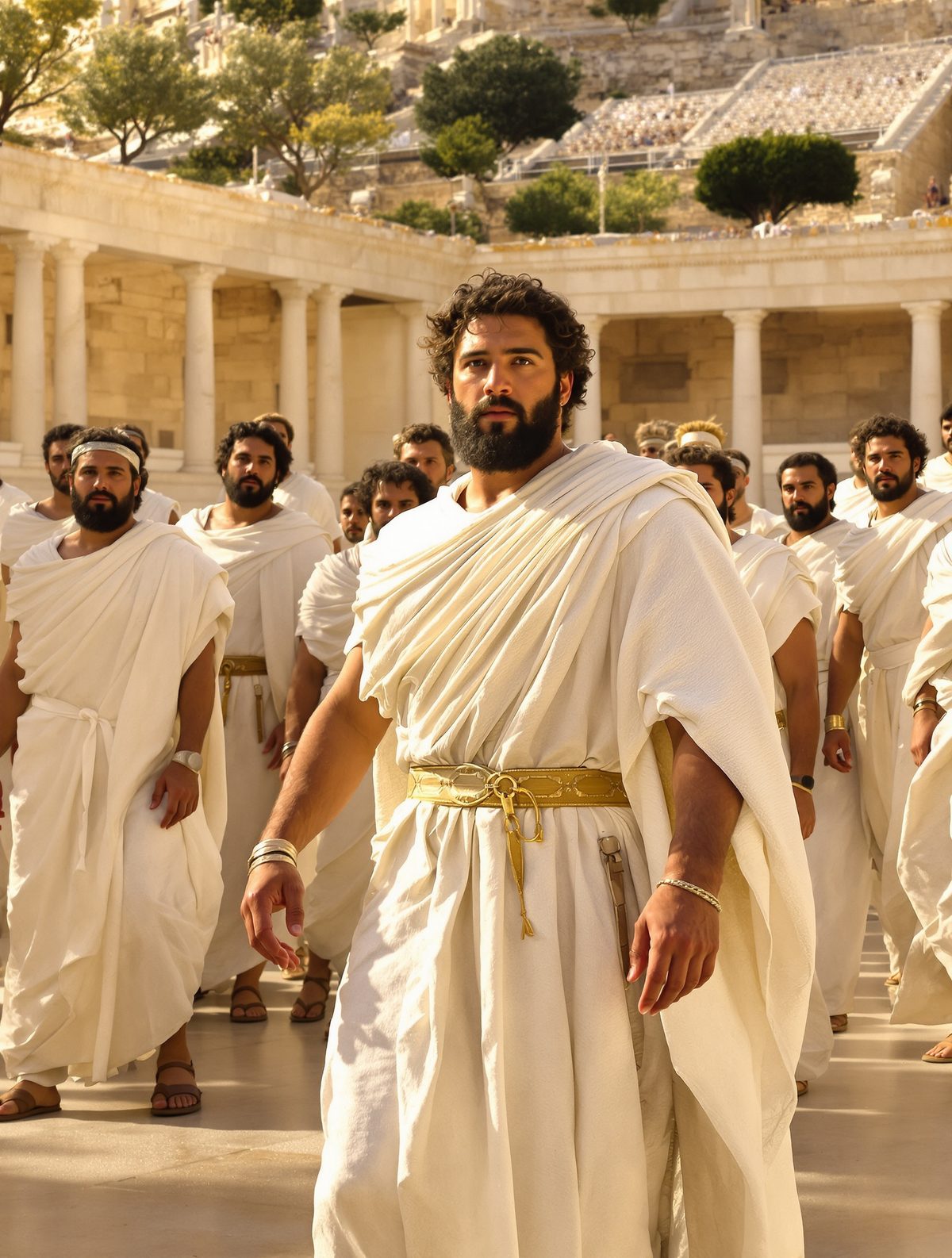
Picture this: while enemy armies mass at your kingdom's borders and your own people whisper of rebellion, you order workers to tear up the marble floors of your palace. Not to hide treasure or escape through secret tunnels, but to dig up pottery shards and clay tablets left by kings who died before Moses was born. This wasn't the behavior of a madman—this was King Nabonidus of Babylon, history's first royal archaeologist, whose obsession with the past would ultimately cost him his empire.
In 539 BC, as Persian forces under Cyrus the Great prepared to march on Babylon, the last king of the Neo-Babylonian Empire was literally digging himself into history. While his advisors pleaded with him to focus on military preparations, Nabonidus was on his hands and knees in the excavated foundations of his own throne room, carefully brushing dirt from cuneiform inscriptions that hadn't seen daylight for fifteen centuries.
The Scholar Who Stumbled Into a Crown
Nabonidus never expected to rule Babylon. Born around 620 BC, he was the son of a priestess and grew up immersed in the temple libraries of Harran, a city famous for its scholars and scribes. While other nobles learned swordplay and statecraft, young Nabonidus spent his time deciphering ancient texts and studying the reigns of long-dead kings. He could recite the genealogies of Mesopotamian rulers going back a thousand years, but he'd never commanded so much as a single soldier.
Then, in 556 BC, everything changed. A palace coup removed the boy-king Labashi-Marduk after just nine months on the throne, and the conspirators needed a respectable figurehead—someone with noble blood but no political ambitions. The 64-year-old scholar seemed perfect for the role. They couldn't have been more wrong.
Within months of his coronation, Nabonidus began displaying behavior that baffled his court. Instead of hosting diplomatic banquets, he organized expeditions to ancient ruins. Rather than commissioning new monuments to his own glory, he ordered the restoration of temples that had been abandoned for centuries. His courtiers watched in bewilderment as their elderly king transformed into something unprecedented: a ruler more interested in preserving the past than conquering the future.
Digging Through Time in the Royal Basement
The real madness began in 549 BC when Nabonidus made an extraordinary decision. Ancient records mentioned that his palace in Babylon had been built atop the ruins of much older structures, possibly dating back to the legendary kings Hammurabi and Nebuchadnezzar I. While any sensible monarch might have been content with this historical footnote, Nabonidus ordered his workers to begin excavating.
What they found beneath the palace floors was archaeological gold: foundation deposits left by kings from the Old Babylonian period, some dating back to 1800 BC. These weren't random artifacts—they were carefully placed time capsules containing inscribed bricks, clay cylinders, and metal figurines that documented the construction and renovation of temples and palaces across the centuries.
Nabonidus didn't just collect these artifacts; he studied them with the methodical precision of a modern archaeologist. He carefully recorded where each item was found, noted the style of cuneiform script used, and cross-referenced the royal names with his extensive knowledge of Mesopotamian chronology. He was conducting stratigraphic archaeology fifteen hundred years before the technique was formally developed.
The king's most spectacular discovery came when his diggers uncovered a foundation stone left by Naram-Sin, the grandson of the legendary Sargon of Akkad, who had ruled around 2250 BC. The inscription was so ancient that even the palace scribes couldn't read it properly—the cuneiform script had evolved dramatically over the intervening centuries. But Nabonidus, drawing on his decades of scholarly training, managed to decipher the text and proudly announced that he now possessed a relic from "the time before time."
The Archaeological King's Greatest Obsession
As word of the king's discoveries spread, Nabonidus launched what can only be described as the ancient world's first systematic archaeological survey. He dispatched teams of diggers to sites across Mesopotamia with specific instructions: find foundation deposits, document their locations, and bring back any inscribed materials for royal examination.
The results were staggering. From the ruins of Sippar came inscribed bricks from the reign of Hammurabi himself, the great lawgiver whose code had shaped civilization. From Ur, the biblical birthplace of Abraham, came cylinder seals and votive offerings spanning two millennia. Each discovery sent Nabonidus into scholarly ecstasy, and he would spend days studying each artifact, sometimes ignoring state business entirely.
But it was at the temple of Shamash in Sippar that Nabonidus made his most significant find—and committed what might be history's first act of archaeological fraud. After weeks of digging failed to produce the foundation stone he was seeking, the king ordered his craftsmen to create a replica inscription "in the ancient style" and bury it where his diggers would conveniently discover it the next day. The fake discovery was celebrated throughout the kingdom, and Nabonidus used it to justify extensive (and expensive) renovations to the temple.
An Empire Crumbles While the King Plays in the Dirt
While Nabonidus excavated ancient ruins, his empire was falling apart. The Persian Empire under Cyrus the Great had been steadily expanding westward, swallowing up kingdom after kingdom. By 540 BC, Babylonia was virtually surrounded, and refugees fleeing Persian armies brought daily reports of approaching doom.
The king's response was to dig deeper. As Persian scouts probed his borders, Nabonidus ordered new excavations beneath the throne room itself, convinced that he would find some artifact or inscription that would grant him the divine favor that had protected ancient kings. His generals pleaded for military conferences; instead, they got lectures on the building techniques of the Third Dynasty of Ur.
The situation grew so desperate that Nabonidus's own son, Belshazzar, attempted to take control of the government and organize the kingdom's defenses. But the archaeological king refused to be sidelined, continuing his excavations even as Persian armies crossed into Babylonian territory. He was literally digging his own grave while his enemies dug his empire's.
The end came with shocking swiftness. In October 539 BC, Cyrus's forces entered Babylon without a fight—the city's defenders, fed up with their distracted king, simply opened the gates. Nabonidus was captured while attempting to flee, not from the palace, but from the archaeological site where he'd been working when news of the city's fall finally reached him.
The Legacy of the King Who Loved the Past Too Much
Nabonidus's archaeological obsession cost him his throne, but it gave the world something far more valuable: the systematic preservation of Mesopotamian history. His careful documentation of artifacts and inscriptions preserved knowledge that would otherwise have been lost forever. Many of the chronological frameworks modern historians use to understand ancient Mesopotamia are based on the royal lists and genealogies that Nabonidus painstakingly compiled during his reign.
Perhaps more remarkably, Nabonidus pioneered archaeological techniques that wouldn't be rediscovered until the 19th century. His emphasis on recording the exact location of finds, his attempts to date artifacts through script analysis, and his systematic approach to excavation all prefigure modern archaeological methodology. He was conducting scientific archaeology at a time when most people still believed the world was only a few hundred years old.
Today, as we grapple with questions about preserving cultural heritage in an rapidly changing world, Nabonidus's story resonates in unexpected ways. He understood something that many leaders still struggle to grasp: that understanding the past isn't just about satisfying curiosity—it's about anchoring identity in an uncertain world. His tragedy wasn't that he loved history too much, but that he loved it at the wrong time. In our age of digital preservation and cultural documentation, perhaps we need more leaders willing to dig beneath the surface, even if it means getting their hands dirty with the past while others focus solely on the future.