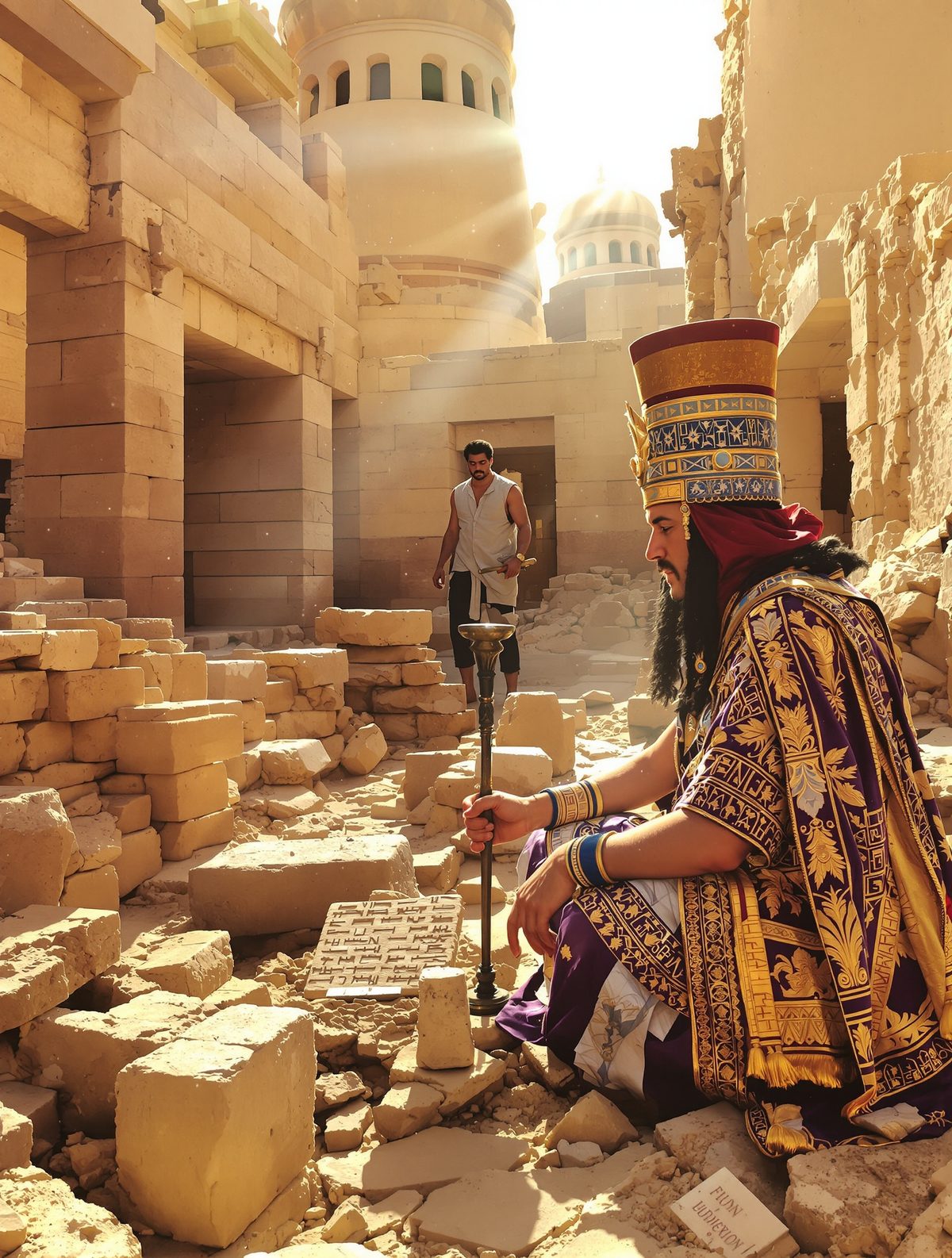
Picture this: the greatest conqueror in human history lies dying in a Babylon palace, his vast empire stretching from Greece to India hanging in the balance. As fever consumes Alexander the Great in June 323 BC, his generals frantically whisper about succession. The obvious heir—Alexander's infant son—won't be born for months. In desperation, they turn to a man they'd spent decades ignoring: Arrhidaeus, Alexander's mentally disabled half-brother who had lived his entire life in the shadows of the Macedonian court.
Within weeks, this forgotten prince would be crowned King Philip III, ruler of the largest empire the ancient world had ever seen. The man who couldn't tie his own sandals now commanded armies that had conquered Persia, Egypt, and half of Asia. It was perhaps history's most unlikely coronation—and it would unleash six years of chaos that would tear apart everything Alexander had built.
The Forgotten Son of Philip II
Arrhidaeus entered the world around 357 BC as the son of Philip II of Macedon and a minor wife named Philinna. While his half-brother Alexander was being tutored by Aristotle and learning the arts of war and statecraft, Arrhidaeus remained largely invisible. Ancient sources describe him as suffering from some form of intellectual disability—possibly what we might today recognize as developmental delays or brain damage.
The exact nature of his condition remains one of history's medical mysteries. Some historians suggest he may have suffered from epilepsy, while others point to possible fetal alcohol syndrome or complications during birth. What we know for certain is that he was deemed unfit for the rigorous education expected of Macedonian princes. While Alexander was conquering Asia Minor at age 22, Arrhidaeus was still living quietly in the royal household, overlooked and underestimated.
Plutarch tells us that Arrhidaeus was actually quite physically capable and even showed flashes of intelligence, but that he had been deliberately "damaged" by Alexander's mother, Olympias, who allegedly poisoned him to eliminate competition for her son's inheritance. Whether this dark tale holds truth or represents ancient character assassination, it reveals how disposable Arrhidaeus seemed to the major players of his era.
A Throne Born of Desperation
When Alexander breathed his last on June 13, 323 BC, the Macedonian Empire faced an unprecedented crisis. Alexander had conquered territories spanning three continents but had failed to provide a clear succession plan. His generals—the powerful Diadochi—gathered in the sweltering heat of Babylon to decide the fate of millions.
The infantry, representing traditional Macedonian values, demanded that the throne pass to Arrhidaeus as Philip II's legitimate son. The cavalry and nobility preferred to wait for Alexander's unborn child by Roxana, his Bactrian wife. After heated debates that nearly erupted into civil war within the palace walls, they reached a compromise that would have been laughable if it weren't so desperate: Arrhidaeus would become king immediately, but if Roxana bore a son, they would rule jointly.
On a scorching summer day in 323 BC, Arrhidaeus was crowned Philip III in a ceremony that must have bewildered him as much as it did the watching world. The man who had never commanded so much as a household guard now theoretically controlled armies stretching from Macedonia to the Indus River. The crown that had sat on the heads of Philip the Great and Alexander the Conqueror now rested uneasily on a prince who struggled to understand the political machinations swirling around him.
The Ultimate Puppet King
Philip III's reign was kingship in name only—he became history's most powerful puppet. Real authority rested with his regent and the various generals who carved up administrative control of the empire. Yet in a strange twist of fate, this very powerlessness may have initially protected him. Unlike his more capable relatives, he posed no direct threat to the ambitious Diadochi.
The newly crowned king was assigned a wife for political purposes: Eurydice III, a fierce and intelligent woman who was actually Alexander's great-niece. This marriage, arranged in 321 BC, would prove to be one of the most fascinating partnerships in ancient history. While Philip III remained largely passive, Eurydice seized every opportunity to assert royal authority, essentially attempting to rule through her husband's legitimacy.
Contemporary accounts describe Philip III dutifully attending state ceremonies and public appearances, where he would stand regally while others spoke for him. In many ways, he became the perfect figurehead for an empire that was already fracturing—present enough to maintain the illusion of continuity with Alexander's legacy, but absent enough not to interfere with the real business of power.
Watching an Empire Crumble
From 323 to 317 BC, Philip III presided over the systematic dismantling of his half-brother's achievements. The Wars of the Diadochi erupted almost immediately, as Alexander's former generals fought brutal campaigns across the Mediterranean and Asia for control of various territories.
Antigonus claimed Asia Minor and much of the eastern territories. Ptolemy secured Egypt and began establishing what would become the Ptolemaic Dynasty. Seleucus carved out the massive Seleucid Empire in the east, while Cassander fought for control of Macedonia itself. Each claimed to act in the name of Philip III and the young Alexander IV (Roxana's son, born shortly after Alexander's death), but in reality, they were building personal kingdoms from the corpse of the unified empire.
Philip III likely understood little of these grand strategic maneuvers, but he would have witnessed their immediate effects: endless military preparations, constant movement of the court, and the gradual disappearance of the unity that had defined Alexander's reign. The king who had inherited the world's largest empire watched it shrink daily as his supposed subordinates declared independence in all but name.
The Queen Who Tried to Rule
By 317 BC, Eurydice had grown tired of being married to a powerless king while the empire dissolved around them. In a bold move that shocked the Macedonian world, she began asserting royal authority in her own right, making political alliances and issuing commands to military units. She effectively attempted to rule the empire through her husband's legitimacy while sidelining the established regency.
This power grab put her directly in conflict with Olympias, Alexander's mother, who had returned from exile in Epirus. The two queens represented different visions for the empire's future—Eurydice advocating for a more assertive Macedonian monarchy, while Olympias fought to preserve the regency system that protected her grandson Alexander IV's eventual inheritance.
The confrontation came to a head when their armies faced each other in Macedonia. In one of history's most dramatic moments, Olympias appeared before the troops wearing Alexander's royal regalia and invoked his memory. The soldiers, many of whom had served under the great conqueror, refused to fight Alexander's mother. Eurydice and Philip III were captured without a battle.
A King's Quiet End
Philip III's death in 317 BC was as understated as his life had been. Olympias, ruthless in protecting her family's legacy, ordered both Philip III and Eurydice killed. According to Plutarch, Eurydice was given a sword, a noose, and poison, and told to choose her method of death—she chose hanging. Philip III was executed quietly, ending the reign of perhaps history's most reluctant king.
In death, Philip III achieved what had eluded him in life: he became a symbol. His murder sparked outrage among Macedonians who saw it as the final breakdown of royal legitimacy. Cassander used this anger to justify his own bid for power, eventually hunting down and killing both Olympias and, later, the young Alexander IV.
The disabled king who had outlived Alexander's empire by six years had, in his passive way, witnessed and symbolized its complete transformation. The unified world-spanning kingdom that Alexander had forged through conquest and charisma fragmented into the Hellenistic kingdoms that would dominate the Mediterranean for centuries.
Philip III's story offers a haunting reminder that history often turns on the decisions of reluctant leaders thrust into impossible circumstances. In our modern era of global uncertainty and fractured institutions, perhaps there's something to learn from the king who inherited everything and understood that he controlled nothing—except his own quiet dignity in the face of forces far beyond his comprehension or control.