The man responsible for one of the most ingenious tactical maneuvers in the American Revolutionary War wasn't a seasoned military theorist. He was a former teamster with a strong will and an uncanny intuition for battle.
Setting the Stage: The Unlikely Strategist
Daniel Morgan was not your typical military leader. Born in 1736, he learned the art of strategy not in military academies, but on the unforgiving frontiers of early America. Known for his brute strength and unyielding determination, Morgan's reputation among the ranks was sealed on constant show of courage. He developed an eye for the quirks of human nature and a nose for opportunity, which he would use to great effect on a pivotal day—January 17, 1781.
The Revolutionary War was turning into a war of attrition in the South. British forces, under the leadership of Lord Cornwallis, sought to consolidate their grip, banking heavily on cavalry commander Banastre Tarleton's feared reputation. Known as "Bloody Ban" for his ruthlessness at the Battle of Waxhaws, Tarleton was confident, perhaps overly so, in his ability to crush the American rebellion.
The Lure: Building a Battlefield
Morgan was stationed in South Carolina tasked with the protection of the patriots in the South. He was acutely aware of Tarleton's tendencies—his aggressive style, his disdain for colonial forces, and, crucially, his arrogance. Morgan planned to use this overconfidence against him.
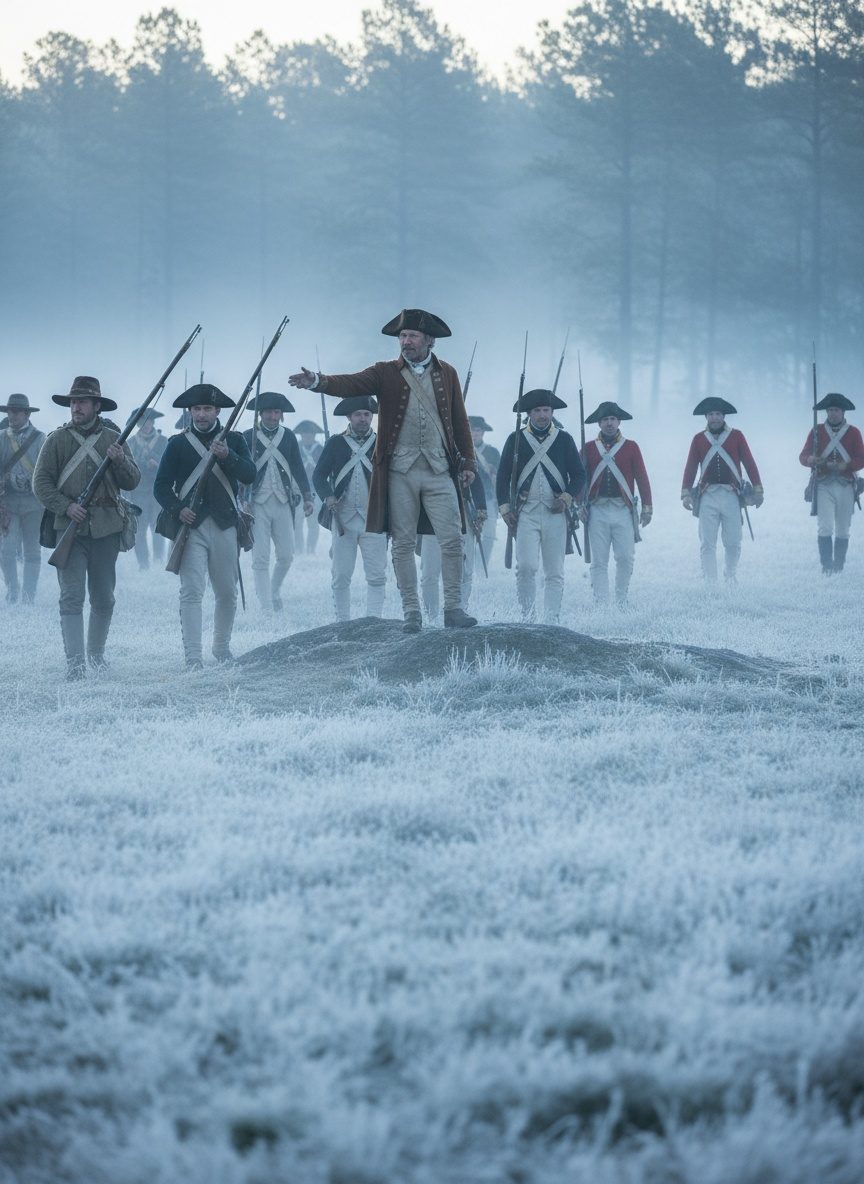
The site was a cattle pasture known as Cowpens, characterized by its open fields surrounded by sparse trees. The battlefield Morgan envisioned was one that seemed to offer a strategic advantage to Tarleton: a position that appeared weak and easily assaultable. Morgan arranged his militia men at the front, historically known to be unreliable in prolonged engagements, creating what looked like a thin, fragile line ready to snap.
Behind this line stood his Continental regulars, bolstered by experienced sharpshooters. His cavalry waited in strategic reserve, hidden in the folds of the gently rolling landscape, ready to strike. As dawn broke on that January day, the scene was set for a deliberate deception.
Caught in the Tangle: Tarleton's Charge
Tarleton advanced with confidence, leading his 1,100-strong force toward what he believed would be a swift victory to claim. As the British approached, Morgan's front-line militia executed their orders with precision. They fired two volleys, then, in apparent retreat, turned and fled. Tarleton took the bait, convinced of the militia's cowardice, and ordered his troops forward.
Yet, the unfolding chaos was a ruse. Morgan's forces maneuvered into position. As Tarleton's troops surged forward, they suddenly found themselves ensnared in Morgan’s trap. The Continental soldiers held their ground steadfastly, turning the attacker's momentum back upon them in a lethal reversal. The British line faltered under a punishing crossfire.
In the ensuing melee, Morgan's cavalry, led by William Washington, a cousin of George Washington, thundered into the fray from behind the British, completing the encirclement. The perfectly executed double envelopment shattered Tarleton's ranks, leaving him with no choice but to retreat as his force disintegrated around him.
The Tide Turns: Implications of Cowpens
In less than an hour, Tarleton's forces lay decimated. Two hundred seventy soldiers were killed or wounded, and more than another five hundred were captured. Morgan's tactical masterpiece at Cowpens was a sobering lesson in the perils of hubris. The battle was a pivotal turning point in the Southern campaign, marking the beginning of the end for British ambitions in the Carolinas.
For many, the Battle of Cowpens was more than a tactical victory. It was proof that American forces, even without formal training, could outsmart and outfight the most imposing armies. Morgan's understanding of psychology and terrain—his ability to make the lie seem real and the real seem a lie—was revolutionary. He demonstrated that war does not always favor the strongest or most conventional, but rather, those who can turn their very weaknesses into strength.
The triumph at Cowpens reshaped the dynamics of the war, weakening British capabilities and morale. It was not just a battle won, but a foundational story in the narrative of American independence—one that underscored the power of ingenuity and resolve against might. As Daniel Morgan faded into the backdrop of history, his legacy as the strategist who turned Tarleton's arrogance against him remains a testament to the broader revolutionary spirit of American resilience.