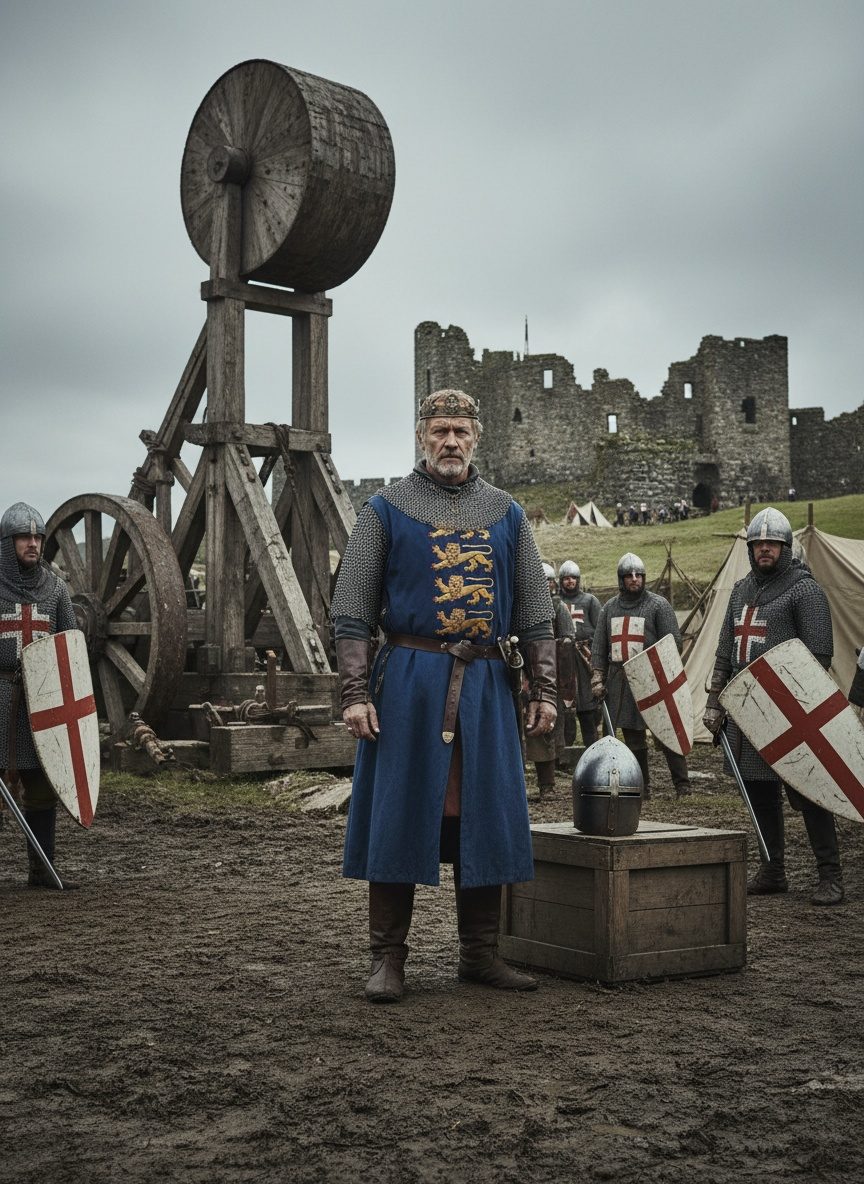
July 20, 1304. The sunlight glinted off the towering stone walls of Stirling Castle, casting long shadows over the Scottish countryside.
The King and His Siege
In the year 1304, tension hung heavily over Scotland. Edward I of England, known as "Longshanks" for his formidable height and presence, was at the peak of his campaign to bring Scotland to heel. The struggle for power had become a bitter, ongoing clash, dotted with battles and sieges, each leaving their indelible mark on the landscape and the people.
Among the intimidating war machines of the medieval period, none commanded more awe or dread than the trebuchet—massive, lumbering wooden behemoths capable of hurling boulders with devastating force. Edward had invested considerable time and resources into the creation of the War Wolf, a trebuchet the likes of which had never been seen before. Its construction drew from the minds of England's greatest engineers—an object of both terror and wonder.
Standing against him was Stirling Castle, sitting atop its rocky crag like an untamed sentinel. The keep was one of the few remaining Scottish strongholds resisting Edward's advance. Its garrison, probably exhausted and staring down the barrel of inevitable defeat, was prepared to make terms—until they too encountered the War Wolf.
The Making of a Monster
Stirling Castle's determination to resist had prompted Edward to unleash his monstrous creation. Over months, Edward’s men toiled at assembling the War Wolf, its skeleton rising like a vast wooden cathedral. Measuring over 300 feet in its arm span, the trebuchet demanded the collective might of numerous men to load and operate. It was, by all accounts, an unprecedented feat of medieval engineering.
The very concept of the War Wolf was as much psychological warfare as it was physical. As the behemoth took shape, those watching from the castle would have felt a palpable shift in the air—a mix of dread and reluctant admiration. It was said that the mere sight of this colossal siege engine was enough to shake the morale of any defender, instilling a certainty that resistance was futile.
While trebuchets were nothing new in the art of war, War Wolf was a project of single-minded vision and obsession by Edward. Some say he sought validation not just in conquest, but in the mastery of engineering, a demonstration of dominion not just over armies but over the very principles of physics and craftsmanship.
The Refusal to Accept Peace
As construction neared completion, the defenders of Stirling Castle, likely realizing the inevitability of their defeat, came forth under truce to express their willingness to surrender. Such an outcome would have been a strategic victory for Edward, swift and without unnecessary bloodshed. Yet, against all expectations, Edward refused. He had not yet fired the War Wolf.
This decision was not merely born of cruelty or a desire to humiliate the enemy further. It was the culmination of a campaign of mental and material warfare, and perhaps a deeply personal need to see this triumph of engineering realized. The King reportedly wanted to see his momentous creation unleash its power, a vision that had begun as mere sketches and calculations, now on the cusp of a deafening debut.
Edward ordered his men to prepare. Stones were loaded, ropes were tightened, and every man involved braced for the War Wolf's mighty swing. With a motion that must have seemed both woeful and grand, the first boulder was released into the sky, hurtling toward the castle walls with a sound that echoed through the ages—an unyielding roar of wood and stone.
The Unforgettable Lesson of War Wolf
The War Wolf lived up to its fearsome reputation. It systematically demolished the fortress's defenses, sending shockwaves through not just the physical structure, but the psyche of all who beheld its might. This scene has nested itself in the annals of history as an example of technology's profound impact on the martial world, and on human lives caught in its wake.
Why does this moment in history matter? It's more than a tale of a siege engine masterminded by a stern king. It encapsulates the precarious dance of human innovation and its potential for both awe and devastation. The event invites reflection on the inscrutable nature of power, obsession, and the boundless drive for domination.
In the end, Edward’s actions at Stirling Castle underscore the complexities of leadership and the dual-edged sword of technological advancement. The War Wolf was dismantled once its job was done, its pieces scattered, yet the story of the giant that Edward refused to waste reverberates through history as a reminder of the vast constructs humankind is capable of when driven by singular ambition.