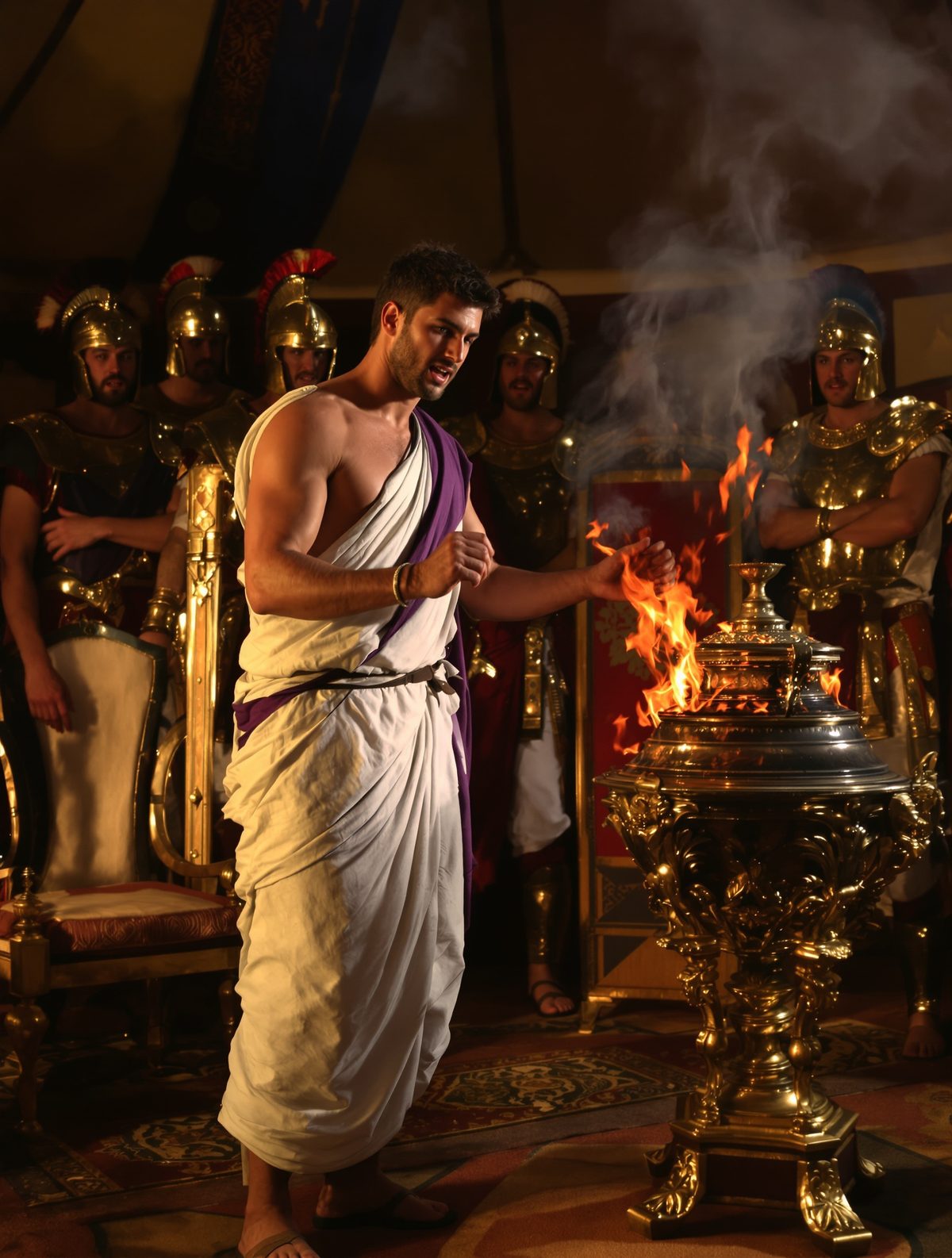
Picture this: You're a prisoner of war, sent by your captors to negotiate your own freedom. You stand before your own government with the power to save yourself with a single word. Instead, you argue passionately for your own death sentence. This isn't the plot of a Hollywood thriller—it's the true story of Marcus Atilius Regulus, a Roman general whose speech to the Senate in 255 BC became the most shocking act of self-sacrifice in ancient history.
The Carthaginians thought they were being clever. Send the captured Roman hero home to negotiate a prisoner exchange, and surely he'd argue for his own freedom. After all, what man wouldn't fight to save his own life? They had no idea they were dealing with someone who valued honor above breath itself.
The General Who Conquered Africa
Marcus Atilius Regulus wasn't just any Roman commander—he was a consul, one of Rome's two highest-ranking officials, and a military genius who had achieved what many thought impossible. In 256 BC, during the early years of the First Punic War, Regulus led a daring invasion force of 15,000 infantry, 500 cavalry, and 330 ships directly into the heart of Carthaginian territory: North Africa itself.
The audacity of the plan was breathtaking. While most of the war had been fought over Sicily, Regulus decided to take the fight to Carthage's doorstep. His fleet crossed the Mediterranean and landed near what is now Tunisia, catching the Carthaginians completely off guard. Within months, he had captured the city of Aspis and was marching toward Carthage itself, leaving a trail of destroyed cities in his wake.
For a brief, shining moment, it seemed like Rome might win the entire war in a single campaign. Carthaginian resistance crumbled before the Roman legions, and panic gripped the great trading city. Carthage even sent peace envoys to negotiate surrender terms. But here's where Regulus made his fatal mistake: his demands were so harsh—complete surrender, abandonment of Sicily, and crippling tribute payments—that the Carthaginians decided they'd rather die fighting than accept such humiliation.
When Victory Turned to Catastrophe
Desperate times called for desperate measures, and Carthage found salvation in an unexpected source: a Spartan mercenary named Xanthippus. This wasn't just any soldier-for-hire—he was a student of Spartan military doctrine, and he immediately spotted the fatal flaw in how the Carthaginians had been fighting the Romans.
The problem wasn't Carthaginian weakness; it was that they'd been fighting Rome's kind of war. Xanthippus convinced them to abandon the hills and broken terrain where Roman infantry excelled and instead fight on the flat plains where Carthage's superior cavalry and war elephants could dominate. It was a strategic revolution that would change everything.
In the spring of 255 BC, near the town of Tunis, the two armies finally met on Xanthippus's chosen ground. Regulus commanded roughly 15,000 Roman soldiers, battle-hardened veterans who had conquered half of North Africa. But as the morning mist cleared, they found themselves facing a terrifying sight: 100 war elephants flanked by 4,000 Carthaginian cavalry, with 12,000 infantry forming the center.
What happened next was a masterclass in tactical warfare. The elephants charged the Roman center while the cavalry swept around both flanks. The legendary Roman discipline that had conquered Italy crumbled under the assault. When the dust settled, only 2,000 Romans had escaped death or capture. Regulus himself was taken prisoner, along with 500 of his men—a catastrophic defeat that wiped out an entire Roman army in a single afternoon.
The Prisoner's Dilemma
For five long years, Marcus Regulus languished in Carthaginian dungeons. But in 250 BC, the Carthaginians hatched what they thought was a brilliant scheme. They would send Regulus back to Rome as their ambassador, with a proposal for a prisoner exchange and peace negotiations. The catch? He had to swear a sacred oath to return to Carthage if the negotiations failed.
The plan seemed foolproof from Carthage's perspective. Regulus would naturally argue for his own freedom and the release of other Roman prisoners. Even if he didn't explicitly advocate for peace, his mere presence would remind the Senate of what they had lost and make them more amenable to negotiations. After all, what man wouldn't seize the chance to save himself?
But the Carthaginians fundamentally misunderstood Roman culture. To Romans of Regulus's generation, honor wasn't just important—it was everything. Death with honor was infinitely preferable to life with shame. And Regulus had already decided that Rome's interests outweighed his own survival.
The journey from Carthage to Rome must have been agonizing for the former consul. He knew he was traveling toward his own death sentence, yet he never wavered from his chosen path. When he finally reached the eternal city, crowds gathered to welcome home their hero. They had no idea what he was about to tell them.
The Speech That Defied Death
On the day Marcus Regulus addressed the Roman Senate, every member knew they were witnessing history. Here stood one of their greatest generals, a man who had brought Rome to the brink of total victory, now gaunt from five years of captivity. Surely he would argue for his freedom, for prisoner exchanges, perhaps even for peace with honor.
Instead, Regulus delivered the most shocking speech in Roman political history. Standing before the assembled senators, he systematically destroyed every argument for his own salvation. The prisoners Carthage offered to exchange? Worthless compared to what Rome would have to give up in return. A peace treaty? Impossible while Carthage remained strong enough to threaten Roman interests. The war must continue, regardless of the personal cost.
But here's the detail that makes this story even more incredible: Regulus didn't just argue against the prisoner exchange—he refused to enter the Senate house itself. Because he was technically still a prisoner of war, he argued that he was no longer worthy to participate in Roman governance. He delivered his death sentence while standing outside the building where he had once held the highest office in the Republic.
The senators were stunned. Some tried to convince him to break his oath to Carthage and remain in Rome. Others argued that oaths made under duress weren't binding. But Regulus was unmovable. He had given his word, and a Roman's word was sacred—even when given to enemies, even when it meant certain death.
The Price of Honor
When Marcus Regulus returned to Carthage, the Carthaginians were furious. Their clever diplomatic gambit had backfired spectacularly. Not only had they failed to secure peace or prisoner exchanges, but they had actually strengthened Roman resolve for war. In their rage, they subjected Regulus to tortures that shocked even the ancient world.
According to Roman historians, the Carthaginians cut off his eyelids and forced him to stare at the blazing sun until he went blind. They locked him in a box studded with spikes, making sleep impossible. Some accounts claim they rolled him down a hill in a barrel lined with nails. Whether all these details are accurate remains debated, but the message was clear: Carthage wanted to make an example of the man who had defied them.
Yet even in death, Regulus achieved a kind of victory. His story became legendary throughout Rome, inspiring generations of soldiers and citizens to value honor above life itself. The tale was retold by everyone from the poet Horace to the philosopher Cicero. Roman mothers would tell their children about the general who chose death over dishonor.
The war itself would continue for another fourteen years, ultimately ending in Roman victory. Carthage would be forced to pay massive indemnities and abandon Sicily forever. In a sense, Regulus's sacrifice helped secure the very victory he died for.
Why This Ancient Story Still Matters
In our modern world of flexible ethics and situational morality, the story of Marcus Regulus seems almost incomprehensible. Who would choose torture and death over a comfortable retirement? Who would honor an oath made to enemies who had already proven their cruelty?
But perhaps that's exactly why this 2,300-year-old story remains so powerful. In an age where public figures routinely break promises and abandon principles for personal gain, Regulus stands as a reminder that some people once believed there were things more important than survival itself. His story challenges us to consider what principles we would die for—and whether we have any principles worth living for.
The Carthaginians thought they understood human nature when they sent Regulus to Rome. They assumed that self-interest would triumph over duty, that personal survival would outweigh public service. They learned too late that they were dealing with a man who belonged to a different moral universe entirely—one where honor was worth more than life itself. In the end, Marcus Regulus got exactly what he chose: immortality through sacrifice, and a legacy that outlasted the very empire that killed him.