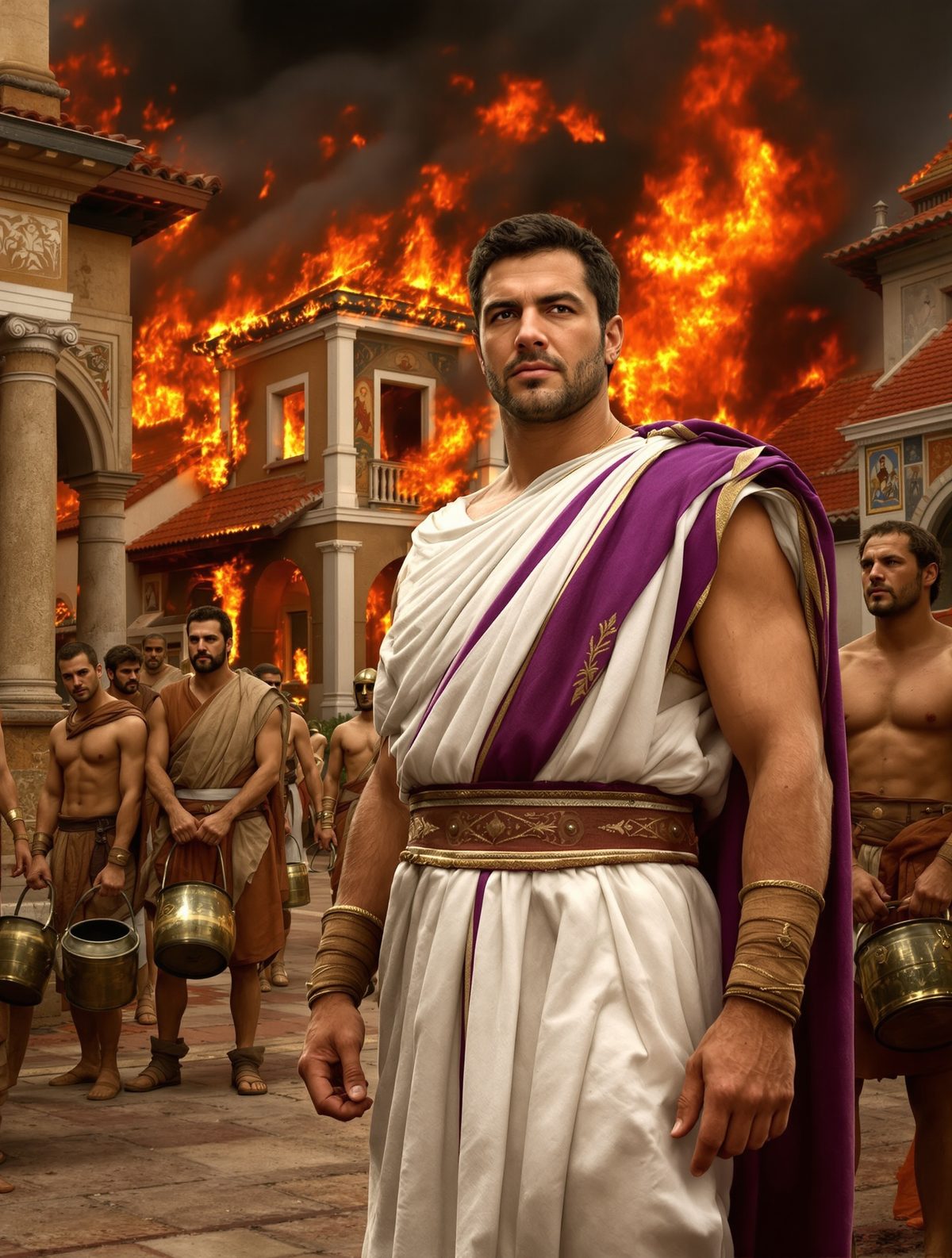
Picture this: You're a Roman merchant's son aboard a grain ship in 87 BC, watching Greek divers haul up what looks like a corroded lump of bronze from a recent shipwreck. You toss it aside with the other "junk," never suspecting you've just discarded the most sophisticated piece of technology that won't be seen again for over a millennium. What you've thrown away is humanity's first computer—a machine so advanced that when archaeologists finally crack its secrets 2,000 years later, they'll question everything they thought they knew about ancient intelligence.
The Treasure Hunter's Paradox
In October 1900, a team of Greek sponge divers took shelter from a storm near the tiny island of Antikythera, caught between mainland Greece and Crete. Captain Dimitrios Kondos sent diver Elias Stadiatis down to check for sponges in the crystal-clear waters. What Stadiatis saw when he hit the seafloor at 150 feet nearly made him lose his breathing apparatus.
Rising from the sandy bottom like a scene from a fever dream were bronze arms, marble torsos, and the ghostly remains of a Roman cargo ship that had sunk over 2,000 years earlier. The wreck was a floating museum of ancient art—bronze statues of philosophers, marble figures of gods, luxury goods destined for Roman elites who would never receive them.
But buried among the obvious treasures was something far more extraordinary: a shoebox-sized chunk of corroded bronze and wood, split into fragments and covered in mysterious gear wheels. The archaeologists catalogued it as simply "Item 15087." For decades, this unassuming artifact would sit in storage at the National Archaeological Museum in Athens, its true nature hidden beneath layers of marine growth and oxidation.
It wasn't until 1951 that British science historian Derek J. de Solla Price took a serious look at the fragments and realized he was staring at something impossible: the remains of an ancient Greek computer.
Gears Within Gears: Decoding the Impossible
What Price discovered defied everything historians believed about ancient technology. Hidden within the corroded bronze were at least 37 meshing gear wheels, precisely cut and arranged in a complex system that wouldn't be seen again until medieval astronomical clocks appeared in European cathedrals around 1300 AD. But this machine was 1,400 years older.
Using X-ray tomography and advanced imaging techniques that would make a CSI team jealous, modern researchers have painstakingly reverse-engineered the Antikythera mechanism. What they found was breathtaking: a bronze machine about the size of a laptop computer, operated by a hand crank, that could predict the positions of the sun, moon, and planets with stunning accuracy.
The gear ratios were masterfully calculated. The main solar gear had 365 teeth—one for each day of the year. The lunar calendar gear incorporated the 19-year Metonic cycle, accounting for the complex relationship between solar and lunar calendars. Most remarkably, the mechanism could predict eclipses decades in advance, track the four-year cycle of the Olympic Games, and even account for the elliptical orbit of the moon—a level of astronomical sophistication that wouldn't be "rediscovered" until Kepler's work in the 1600s.
The precision was extraordinary. The gear teeth were cut to tolerances of 0.1 millimeters—work that required master craftsmen using techniques we're still trying to understand.
The Ancient Silicon Valley
So who built this marvel? The answer takes us to the intellectual powerhouse of the ancient world: Rhodes. In the 1st century BC, this island was home to the most advanced astronomical school in the Mediterranean, where Greek engineers combined theoretical mathematics with practical craftsmanship in ways that wouldn't be seen again for centuries.
The mechanism's construction points to a workshop culture where master artisans worked alongside brilliant mathematicians. Think of it as ancient Greece's version of Silicon Valley—a place where cutting-edge theory met innovative engineering. The bronze work required techniques for cutting precise gear teeth, probably using file-based methods that demanded extraordinary skill and patience.
Evidence suggests this wasn't a one-off creation. Inscriptions on the device reference user manuals, implying there were multiple units and trained operators. This was technology in production, not just a clever prototype. Cicero wrote about similar devices owned by the Roman general Marcellus, describing mechanical models of celestial movements that could demonstrate eclipses and planetary motion.
The Roman ship carrying our mechanism was likely transporting luxury goods and scientific instruments from Greek workshops to wealthy Roman collectors—ancient technology transfer in action.
The Knowledge That Vanished
Here's what makes the Antikythera mechanism so haunting: the knowledge to build it completely disappeared. By 500 AD, the techniques for creating such precise bronze gear work had vanished. The mathematical understanding of planetary cycles was lost. The workshop traditions died out.
This wasn't gradual decline—it was technological amnesia on a civilizational scale. The fall of the Roman Empire, the rise of Christianity with its sometimes skeptical view of pagan learning, economic collapse, and the gradual breakdown of Mediterranean trade networks all contributed to one of history's greatest brain drains.
Islamic scholars preserved much Greek astronomical knowledge, but they seem to have worked with the theoretical texts, not the mechanical engineering traditions. The hands-on craftsmanship that could cut 37 precisely meshing gears from bronze became extinct, not to be reinvented until medieval European clockmakers began creating astronomical clocks.
It's as if we discovered that ancient Rome had somehow built smartphones, used them for centuries, then completely forgot how they worked. The Antikythera mechanism represents a road not taken—a glimpse of a technological timeline that was severed and wouldn't reconnect for over a millennium.
Rewriting the History Books
The implications are staggering. For centuries, we've told the story of human technological progress as a steady climb from primitive to sophisticated. The Antikythera mechanism shatters that narrative. It proves that ancient Greeks achieved a level of mechanical sophistication that Renaissance Europeans would have considered miraculous.
Modern attempts to recreate the device using period-appropriate techniques have given researchers new respect for ancient craftsmanship. Building just the gear-cutting tools requires master-level metalworking skills. Creating the precise astronomical calculations demands advanced mathematical knowledge. Combining both into a working machine represents a level of interdisciplinary collaboration that rivals modern engineering projects.
The mechanism also forces us to reconsider ancient attitudes toward technology and nature. This wasn't just an impressive gadget—it represented a worldview that saw celestial movements as predictable, mathematical, and mechanically modelable. In bronze gears and careful calculations, ancient Greeks encoded a vision of the universe as an elegant, comprehensible machine.
The Computer Before Computers
Today, as we grapple with artificial intelligence and quantum computing, the Antikythera mechanism offers a humbling reminder: human ingenuity has always found ways to exceed expectations. Those ancient Greek craftsmen, working with bronze and hand tools, created something that would fit comfortably in a modern engineering museum.
But perhaps the mechanism's greatest lesson isn't about ancient achievement—it's about the fragility of knowledge itself. In our digital age, when information seems permanent and progress inevitable, the story of this 2,000-year-old computer reminds us that even the most sophisticated technologies can vanish without trace. Civilizations rise, knowledge accumulates, and then—sometimes—it all disappears, waiting in the darkness for rediscovery.
The Antikythera mechanism survived only by accident, protected by Mediterranean salt water and chance discovery. How much other ancient knowledge lies lost forever, never to be recovered? And what irreplaceable wisdom might our own civilization lose if we're not careful to preserve not just our digital files, but the human skills and understanding that make them meaningful?
In the end, this corroded bronze computer is more than an archaeological marvel—it's a mirror that reflects both our potential for brilliance and our capacity for forgetting. The Greeks who built it were, in all the ways that matter, exactly as intelligent as we are. They simply lived in a different chapter of humanity's long, complicated relationship with knowledge, discovery, and loss.