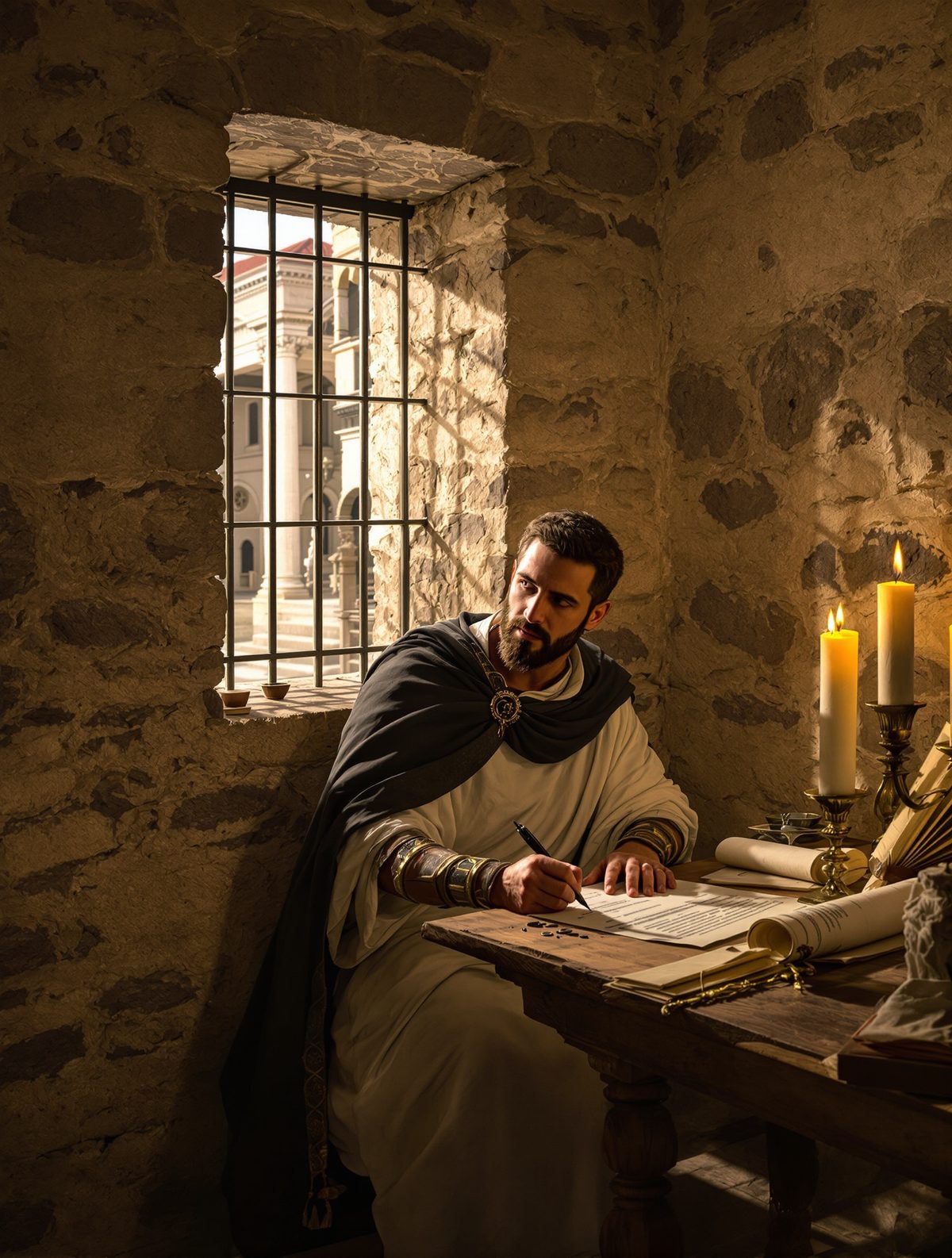
Imagine being so thoroughly outmaneuvered by your political rival that your only remaining strategy is to lock yourself in your bedroom and scream at the world through angry letters. This was the spectacular fate of Marcus Calpurnius Bibulus, one half of Rome's most dysfunctional consulship, who spent 59 BC cowering in his own house while Julius Caesar single-handedly ran the Roman Republic into the ground—or into greatness, depending on your perspective.
In what would become one of the most bizarre episodes in Roman political history, Bibulus chose voluntary house arrest over facing Caesar's steamroller tactics in the Forum. For ten months, Romans joked that they didn't have two consuls named Caesar and Bibulus—they had one consul named Julius and Caesarius. The joke stung because it was essentially true.
The Odd Couple of Roman Politics
The year 60 BC had seen Julius Caesar return from his governorship in Further Spain with triumph on his mind and debts weighing heavy on his shoulders. Caesar faced a choice: he could either celebrate a triumph (a massive military parade through Rome) or run for consul. Roman law prevented him from doing both, since entering the city for the triumph would end his military command and he'd have to declare his candidacy in person, giving his enemies time to prosecute him for his debts.
Caesar chose power over pageantry. He skipped the triumph and ran for consul, winning election alongside Marcus Calpurnius Bibulus, a man who represented everything Caesar was not. Where Caesar was charismatic and populist, Bibulus was stern and traditional. Where Caesar courted the masses with bread and circuses, Bibulus believed in the ancient Roman virtues of discipline and restraint. They were political opposites thrust into the highest office of the Republic, forced to share power for an entire year.
What nobody anticipated was just how completely Caesar would dominate the partnership. Bibulus had been consul-elect, expecting the usual give-and-take of Roman politics. Instead, he found himself facing a political hurricane that would reshape the known world.
When Democracy Becomes a Blood Sport
The trouble began almost immediately when Caesar proposed his first major legislation: a land redistribution bill that would grant plots to Pompey's veterans and Rome's urban poor. It was exactly the kind of populist measure that made traditionalists like Bibulus break out in cold sweats. In the Senate, Bibulus and his ally Cato the Younger attempted to filibuster the bill to death, with Cato literally talking for hours to prevent a vote.
Caesar's response was characteristically bold: he bypassed the Senate entirely and took the bill directly to the popular assemblies. This wasn't technically illegal, but it shattered centuries of precedent. Roman governance relied on consensus and tradition, not constitutional technicalities. Caesar was essentially declaring war on the entire system of Roman politics.
When Bibulus attempted to intervene during the assembly vote on January 23, 59 BC, the situation turned violent. Caesar's supporters—likely organized thugs rather than random citizens—surrounded Bibulus in the Forum. Someone dumped a basket of excrement over his head. His fasces, the ceremonial bundles of rods that symbolized consular authority, were broken. Most humiliatingly of all, the crowd physically manhandled him, a sitting consul of Rome, and drove him from the Forum in disgrace.
For a proud Roman aristocrat like Bibulus, this public humiliation was worse than death. Roman culture prized dignitas—personal honor and public respect—above almost everything else. Bibulus had been stripped of both in the most public way possible.
The Great Sulk of 59 BC
Faced with the choice between enduring further humiliation or strategic retreat, Bibulus chose the nuclear option of Roman politics: he locked himself in his house and refused to come out. This wasn't a brief tantrum but a sustained political protest that lasted from early spring until the end of the consular year in December.
From his self-imposed exile, Bibulus waged a war of words against Caesar's administration. He issued a constant stream of proclamations and edicts, posted throughout the city, denouncing Caesar's actions as illegal and unconstitutional. These weren't dry legal documents but scorching political pamphlets filled with personal attacks and dire warnings about the death of the Republic.
Bibulus particularly focused on Caesar's alliance with Pompey and Crassus—the secret partnership that historians would later call the First Triumvirate. In his edicts, Bibulus accused Caesar of reducing the consulship to a puppet show, with the real power held by private citizens operating behind the scenes. He wasn't wrong, but his isolation made him appear weak rather than principled.
The situation became so absurd that Romans began dating their official documents not with the traditional formula "in the consulship of Caesar and Bibulus" but "in the consulship of Julius and Caesar," as if Caesar held both positions himself. The joke caught on so well that even official records sometimes used this mocking formula.
Caesar's Steamroller Continues Rolling
While Bibulus sulked at home, Caesar proceeded to ram through a legislative agenda that would have been impossible under normal circumstances. He passed his land law, confirmed Pompey's eastern settlements (providing massive financial relief to his ally), reduced the tax burden on Asian publicans (pleasing Crassus), and secured for himself the governorship of Gaul for an unprecedented five years.
Most shocking of all, Caesar managed to get these measures passed with minimal senatorial input. He had discovered that a determined consul could essentially rule Rome by appealing directly to the popular assemblies, bypassing traditional checks and balances entirely. It was a constitutional revolution disguised as business as usual.
Caesar even arranged advantageous marriages to cement his political alliances, giving his daughter Julia to Pompey despite their significant age difference. Every month that Bibulus remained in hiding, Caesar's power grew stronger and his position more unassailable.
The traditional Roman system assumed that both consuls would participate in governance, providing natural checks on each other's power. With Bibulus voluntarily removed from the equation, Caesar had a free hand to remake the Roman state according to his vision.
The Pathetic End of a Failed Protest
When Bibulus finally emerged from his house in December 59 BC, he found a Rome that Caesar had fundamentally transformed. The Republic still existed in name, but its informal constitutional constraints had been shattered. Caesar had proven that traditional Roman governance relied more on custom than law, and that custom could be swept away by someone bold enough to ignore it.
Bibulus had intended his house arrest as a dramatic protest that would shock Romans into opposing Caesar's autocratic behavior. Instead, his absence had simply made Caesar's job easier. Without a colleague to obstruct or even question his decisions, Caesar had enjoyed the closest thing to dictatorial power that Rome had seen in decades.
The year 59 BC marked a point of no return in Roman politics. Caesar's consulship demonstrated that the Republic's checks and balances could be defeated by someone willing to break with tradition and use force when necessary. The old guard's strategy of moral authority and constitutional propriety had proven utterly inadequate against Caesar's combination of popular appeal and political ruthlessness.
Why the Man Who Hid Matters Today
Bibulus's spectacular failure offers a timeless lesson about the fragility of democratic institutions. He represented the traditional belief that constitutional norms would somehow enforce themselves, that respect for precedent and proper procedure would naturally constrain ambitious politicians. Caesar proved this assumption catastrophically wrong.
In our own era of political polarization and institutional stress, Bibulus's story serves as a warning about what happens when one side tries to maintain decorum while the other side abandons all constraints. His year-long sulk in his bedroom might seem comical, but it represents the helplessness of traditional institutions when confronted with someone willing to break all the rules.
The Roman Republic didn't die in 59 BC, but Caesar's steamroller consulship began its terminal decline. Within a decade, Caesar would cross the Rubicon and plunge Rome into civil war. Within two decades, Augustus would become emperor and end the Republic forever. It all began with one man's decision to lock himself in his house rather than find a way to effectively oppose his partner's revolutionary agenda. Sometimes the most dramatic political gesture is also the most futile.