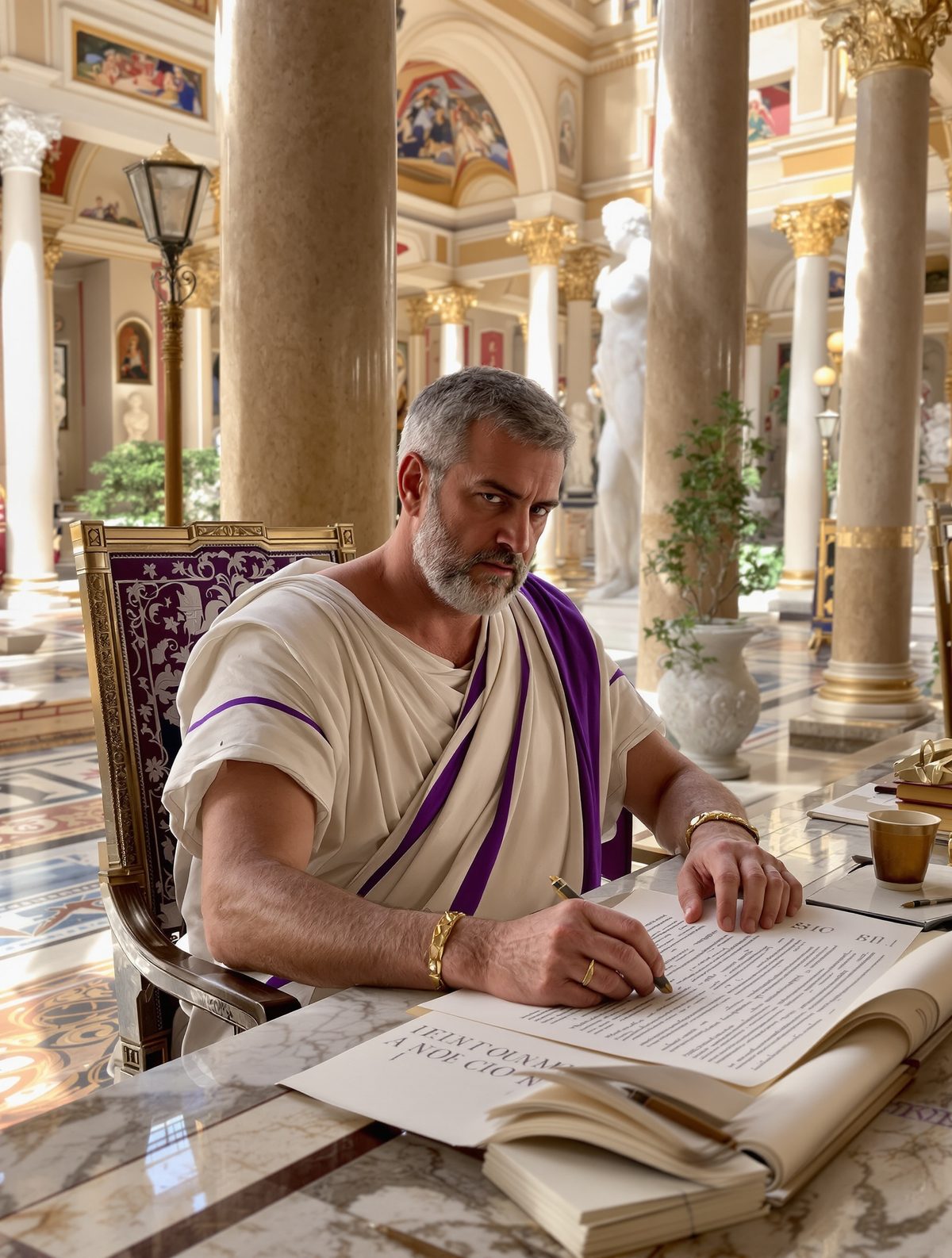
The marble floors of the Athenian courthouse echoed with sandaled footsteps as citizens gathered to witness something unprecedented. It was 430 BC, and the man standing trial wasn't a common criminal or political rebel—he was one of Athens' most respected intellectuals. Anaxagoras of Clazomenae, tutor to the great Pericles himself, faced a charge that would make modern scientists shudder: corrupting the youth and denying the gods. His crime? Teaching that the sun wasn't a divine chariot driven across the sky by Helios, but merely a massive, glowing rock larger than the Peloponnese peninsula.
In a city that prided itself on being the birthplace of democracy and rational thought, one man's scientific curiosity had become grounds for execution.
The Dangerous Mind That Explained Eclipses
Born around 500 BC in Clazomenae, a prosperous Greek colony in Asia Minor, Anaxagoras arrived in Athens during the city's golden age. This wasn't just any philosopher seeking wisdom—this was a man whose mind operated on a cosmic scale. While most Athenians looked up at the heavens and saw gods and mythology, Anaxagoras saw a vast laboratory waiting to be understood.
His revolutionary ideas began with a simple observation that would terrify the religious establishment. During a solar eclipse, when darkness swallowed the day and sent citizens rushing to temples in panic, Anaxagoras calmly explained that the moon was simply passing between Earth and the sun. No angry gods, no cosmic punishment—just celestial mechanics operating according to natural laws.
But Anaxagoras didn't stop there. He declared that the sun was a white-hot stone, approximately 35 miles across (a significant underestimation, but revolutionary for its time), and that the moon was made of earth and mountains, reflecting the sun's light. Even more scandalously, he suggested that the stars were distant suns, so far away they provided no heat. To drive the nail deeper into the coffin of traditional beliefs, he proclaimed that meteorites were chunks of rock falling from space—not messages from Zeus.
These weren't casual dinner party observations. Anaxagoras was systematically dismantling the entire Greek cosmology, replacing divine intervention with natural explanation. In a society where religious festivals marked the calendar and temple sacrifices governed daily life, this was nothing short of intellectual warfare.
The Mind Behind the Golden Age
What made Anaxagoras particularly dangerous to traditional thinking wasn't just his radical ideas—it was his influence. The philosopher had become the intellectual mentor to Pericles, the statesman who would transform Athens into the cultural and political powerhouse of the ancient world. For nearly thirty years, from around 460 to 430 BC, Anaxagoras operated as an unofficial advisor to the man who commissioned the Parthenon and championed Athenian democracy.
Imagine the conversations that must have taken place in Pericles' home overlooking the Acropolis. While artisans carved marble columns dedicated to Athena, the city's patron goddess, Anaxagoras was quietly explaining to its most powerful leader that the entire pantheon might be nothing more than human imagination. He introduced Pericles to the concept of nous—a cosmic mind or intelligence that set the universe in motion through purely natural processes, with no need for anthropomorphic gods hurling thunderbolts or driving chariots across the sky.
This intellectual relationship shaped Pericles' famously rational approach to governance. When other leaders consulted oracles and interpreted omens, Pericles made decisions based on logic and evidence. His confidence in facing down Sparta during the early stages of the Peloponnesian War reflected, in part, his mentor's teaching that natural phenomena followed predictable patterns rather than divine whims.
But this rational approach to leadership came with hidden costs. Pericles' political enemies couldn't attack him directly—he was too popular and powerful. Instead, they targeted those closest to him, and Anaxagoras presented a perfect opportunity.
When Science Became Sedition
The charges brought against Anaxagoras in 430 BC weren't unique to him alone. Athens was experiencing a wave of religious paranoia, driven partly by the pressures of war with Sparta and partly by conservative backlash against the city's increasingly secular intellectual culture. The formal accusation was asebeia—impiety or disrespect toward the gods—a charge that carried the death penalty.
The specific trigger for the trial appears to have been Anaxagoras' explanation of a meteorite that fell near Aegospotami around 467 BC. While witnesses described the terrifying celestial visitor in terms of divine portents, Anaxagoras matter-of-factly explained that such objects were simply stones that had broken off from other celestial bodies. He even predicted that similar events would occur again, following natural patterns rather than divine anger.
Standing before the court, Anaxagoras faced prosecutors who argued that his teachings undermined the very foundation of Athenian society. How could citizens honor Helios with proper sacrifices if they believed the sun was merely a rock? How could they respect Zeus if thunder was just a natural atmospheric phenomenon? In their view, Anaxagoras wasn't just wrong—he was dangerous.
The trial revealed a fundamental tension at the heart of Athenian civilization. The same city that celebrated rational discourse and philosophical inquiry also depended on religious traditions for social cohesion. Citizens who prided themselves on logical thinking during political debates still expected their philosophers to respect the gods who supposedly protected their city.
The Narrow Escape and Lasting Legacy
As the trial reached its climax, Pericles faced an agonizing choice. Standing by his mentor would mean political suicide during an increasingly unpopular war. Abandoning him would mean betraying the intellectual principles that had shaped his leadership. In a move that revealed both his loyalty and his pragmatic genius, Pericles engineered a middle path.
Rather than allowing the trial to reach its potentially fatal conclusion, Pericles used his political influence to arrange Anaxagoras' exile. The philosopher escaped Athens under cover of darkness, avoiding both execution and the public humiliation of recanting his beliefs. He settled in Lampsacus, a city in Asia Minor, where he continued teaching until his death around 428 BC.
But the damage to Athens' intellectual reputation was already done. The trial sent a chilling message to other philosophers and scientists: push too hard against religious orthodoxy, and even the most brilliant minds could face destruction. This intellectual climate would ultimately contribute to the execution of Socrates thirty years later, on remarkably similar charges.
From his exile in Lampsacus, Anaxagoras continued developing his theories about the natural world. He correctly explained why the Nile River flooded annually (snowmelt from distant mountains, not divine intervention), and he laid groundwork for atomic theory by proposing that all matter consisted of infinitely small particles he called "seeds." His students carried these ideas throughout the Greek world, influencing later giants like Democritus and eventually Aristotle.
The Ideas That Refused to Die
The supreme irony of Anaxagoras' persecution is that virtually every "blasphemous" idea he proposed turned out to be correct, or at least pointed in the right direction. The sun is indeed a giant burning mass (though powered by fusion rather than combustion). The moon does reflect solar light and causes eclipses through orbital mechanics. Meteorites are cosmic debris following natural trajectories. The stars are distant suns, exactly as he claimed.
More importantly, Anaxagoras established a revolutionary principle that would eventually transform human civilization: natural phenomena have natural causes that can be understood through observation and reasoning. This concept, which nearly cost him his life in 430 BC, became the foundation of modern scientific method.
His influence extended far beyond astronomy and physics. By arguing that intelligence (nous) operated through natural laws rather than arbitrary divine intervention, Anaxagoras helped establish philosophical traditions that would eventually support democratic governance, individual rights, and rational education. The man who fled Athens in disgrace had planted intellectual seeds that would bloom into the Enlightenment.
Why This Ancient Trial Still Matters
Today, as we debate the role of science in public policy and education, Anaxagoras' trial offers a sobering reminder of how easily societies can turn against the knowledge they need most. His persecution wasn't driven by ignorance or malice, but by fear—fear that new understanding would undermine social stability and traditional values.
The Athenians who condemned Anaxagoras weren't fools. They were intelligent people caught between competing visions of truth, struggling to maintain community cohesion while processing revolutionary ideas. Their dilemma reflects ongoing tensions between scientific advancement and cultural tradition, between individual discovery and collective belief.
Perhaps most remarkably, Anaxagoras' story demonstrates that the most dangerous ideas are often the most important ones. His "blasphemous" claim that natural phenomena follow natural laws ultimately liberated humanity from the capricious rule of imaginary gods, enabling the scientific progress that shapes our modern world. The philosopher who barely escaped execution for teaching about the sun had lit an intellectual fire that would never be extinguished.