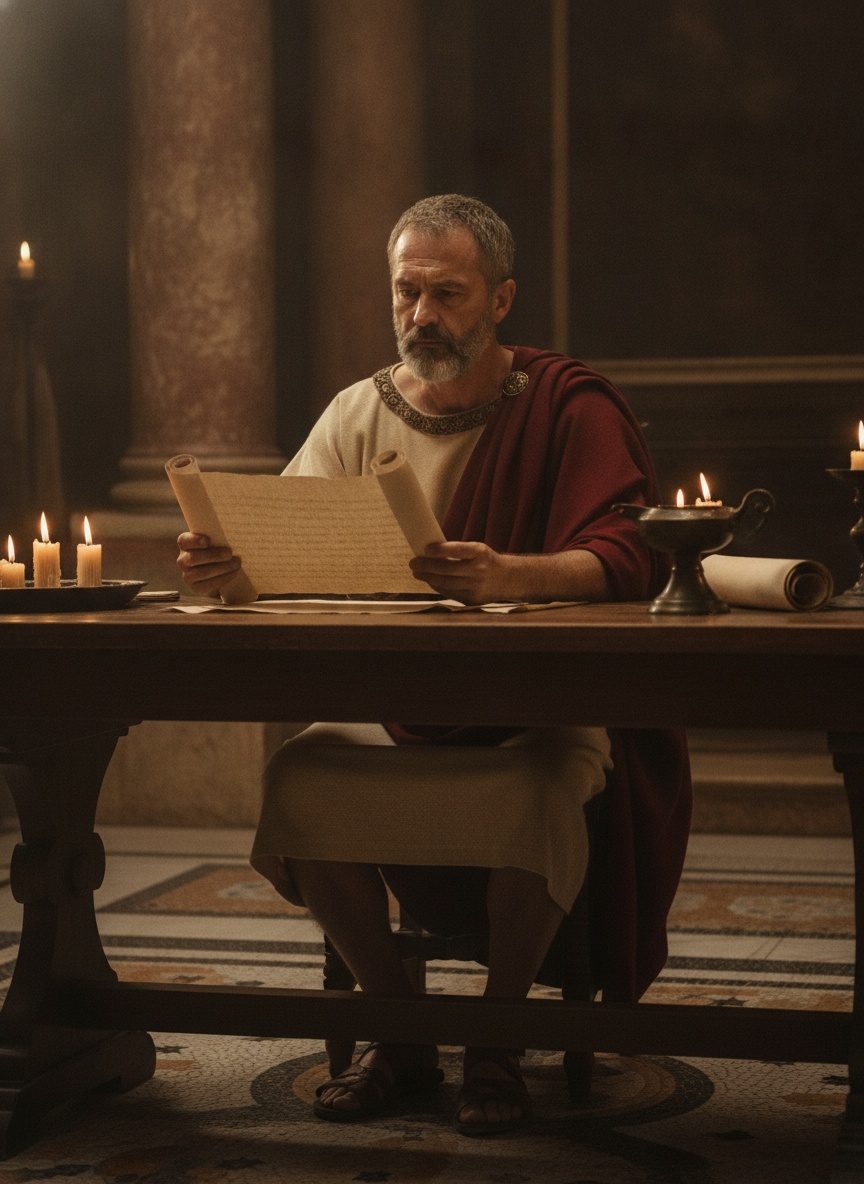
A murmur rustled through the chamber as Marcion of Sinope stepped forward, his sandals echoing off the worn stone floor of the Roman basilica. In his hands he clasped a list of texts—books he believed should be the sacred cornerstone of all Christian belief. He was no ordinary petitioner; Marcion was wealthy, a shipowner by trade, his coffers filled with the profits of commerce that flowed through the bustling ports of Pontus. His eyes, sharp and determined, met those of the Roman Christian leaders gathered before him. The room held its breath.
This moment in 144 CE marked the beginning of a conflict that would ripple through centuries. Marcion's proposal was unprecedented: a fixed collection of writings to define a unified Christian doctrine. His canon included ten of Paul's epistles and a singular Gospel, one that he asserted must be untainted by Judaic influence. The Hebrews seemed to him gripped by a vengeful deity, a stark contrast to the loving God of Jesus. As he unfurled his vision before the church leaders, Marcion likely felt the weight of history on his shoulders, convinced of the righteousness of his cause. Yet, his grand design was met with suspicion, even outrage. This was heresy, they declared.
The bishops' rejection was swift. To them, Marcion's exclusion of the Hebrew Scriptures—the foundation stones of their faith—was nothing short of a sacrilege. Still, Marcion's approach raised a question that could not be ignored: if not his list, then what? The early Christian movement was a mosaic of diverse beliefs and interpretations, not yet solidified into an orthodoxy. Marcion was cast out, his ideas condemned, but his actions ignited a crucial realization within the early church. Between debating theology and discerning divine scripture, they began to understand the necessity of constructing a coherent canon, a task that would consume the church for nearly two hundred years.
As news of Marcion's audacious proposition spread, so too did his influence. He established his own communities, promising salvation through a novel understanding of Christ that appealed to those disenchanted with the conventional teachings. His church grew rapidly, stretching across the Roman Empire, a testament to the power and persuasiveness of his message. Meanwhile, in the inner circles of church authority, the battle for doctrinal purity intensified. With the aim of safeguarding tradition and maintaining unity, church leaders began the painstaking process of assessing the texts revered by the followers of the Way.
It's remarkable to consider that without Marcion, we might not have the Bible we recognize today. Spurred by what they saw as heretical extremism, the early church fathers painstakingly evaluated countless scrolls and letters circulating among the faithful. This was an era when Christianity was still underground, when believers huddled in shadows, debating the teachings and stories shared orally amongst themselves. Slowly, a consensus began to emerge, coalescing around a set of texts that balanced the Old Testament foundations with the new revelations of the Christian Gospel.
As decades slipped by, councils and synods deliberated, decisions etched onto papyrus and parchment. It was a colossal task fraught with complexity—the diversity of early Christian writings was as vast as the empire itself. Through tireless discourse, the church sought to distill the essence of faith, a narrative arc that both honored its Judaic roots and embraced the transformative message of Jesus. Yet, even as boundaries were drawn, voices from every corner of the Christian world clamored to be heard. The church fathers walked a delicate line: canonization required discernment without diminishing the richness of the Christian experience.
Efforts culminated in the eventual creation of the New Testament as we know it—a curated collection that stood as a pillar of orthodoxy. By the end of the 4th century, the church canon was largely settled. The final configuration sought by councils such as those at Hippo and Carthage solidified a testament that incorporated both the Hebrew Scriptures and a new covenant through Christ's teachings. Marcion’s shadow loomed over each decision—the response to his provocations was now ingrained in the teaching and identity of Christianity.
The irony could not be more profound. Once a castaway branded heretic, Marcion’s idea of establishing a canon had not only survived but triumphed in shaping early Christian identity. His name was largely forgotten, scrubbed from the annals as a cautionary tale of hubris. Yet, it was his rebellious spark that kindled a redefining of Christian scripture, ultimately leading to a book that would endure for millennia. The Church had not just reacted to Marcion's bold proposition; it had evolved because of it. His exclusions were ultimately rejected, but in the struggle to counter them, the church forged a testament much stronger than any single man could have envisioned.
Marcion’s story, though buried beneath layers of history, serves as a powerful reminder of the tensions that exist within belief and the resilience required to forge collective truth. Without intending to, he challenged the early Christians to look inward, to examine the essence of their beliefs, and to emerge with a blueprint for faith that would become one of humanity's most profound cultural touchstones. In a world so shaped by sacred texts, his audacious act of compiling a Bible is a fascinating snapshot of how ideas, even when deemed dangerous, can catalyze profound and lasting change. Perhaps it's in the echoes of his heresy that today's world finds part of its spiritual compass.