1200 AD. Dust settled quietly over the Ethiopian highlands, shrouding the landscape in a muted embrace.
A Vision in the Highlands
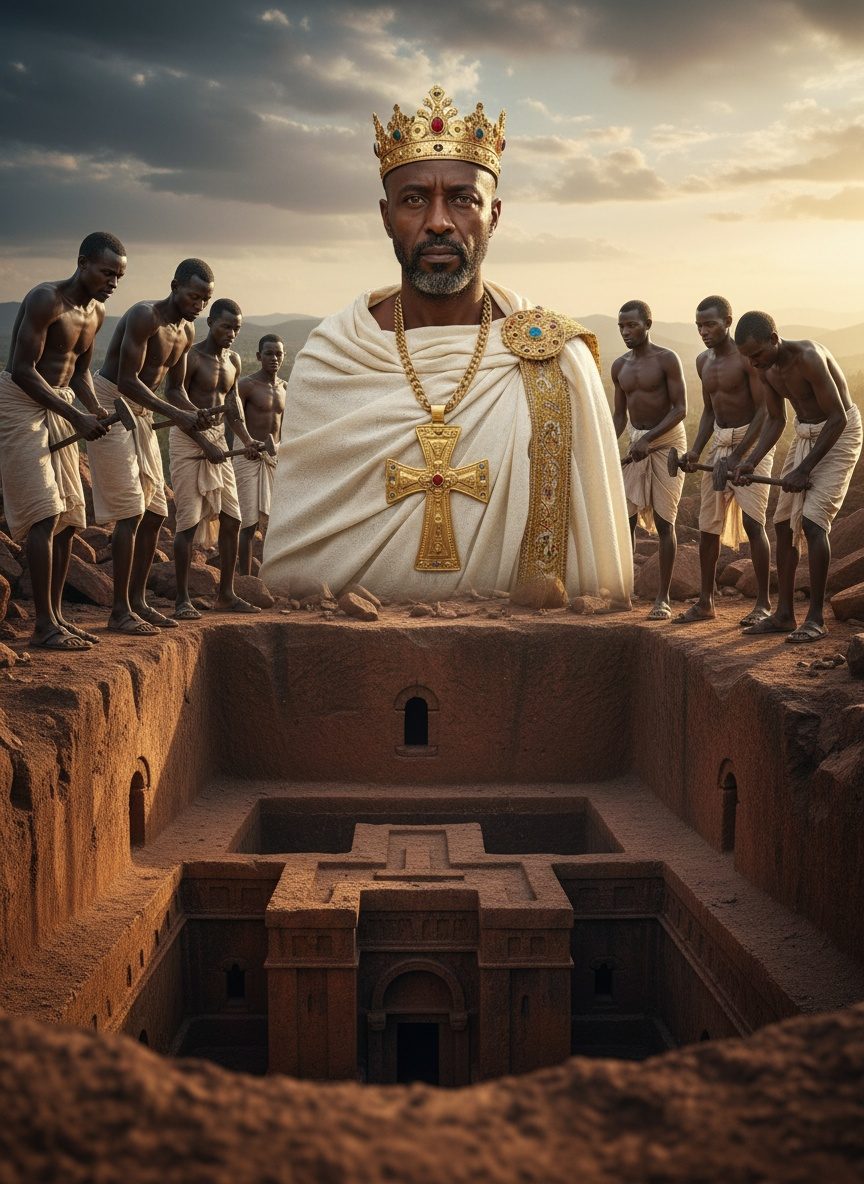
In an era where Europe reeled from the rise and fall of crusader kingdoms, a formidable dream was born under the clear skies of Ethiopia. King Lalibela, a monarch driven by a divine vision, cast his eyes over the rugged terrain of his kingdom. His mission was audacious, yet imbued with spiritual fervor: to carve a new Jerusalem from the living rock of his homeland, a sanctuary for his people amidst the turbulence of war-torn holy lands.
Situated in the mountainous highlands of modern-day Ethiopia, Lalibela's project was anything but conventional. Inspired by his pilgrimage to Jerusalem or perhaps by divine revelation itself, Lalibela envisioned not erecting churches from free-standing stones, but intricately carving them downwards from solid volcanic rocks. This was an undertaking as monumental in ambition as it was bizarre in execution.
The Ethiopian Orthodox Tewahedo Church, to which Lalibela dedicated much of his life, played a critical role in shaping his monumental undertaking. Christianity had reached Ethiopia centuries before, becoming a cornerstone of Axumite culture under King Ezana in the 4th century. Under Lalibela's guidance, it would find rock-solid expression in the form of sanctified structures, hewn directly from the earth itself.
The Labor of Sacred Carving
The vision, however divine, required the hands of many to transform hard rock into holy sanctuary. The artisans and laborers of Lalibela took to the task with religious zeal, their chisels and hammers shaping both faith and stone. Though the exact timeline of construction is lost to history, what survives is the sheer enormity of the endeavor.
The chiseling began with trenches, separating blocks from the surrounding rock. Craftsmen then carved intricate façades and carefully planned interiors directly into the stone, an architectural feat unmatched in their time. These were no mere caves, but elaborate structures complete with windows, doors, and even downscaled cathedrals.
The churches bore witness to a melding of artistic traditions, partaking in Byzantine and Axumite influences yet asserting their own particularly Ethiopian identity. Sacred crosses were etched into ceilings, while cruciform columns supported expansive naves. The laborious task required not only physical finesse, but a spiritual dedication that extended through the workforce like a lifeline.
The Fruits of Faith
Among the eleven rock-hewn churches, each symbolizes a facet of faith and craftsmanship but none more strikingly than Biete Ghiorgis—Saint George's Church. Fashioned in the form of a Greek cross, it stands isolated, cut into the earth and accessible only by a narrow chasm pathway. This solitary sanctum remains the crown jewel of Lalibela's holy pursuit.
This achievement is mirrored in the wider grouping of holy sites, reminiscent of a sprawled complex, evoking a spiritual journey akin to the stations of the cross. Each church is connected via a labyrinth of trenches and tunnels, facilitating pilgrims' meditative walks through this man-made wonder. Some paths lead not just horizontally but venture vertically, suggesting a physical ascension toward spiritual enlightenment.
The churches of Lalibela served not only as devotional spaces but as symbols of Ethiopian endurance. During an era plagued with external crusader pressures and the decline of once-great Empires, Lalibela's creation provided a haven for religious perseverance. It underscored the notion that faith need not flee before adversities but could instead root itself deeper, carved from the very heart of creation.
Survival of a Sacred Legacy
Over the centuries, the churches of Lalibela have withstood both natural and human threats. Wars and climatic changes have not displaced them, nor have the seismic shifts of geopolitical landscapes. And while guiding the construction of Christendom's stones into sky-reaching steeples became Europe's hallmark, Ethiopia's temples remained patiently immovable, anchored in their bedrock.
The passage of time transformed these churches into items of mystery and intrigue for the outside world, drawing travelers and pilgrims alike. In their persistence, they became encoded with the whispers of ancient rituals and prayers, silent guardians of Ethiopia's soul and spiritual resilience.
The architects of this holy site did more than sculpt churches; they crafted a timeless testament to the fusion of faith and ingenuity. Appearing carved by angels, as some legends suggest, these marvels call upon history time and again, offering sacred shelter and spiritual insight to all who find themselves within their shadow.
A Monumental Lesson in Stone
Though names on the annals of global history seldom mention him alongside the great architects and visionaries, King Lalibela's legacy resounds through the ages. His rock-hewn churches are more than landmark achievements in architecture; they're vibrant reminders of humankind's capacity to blend faith with design, creating spaces of profound inspiration and enduring beauty.
In a world often hurried by transient pursuits, Lalibela teaches us the importance of anchoring ideals—molding them from enduring metaphysical substance rather than building upon the shifting sands of temporality. His monuments stand as a reminder that even amidst turbulence, there is a way to carve sanctity from chaos, shaping magnificent wonders for future generations to uncover.