The Icelandic sky stretched overhead, its grey palette tinged with the faint shimmer of the northern lights. Beneath that vast canopy, the wind whipped across the rocky cliffs of a northern fjord, carrying with it the scent of salt and the hint of impending rain. There, where the earth met the restless sea, Hallfred sat with his thoughts, knowing that soon he would face his greatest challenge yet: the summons of King Olaf Tryggvason, a man determined to convert his realm from the old ways to the new religion that flowed from the south — Christianity.
The King's Decree
In the year 996 AD, Norway found itself at a crossroads, caught between the thunderous echoes of Odin and the gentle whispers of Christ. King Olaf, a convert to Christianity, had returned to his homeland with a singular vision — to unify Norway under the cross. His methods were as unyielding as the Norse winter, and tales of his fervent campaign resonated throughout the land. Skalds, the revered poets and chroniclers of the Norse people, were among the first to experience his demands for conversion. Their role was to compose intricate verse that celebrated the feats of warriors and kings, but now, Olaf required their words to serve a new purpose. They were to praise the Christian God and abandon the tales of their ancestors.
For many skalds, the choice was clear-cut; adapt or face the wrath of a king not known for his patience. Yet, for Hallfred Vandraedaskald, whose very name meant 'the Troublesome Skald,' it was a matter of principle. Does one forsake the stories of their ancestors so easily? Can the essence of one's soul be traded for security? These questions haunted Hallfred, propelling him towards a fateful encounter with Olaf.
The Troublesome Skald
Hallfred was no ordinary skald. Known throughout Iceland for his biting wit and uncompromising nature, he had already earned a reputation that made him both respected and feared. His verses were a tapestry of sharp intellect and unfiltered emotion, and his refusal to bow to convention had often brought him to the brink of exile. However, this time was different. King Olaf awaited not just a skald, but a potential ally in his crusade of conversion. The stakes were high, and Hallfred understood that defiance carried risks that could shape the course of his life forever.
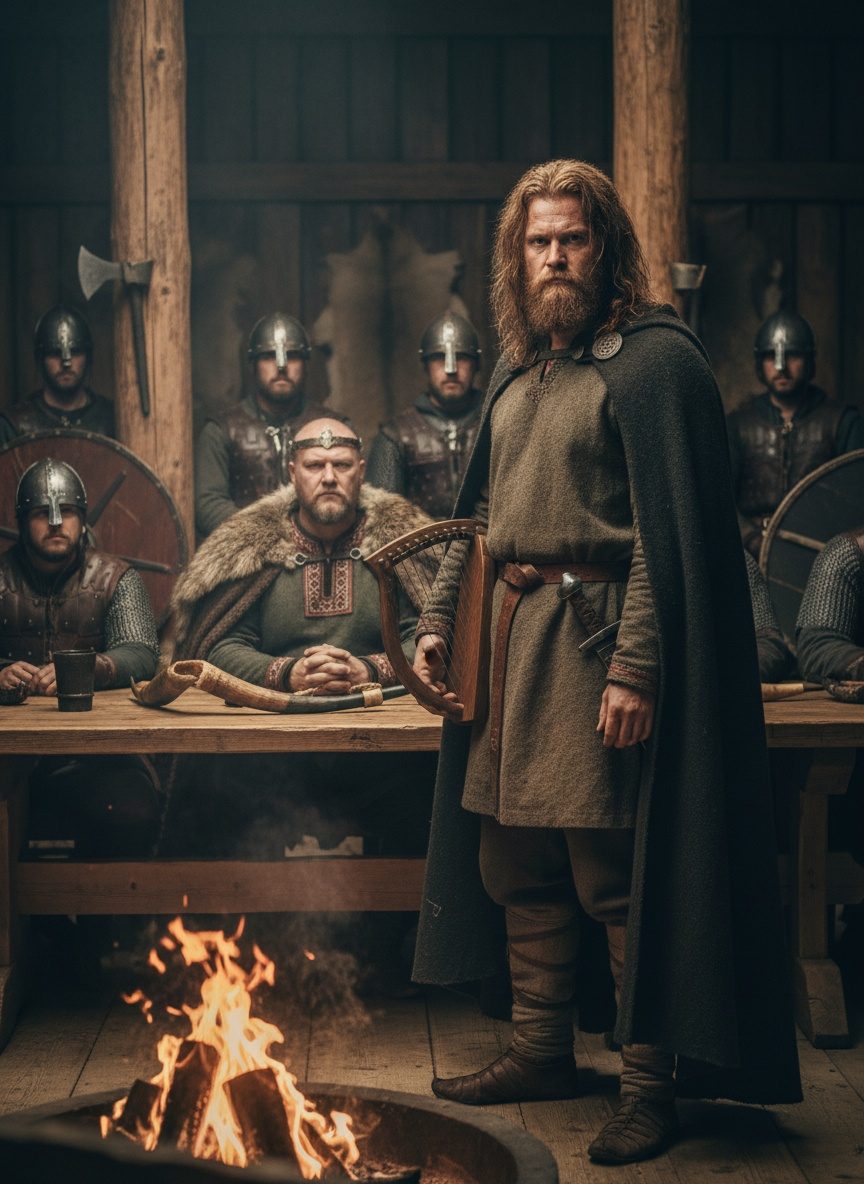
As he approached the royal hall, its walls resonated with the chants of holy songs unfamiliar to his ears. Inside, warriors and priests stood side by side, a symbolic merging of the old martial tradition with the new spiritual order. Hallfred entered the king's presence, aware that every eye was upon him. King Olaf, with his commanding presence, was a man used to bending others to his will, and as his gaze fell upon Hallfred, the air seemed to thicken with unspoken tensions.
The Price of Defiance
Olaf's demands were straightforward: pledge his loyalty to Christ and in return, Hallfred would find favor and patronage. Yet, the Troublesome Skald was not one to yield so readily. He proposed a counteroffer — he would only agree if a price was paid. The terms? A ship laden with goods and full guarantees for his future. Such boldness could have easily earned him Olaf's fury, but there was something in Hallfred's unwavering stare that intrigued the king. The air was charged with uncertainty, and the court waited with bated breath.
For Olaf, this was more than a single skald’s conversion. Hallfred's poetic prowess had the power to influence countless others. To win him over would be a victory that resonated through the sagas yet to be written. Thus, after a tense silence, the king agreed to consider Hallfred's terms. He gave the skald one last chance to prove himself under conditions that rested heavy in the room like a storm waiting to break.
The Path Forward
That evening, alone once more beneath the Icelandic sky, Hallfred considered the ramifications of his choice. His steadfastness in the face of kingly command was a defiance worthy of legend, yet its outcome hung in delicate balance. Were he to convert, it would be on his own terms, without losing the heart of who he was as a skald. If he remained true to his heritage while embracing the new, he could weave both traditions into his poetry, creating a tapestry of Norse identity that would captivate both pagans and Christians alike.
In the days that followed, Hallfred presented the king with a verse that did not explicitly praise a new god, nor did it shun the old. It was a masterful interweaving of tradition and transformation, a poetic dance that honored the past while nodding towards the future. Faced with such ingenuity, King Olaf acknowledged Hallfred’s artful navigation of belief. The king had secured his skald, and Hallfred, his freedom.
The Eternal Lament
The sagas speak of Hallfred and his trials, but they do not end with mere conversion. Instead, they remind us of the timeless struggle between tradition and change. Hallfred Vandraedaskald's story echoes in the perpetual dance of cultural evolution, where the past and future collide, often forcing us to question what must be cherished and what must be adapted. His defiance before Olaf was more than a simple act of rebellion; it was a testament to the power of art and conviction in the face of authority.
As we look back across the centuries, Hallfred's tale serves as a reminder that in times of transformation, the soul of a culture lies not in dogma but in the stories we choose to tell and retell, echoing through the ages. He teaches us that the spirit of the skald, of the poet, lives on in each word we craft, whether we sail into new worlds or remain anchored to the shores of the known.