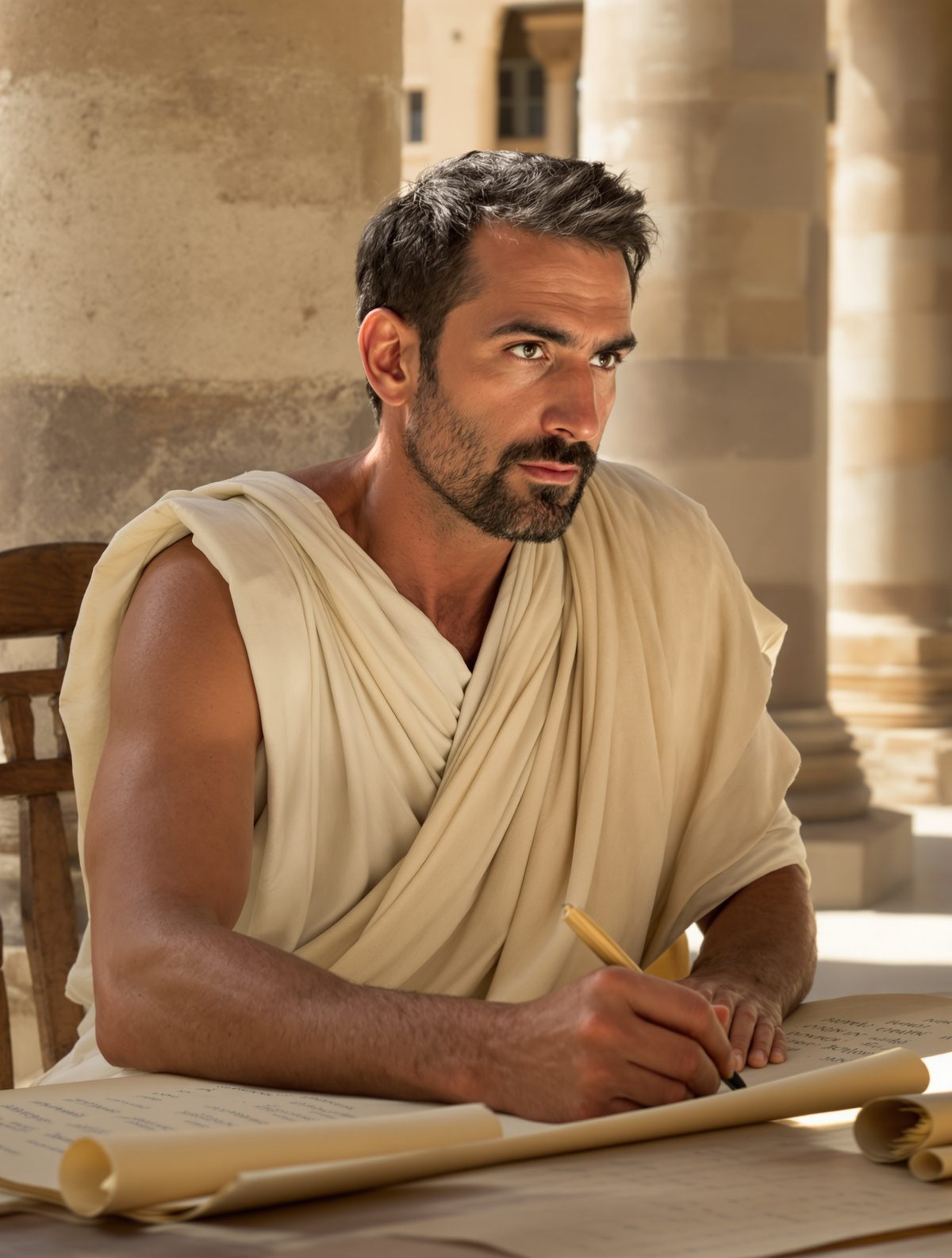
Picture this: It's 1250 BC, and a young Egyptian prince stands before the Great Pyramid of Giza, squinting up at its weathered limestone blocks. To him, this towering monument isn't a symbol of Egypt's glory—it's a crumbling relic from an impossibly distant past. The pyramid is already 1,300 years old, as ancient to Prince Khaemwaset as the Roman Colosseum is to us today. While his father, the mighty Ramesses II, obsesses over building newer, bigger monuments to his own greatness, this unusual prince has fallen in love with Egypt's forgotten history. He's about to become something the world has never seen before: an archaeologist.
The Prince Who Preferred the Past
Khaemwaset wasn't supposed to care about old buildings. As the fourth son of Ramesses II—arguably ancient Egypt's most prolific builder—he grew up surrounded by fresh construction sites where massive temples rose from the desert sands. His father's name was being carved into stone across the empire, from Abu Simbel in the south to Pi-Ramesses in the north. The king's motto might as well have been "build big, build new, and make sure everyone knows who built it."
But Khaemwaset was different. Born around 1281 BC, he served as High Priest of Ptah in Memphis, a position that brought him face-to-face with Egypt's ancient monuments daily. Memphis sat in the shadow of the Saqqara necropolis, where pharaohs had been buried for over a millennium before his birth. Here stood the Step Pyramid of Djoser, the world's first pyramid, and dozens of other royal tombs that most Egyptians of his era barely remembered.
What shocked the prince wasn't just their age—it was their condition. These weren't ruins in the romantic sense we might imagine today. They were forgotten ruins, half-buried by sand, their original purposes lost to time. The names of the pharaohs who built them had faded from memory. Their hieroglyphic inscriptions had been weathered into illegibility. Egypt, despite its reputation for eternal monuments, was losing its own history.
The World's First Archaeological Expedition
Around 1250 BC, Prince Khaemwaset launched what historians now recognize as the world's first systematic archaeological restoration project. But this wasn't some casual renovation job—this was detective work on a massive scale. The prince assembled teams of scribes, stonemasons, and scholars to study, document, and restore monuments that were already ancient when his grandfather was born.
His methods were surprisingly modern. Before touching a single stone, Khaemwaset's teams carefully studied each monument, trying to piece together its original appearance and purpose. They searched for any remaining inscriptions that might reveal the original builder's identity. When hieroglyphs were too weathered to read, they consulted temple archives and oral traditions. Only after this painstaking research would they begin the physical restoration.
The prince's most ambitious project was the restoration of the pyramid complex of Unas, the last pharaoh of Egypt's Fifth Dynasty, who had ruled around 2375 BC—nearly 1,100 years before Khaemwaset's time. The pyramid had been severely damaged by time and neglect, its causeway buried under centuries of sand. But Khaemwaset's teams carefully excavated, repaired damaged stonework, and even restored some of the world's oldest religious texts carved into the pyramid's burial chambers.
An Ancient Copyright System
Here's where Khaemwaset did something that would make him a hero to modern historians: he always gave credit where credit was due. On every monument he restored, the prince added a carefully worded inscription that identified both the original builder and himself as the restorer. These inscriptions, written in formal hieroglyphics, typically read something like: "It was the King's Son, Khaemwaset, who perpetuated the name of the King of Upper and Lower Egypt [original pharaoh's name], for it was found that this pyramid of [original pharaoh] had fallen into decay."
This was revolutionary for its time. Ancient rulers routinely erased their predecessors' names from monuments and claimed credit for their achievements—a practice called usurpation. Ramesses II himself was notorious for this, slapping his cartouche on monuments built by earlier kings. But his son took the opposite approach, becoming perhaps history's first practitioner of what we'd now call proper archaeological attribution.
One of Khaemwaset's most touching inscriptions appears on a restored temple near the pyramid of Sahure at Abusir. The text reveals not just respect for the ancient king, but genuine concern for historical accuracy: "His Majesty ordered that the name of the King of Upper and Lower Egypt, Sahure, be perpetuated on this his monument which the King's Son Khaemwaset made, because it had fallen into decay and the name of its lord could not be read upon it."
The Mummy Detective
Khaemwaset's archaeological interests extended beyond architecture to the pharaohs themselves. In an age when tomb robbing was rampant and royal mummies were often scattered or destroyed, the prince took on the role of ancient Egypt's first forensic archaeologist. He located and reburied several pharaohs whose mummies had been disturbed, creating what amounted to Egypt's first museum of royal remains.
His most famous mummy rescue involved a pharaoh whose identity had been completely lost. Khaemwaset's teams discovered a damaged royal burial that they couldn't identify through conventional means. Undeterred, the prince had his scholars conduct what we'd now recognize as forensic archaeology—examining the mummy's wrappings, burial goods, and tomb construction to determine its approximate age and royal status. Though they never definitively identified this mystery pharaoh, they gave him a proper royal reburial with full honors.
The prince also pioneered the practice of creating detailed written records of his archaeological discoveries. His scribes documented everything from architectural measurements to descriptions of burial goods, creating what may have been the world's first archaeological database. Tragically, most of these records have been lost to time, leaving us to piece together his achievements from the inscriptions he left on the monuments themselves.
A Legacy Written in Stone
Prince Khaemwaset died around 1225 BC, predeceasing his long-lived father and never becoming pharaoh. But his archaeological legacy lived on in ways he couldn't have imagined. The monuments he saved continued to stand for centuries, carrying forward the names of pharaohs who might otherwise have been forgotten entirely. His restoration inscriptions became historical documents themselves, providing modern Egyptologists with crucial information about both the original monuments and restoration techniques used in the 13th century BC.
Even more remarkably, Khaemwaset's work inspired later Egyptian rulers to undertake their own restoration projects. The pharaohs of the 26th Dynasty (664-525 BC), known as the Saite Period, consciously modeled their archaeological efforts on his example, creating inscriptions that directly reference his restoration work. They called him "the ancestor of all restorers" and credited him with establishing the principles of proper historical preservation.
The prince's reputation grew so legendary that he became a character in later Egyptian literature, appearing in stories as a wise scholar-magician who could unlock the secrets of the ancient past. These tales, preserved in papyri from the Ptolemaic period, show how deeply his archaeological work had impressed the Egyptian imagination.
Why the World's First Archaeologist Still Matters
In our age of cultural preservation and heritage conservation, Prince Khaemwaset feels remarkably contemporary. His insistence on crediting original creators, his systematic approach to restoration, and his belief that the past deserves protection regardless of political utility established principles that still guide archaeological work today. When modern museums return artifacts to their countries of origin, or when restoration projects prioritize historical accuracy over aesthetic appeal, they're following paths first carved by an Egyptian prince 3,300 years ago.
Perhaps most importantly, Khaemwaset understood something that many civilizations have forgotten: the past isn't just decoration for the present—it's the foundation upon which all future achievements rest. In an era when his father was literally writing his name over those of previous pharaohs, the prince chose instead to resurrect forgotten voices and preserve ancient wisdom. He recognized that true immortality comes not from building bigger monuments to yourself, but from ensuring that the monuments built by others survive to tell their stories.
Today, as we struggle to preserve our own cultural heritage in the face of development, conflict, and climate change, the example of Prince Khaemwaset reminds us that caring for the past isn't just the job of professional archaeologists—it's a responsibility that belongs to anyone who hopes to leave something meaningful for future generations.