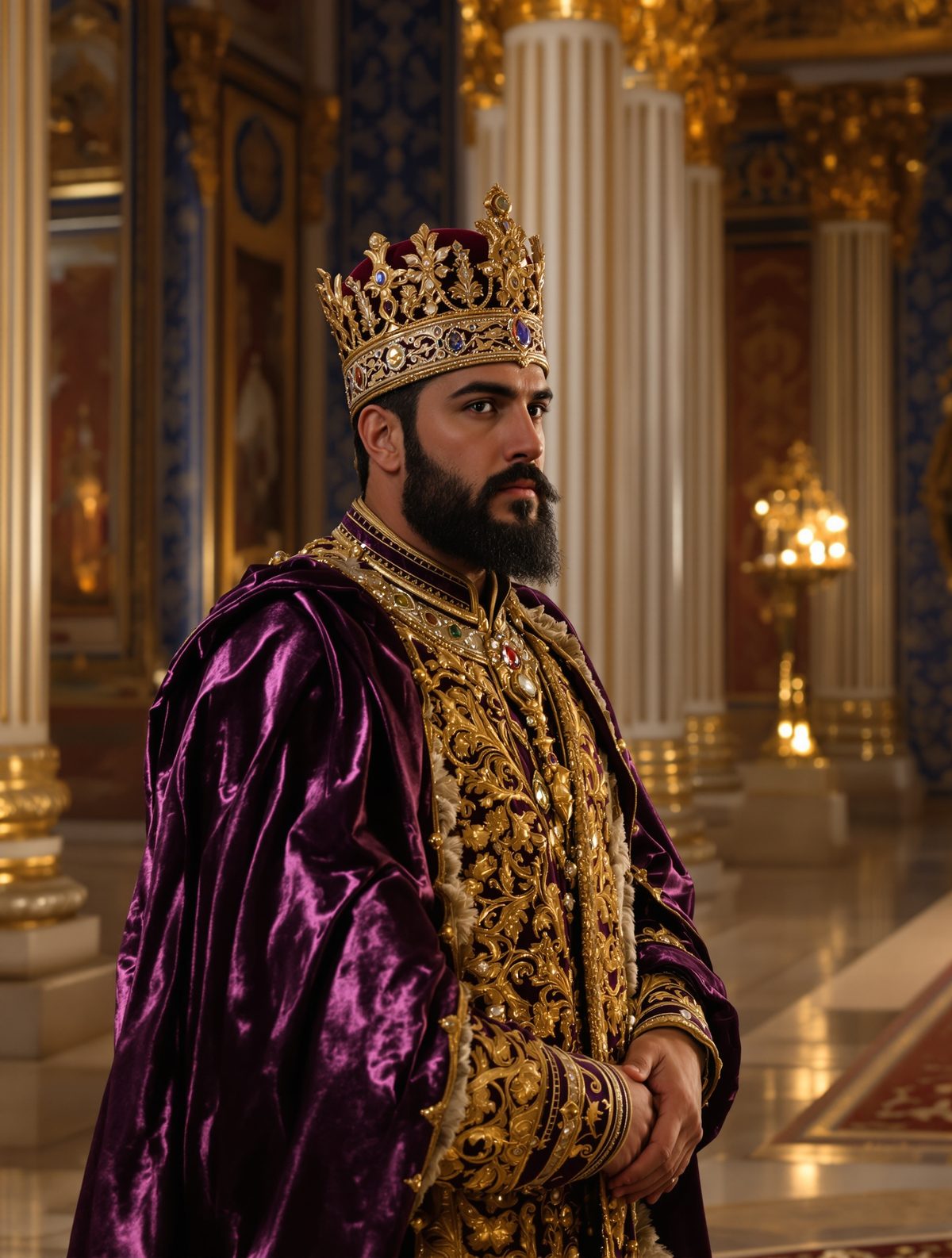
In the scorching heat of the Saqqara desert in 1250 BC, a lone figure knelt in the sand beside a crumbling pyramid, carefully brushing dust from ancient hieroglyphs that hadn't seen daylight for centuries. This wasn't a modern archaeologist with sophisticated tools—this was Prince Khaemwaset, son of the mighty Ramesses II, conducting what may have been history's first systematic archaeological excavation. While his father was busy carving his own name into every available surface across Egypt, the prince was doing something far more extraordinary: he was bringing the forgotten dead back to life.
What makes this scene even more remarkable is that the pyramid Khaemwaset was excavating was already ancient by his standards—built over a thousand years before he was born. Imagine if someone today were meticulously restoring medieval castles, and you'll begin to grasp the magnitude of what this royal archaeologist accomplished.
The Prince Who Preferred the Past to the Present
Khaemwaset was born into the most powerful family in the ancient world. His father, Ramesses II—known to history as Ramesses the Great—ruled Egypt for 66 years and built monuments on a scale that would make modern dictators jealous. The man put his name on everything, often chiseling out previous pharaohs' names to replace them with his own. Yet somehow, his fourth son developed a completely opposite obsession.
While his older brothers focused on military campaigns and political maneuvering, Khaemwaset became fascinated with Egypt's ancient past. By 1250 BC, when he was likely in his thirties, he held the prestigious title of High Priest of Ptah at Memphis, one of Egypt's most important religious positions. But instead of simply performing ceremonial duties, he used his authority and resources to launch an unprecedented mission: finding and restoring the forgotten monuments of pharaohs who had ruled Egypt during the Old Kingdom.
To put this in perspective, the pyramids at Giza were already 1,200 years old when Khaemwaset began his work. That's like someone today deciding to restore Roman buildings from the time of Christ. The temporal gap was staggering, yet it only seemed to fuel the prince's determination.
Digging into Deep Time
Khaemwaset's archaeological expeditions were remarkably sophisticated for their time. He didn't just stumble upon ancient monuments—he actively searched for them, following clues in old texts and local traditions. His primary focus was the Saqqara necropolis, where the earliest pharaohs had built their eternal homes.
The Step Pyramid of Djoser, built around 2670 BC by the legendary architect Imhotep, had become so buried under centuries of sand that local people probably thought it was just another hill in the desert. Khaemwaset's teams carefully excavated the structure, revealing hieroglyphic inscriptions that had been hidden for over a millennium. When they uncovered texts identifying the pyramid's builder as King Djoser, Khaemwaset did something that would make modern archaeologists proud: he left the original inscriptions intact and added his own respectful notation nearby.
His restoration inscription, still visible today, reads: "It is the High Priest of Ptah, Khaemwaset, who has perpetuated the name of King Djoser." Think about that phrase—perpetuated the name. This wasn't vandalism or appropriation; it was conscious historical preservation.
The World's First Archaeological Survey
What sets Khaemwaset apart from tomb robbers or casual explorers was his systematic approach. He didn't just restore one or two monuments—he conducted what amounted to the world's first archaeological survey of an entire region. His teams worked on at least seven different pyramid complexes in Saqqara, including those of pharaohs Unis, Teti, and Pepi I.
Each restoration followed a similar pattern that would be familiar to modern archaeologists. First, his workers would carefully clear away centuries of accumulated sand and debris. Then, they would study the original inscriptions and architectural features. Finally, they would repair structural damage and add commemorative texts crediting both the original builder and the restoration effort.
But here's where it gets really interesting: Khaemwaset wasn't just playing amateur historian. His restorations were technically brilliant. When his team worked on the pyramid of Unis (built around 2375 BC), they discovered that the original entrance had collapsed. Rather than force their way in, they engineered a new entrance tunnel that followed the pyramid's internal geometry perfectly, allowing access without damaging the structure.
Modern archaeologists who have studied Khaemwaset's work are consistently impressed by its quality. In many cases, his repairs have lasted longer than the original construction, surviving another 3,200 years to reach us today.
Racing Against Time and Sand
Why did Khaemwaset feel such urgency about these restorations? The answer lies in Egypt's changing relationship with its own past. By the 19th Dynasty, when Ramesses II ruled, Egypt had already experienced periods of political chaos and foreign invasion. Many of the Old Kingdom monuments had been abandoned for centuries, their mortuary cults forgotten, their very names erased from popular memory.
The desert was literally swallowing Egypt's heritage. Sand dunes migrated across the plateau, burying entire complexes. Stone thieves quarried ancient monuments for building materials. Local people, unaware of the historical significance of certain ruins, built their houses directly on top of ancient temples.
Khaemwaset seemed to understand that he was fighting a battle against time itself. His restoration inscriptions often include phrases about "finding in ruins" and "restoring what had fallen into decay." There's an almost melancholic quality to these texts, as if the prince realized he was one of the last links to Egypt's golden age.
One of his most poignant discoveries involved the pyramid complex of Sahure at Abusir. When Khaemwaset's team cleared the mortuary temple, they found beautiful relief carvings depicting the pharaoh's triumph over foreign enemies—artwork that had been created 1,200 years earlier but had never been seen by human eyes since the temple was abandoned. The prince carefully restored these reliefs and added an inscription marveling at their beauty.
The Archaeological Prince's Legacy
Khaemwaset died around 1224 BC, predeceasing his long-lived father by several decades. He was buried in a magnificent tomb in the Valley of the Kings, but ironically, his own burial place was later forgotten and has never been definitively located by modern archaeologists. The restorer of ancient monuments became himself a mystery of ancient Egypt.
But his work survived. When French archaeologist Auguste Mariette began excavating at Saqqara in the 1850s, he repeatedly encountered Khaemwaset's restoration inscriptions. "Everywhere I dug," Mariette wrote, "I found evidence of this remarkable prince who had been there 3,000 years before me, doing exactly the same work."
Modern Egyptologists consider Khaemwaset the father of archaeology—not because he used modern scientific methods (which didn't exist yet), but because he approached the past with genuine scholarly curiosity rather than simple greed or religious duty. He wanted to understand what came before, to preserve it for future generations, and to ensure that great achievements wouldn't be lost to oblivion.
Perhaps most remarkably, Khaemwaset's approach influenced later Egyptian rulers. Several pharaohs of the 26th Dynasty (664-525 BC) explicitly modeled their own restoration projects on his work, creating an unbroken chain of archaeological consciousness that stretches from ancient Egypt to the present day.
In our modern era of rapid change and disposable culture, Prince Khaemwaset's 3,200-year-old mission feels startlingly relevant. He understood something that we're still learning: that preserving the past isn't about nostalgia or ancestor worship—it's about maintaining the continuity of human achievement. Every time we visit a museum, restore a historic building, or simply try to understand how we got here, we're following in the footsteps of a prince who refused to let greatness be forgotten, even when it was already ancient beyond imagining.