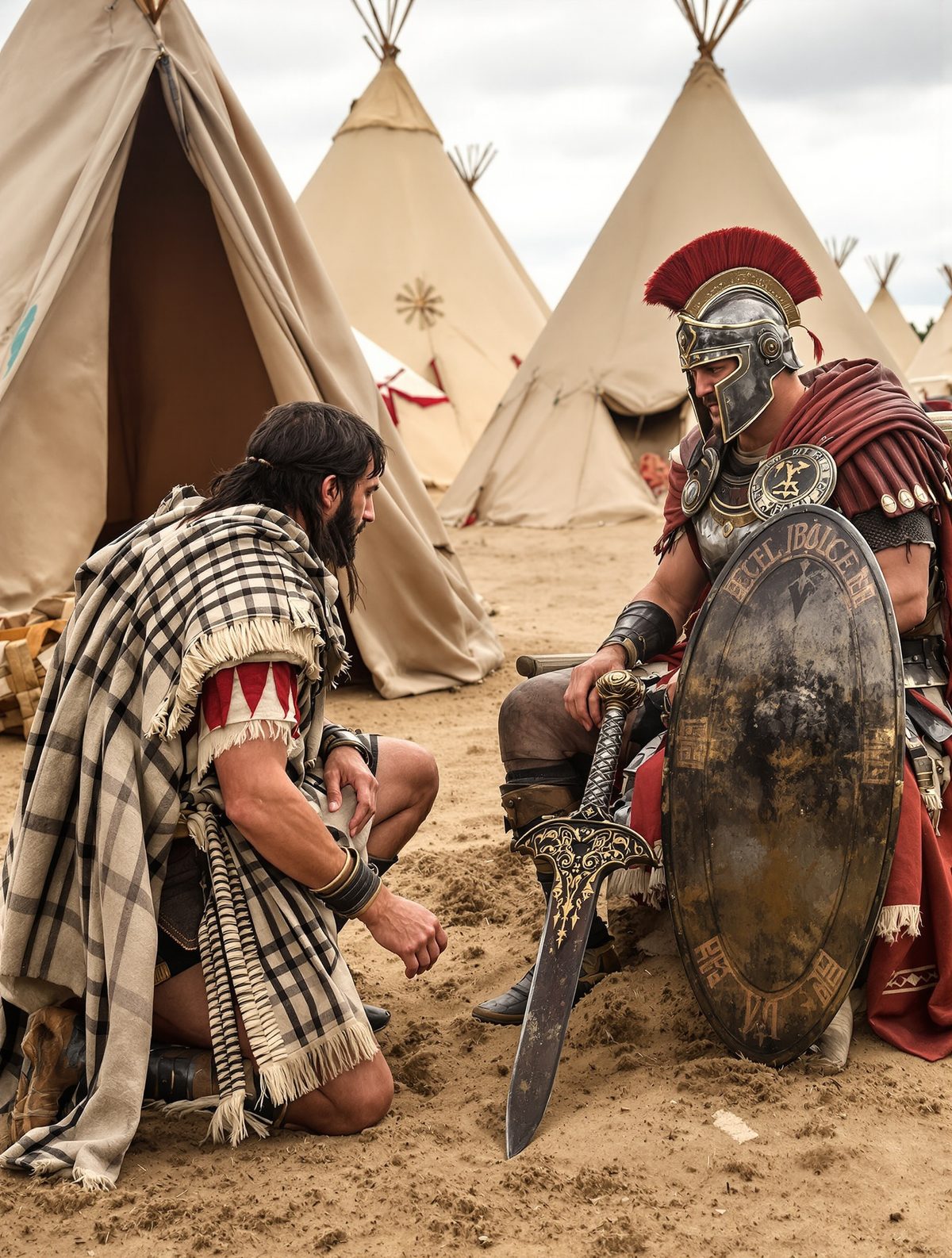
Amidst the cold whispers of autumn winds in 52 BC, atop the Gaulish hills, a solitary figure emerged from the darkness—a chieftain atop a war horse, approaching the camp of his enemy, alone. His name was Vercingetorix, and he was riding toward one of the greatest generals Rome had ever known—Julius Caesar. As he dismounted and threw his sword at Caesar’s feet, it marked the bitter end of a tenacious fight, one filled with strategic brilliance, grueling hardships, and fierce resistance. His silence as he sat by Caesar perhaps spoke louder than any words ever could—a silence that echoed through time with a mixture of defiance and despair.
The United Tribes of Gaul
Vercingetorix was not just any chieftain; he was a visionary leader who, against immense odds, forged a fragile alliance amongst the disparate and often warring tribes of Gaul. Prior to his emergence, the Gallic tribes were fractured, fierce in their independence and often more focused on internal strife than external threats. However, in the face of a common enemy—one as formidable as Rome—unity was imperative.
At the heart of his success in uniting Gaul was his charisma and the sheer desperation of survival. He understood the landscape and used it to his advantage, envisioning a resistance that leveraged the fierce spirit of the Gauls. His leadership was not born out of brute force alone, but a remarkable capacity to rally and inspire. It was this cohesion among the tribes that allowed him to challenge Caesar, who had rarely seen such concerted opposition.
Burning Gaul to Save It
One of the most astonishing tactics employed by Vercingetorix was the scorched earth strategy. In a move of cold pragmatism, he ordered the burning of countless Gallic towns and fields, denying Caesar the supplies and refuge he desperately needed as he and his legions carved through the Gallic landscape. The most striking of these was the burning of Avaricum, a loss deeply mourned yet strategically essential. Starving and outmaneuvered, Caesar's forces found themselves in increasingly dire circumstances.
Such ruthless measures highlighted Vercingetorix's unwavering commitment to the cause. While the destruction of one's own homeland might seem unthinkable, it embodied the stark calculus of survival against an otherwise insurmountable foe. The sacrifices made by the Gauls were severe, yet in their perseverance, a glowing ember of defiance refused to be extinguished.
The Siege at Gergovia
It's fascinating to retrace the footsteps of what is perhaps Vercingetorix’s greatest military triumph: the Battle of Gergovia. In an encounter that tested Caesar’s military genius, Vercingetorix showcased the impact of his masterful strategy and leadership. Utilizing the natural fortifications of the Gergovia plateau, the Gauls trapped the Roman legions in an exquisite display of tactical acumen, holding off assaults with a relentless tenacity.
Gergovia remains significant as one of the rare defeats Caesar endured, showing that the mighty Roman legions were not invincible. It was a victory that emboldened the Gallic spirit and lent hope to the prospect of an enduring resistance. However, this confidence would soon be severely tested.
The Fall of Alesia
Perhaps the most iconic episode of this conflict was the Siege of Alesia, a name now synonymous with both defiance and downfall. Caesar, with the relentless precision of his engineering prowess, constructed a fortification around Alesia, signaling his intention to starve the Gauls into submission. Trapped within the walls were not just warriors but civilians, suffering the gnawing grip of hunger and dwindling hope.
Caesar’s encirclement efforts involved double fortifications—a strategy that remarkably showcased the engineering capabilities of the Romans. Despite several desperate attempts to break the siege, including a formidable sortie by Gallic reinforcements, the stranglehold of the Roman military grip proved insurmountable.
The fall of Alesia marked a significant turning point, with Vercingetorix eventually making the heart-wrenching decision to surrender, ensuring the survival—however temporary—of his people. His journey to the Roman camp was not just a ride but a passage into the annals of history as a testament to his courage and resilience.
Six Years to Martyrdom
After his surrender, Vercingetorix’s life took on the air of a tragic, classical story. He was brought to Rome, where he became a prisoner, awaiting a fate that spanned six agonizing years. These years were spent in captivity within the oppressive confines of a Roman cell, his existence reduced from a celebrated chieftain to a symbol of rebel defiance now caged within enemy hands.
In 46 BC, during Caesar’s grand triumph in Rome—a celebration of victory and power—Vercingetorix was paraded as a trophy, a captured king in chains. It was here that the final act of this tragic tale unfolded. He was ceremoniously strangled, a life snuffed out as part of a spectacle intended to reinforce the dominance of Rome. Yet, the martyrdom of Vercingetorix resonated far beyond his death—a spark of resistance that flickered through the pages of Gallic lore.
The Lessons of Vercingetorix’s Legacy
In examining the life and legacy of Vercingetorix, modern readers are reminded of the enduring power of unity and resistance against overwhelming odds. His story echoes throughout history as a reminder of the complexities of leadership, sacrifice, and the price of defiance. Though ultimately defeated, his will to preserve the Gaulish identity left an indelible mark upon the landscapes of both history and memory.
Today, the tale of Vercingetorix serves not only as a chapter of ancient rebellion but also an enduring reminder of the spirit required to challenge the seemingly invincible. In a world where struggles for freedom and sovereignty continue to unfold, Vercingetorix stands as a symbol of the fight for autonomy, resilience, and the indomitable will of a people united for a cause greater than themselves.