The voluminous writings of medieval Islamic scholars aren't often associated with Vikings. Yet, Ahmad ibn Fadlan's vivid eyewitness accounts ensure they are. Ibn Fadlan’s journey north from the opulent confines of Baghdad thrust him into a world as raw as it was unfamiliar.
When Baghdad Met the North
The dazzling splendor of Baghdad in 922 AD projected a world of sophistication, governed by complex cultural mandates and enriched by centuries of trade and scholarship. But for Ahmad ibn Fadlan, a learned diplomat, his mission extended beyond these familiar corridors of power. Entrusted by the Caliph with a diplomatic journey to the lands of the Volga Bulgars, Ibn Fadlan was to serve not only as a religious envoy, delivering the Caliph's missive, but as an observer tasked with reporting back the wonders and workings of the world beyond the Islamic realms.
His expedition marched resolutely northward, navigating through an array of climates and cultures, moving from the sun-baked sands of Mesopotamia to the chilling airs of the Slavic territories. These interactions with local tribes and their customs were to lay the foundation for what would be one of the Islamic world’s most intriguing travelogues.
The Unexpected Encounter
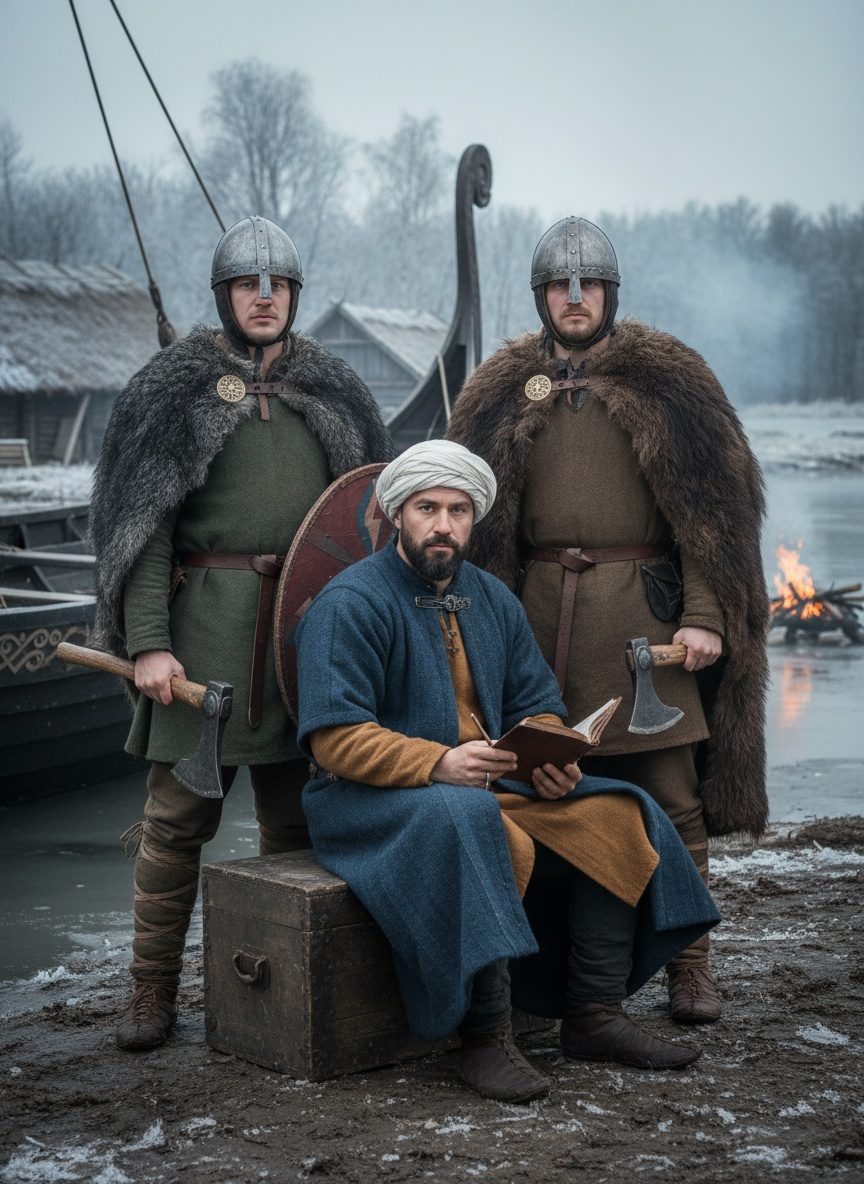
No parchment could have prepared Ibn Fadlan for the sight that awaited him upon reaching the lands near the Volga River. There, amidst the swaying northern trees, he encountered a people he described as *al-Rus*, whom modern scholars identify as Norsemen, or more commonly, Vikings. These were tall, powerful figures whose physical presence left an indelible mark on the Arab emissary. To the sonorous call of their boats, sleek and serpent-like, Ibn Fadlan's narrative unfurled.
He chronicled their arrival with meticulous detail, capturing the raw vitality of their seaborne warriors. Their communal feasts, laden with smoked meats and potent brews, were boisterous affairs juxtaposed starkly against the refined elegance of his native dining experiences. Observing their robust and often brutal rituals, including the infamous ship burials, he etched into history a portrait of both awe and alienation.
Rituals of Life and Death
Among the most striking of Ibn Fadlan's recordings were his observations of Viking funerary practices. His account of a chieftain's burial ceremony reveals both the visceral solemnity and the elaborate orchestration of Viking death rites. Central to this rite was the sacrificial sending off of a slave girl; a gesture intended to accompany her deceased master into the afterlife. The intensity of the ritual, the encircling chants, the precise roles each participant played — all were noted by the keen-eyed diplomat.
What was equally captivating was the stark difference in religious practices. While Ibn Fadlan came from a monotheistic and comparatively austere belief system, his eyewitness account of these pagan ceremonies highlighted a communal embrace of both life and death that was ritualistic and compelling, in ways that defied his expectations.
Beyond the Feasts and Burials
But Ibn Fadlan's account extended beyond the rituals of cherishing and mourning. He offered glimpses into broader aspects of Viking society, noting their hygiene practices, which included combing their hair and washing their faces daily — a habit that contradicted the less savory legends woven around the Viking hygiene regime. Moreover, he documented their trade engagements, detailing how they bartered with furs, swords, and the exotic bounty harvested from their explorative forays.
These interconnections with various tribes and regions highlighted the Vikings not merely as raiders, as Ibn Fadlan’s contemporary society might have simplistically portrayed them, but as astute traders and navigators. His depictions paint them as a bridging people, positioned between East and West, traversing the physical and cultural landscapes of medieval Europe and the Islamic world.
Why It Endures
Ibn Fadlan’s writings introduce a conversation between two worlds often imagined as disconnected. Through his penetrating lens, we glimpse the unexpected commonalities and stark contrasts that defined these encounters. His observations, grounded in the meticulous detail and honesty of an outsider attempting to understand, continue to captivate modern readers who find in his narrative not just an account of Vikings but a tale of encounters that transcended cultural divides.
The account stands not as an endorsement but as a testament to the universality of human curiosity. Through Ibn Fadlan, we are gifted a unique historical record that challenges inherited stereotypes, offering instead a nuanced look at the societies of our past. Readers today remain captivated by his journey not only for its historical significance but because it reminds us of the value in reaching beyond our cultural confines to apprehend and appreciate the ‘other’ with fresh eyes. As history continually reorients its lens, Ibn Fadlan remains a powerful legacy of medieval cross-cultural encounters that echoes through the centuries.