He was seventy years old. He had never written a single word.
The Unwavering Mind of Socrates
In the bustling city of Athens in 399 BC, Socrates stood as a singular figure amidst a sea of changing tides. A philosopher known for his dialogues that taught through questions rather than answers, Socrates had become a cornerstone in the marketplace, where he engaged citizens in debates that often left them questioning their own beliefs. But this penchant for questioning — for digging deeper into the roots of knowledge — was not universally appreciated. Indeed, for some, it was a reason to silence him.
Charged with impiety and corrupting the youth, Socrates found himself on trial before an expansive jury of 500 Athenian citizens. Despite the gravity of such accusations, he remained steadfast in his philosophy. Offered the opportunity to grovel for mercy, perhaps even to save his own life, Socrates opted instead to stand resolute. He addressed the jury without fear, rationally explaining his purpose and motives — a man facing death with the same curiosity as he approached life, eager to explore the unknown without trepidation.
The Hemlock: A Stark Acceptance
As the jury declared Socrates guilty and sentenced him to death by hemlock, an alternative was presented: to simply walk away. Friends and followers begged him to escape, planning ingenious routes for him to get out of Athens unscathed. Nonetheless, Socrates, unwavering in his principles, refused. To him, fleeing would be betraying his ideals and the very philosophical life he tenaciously defended.
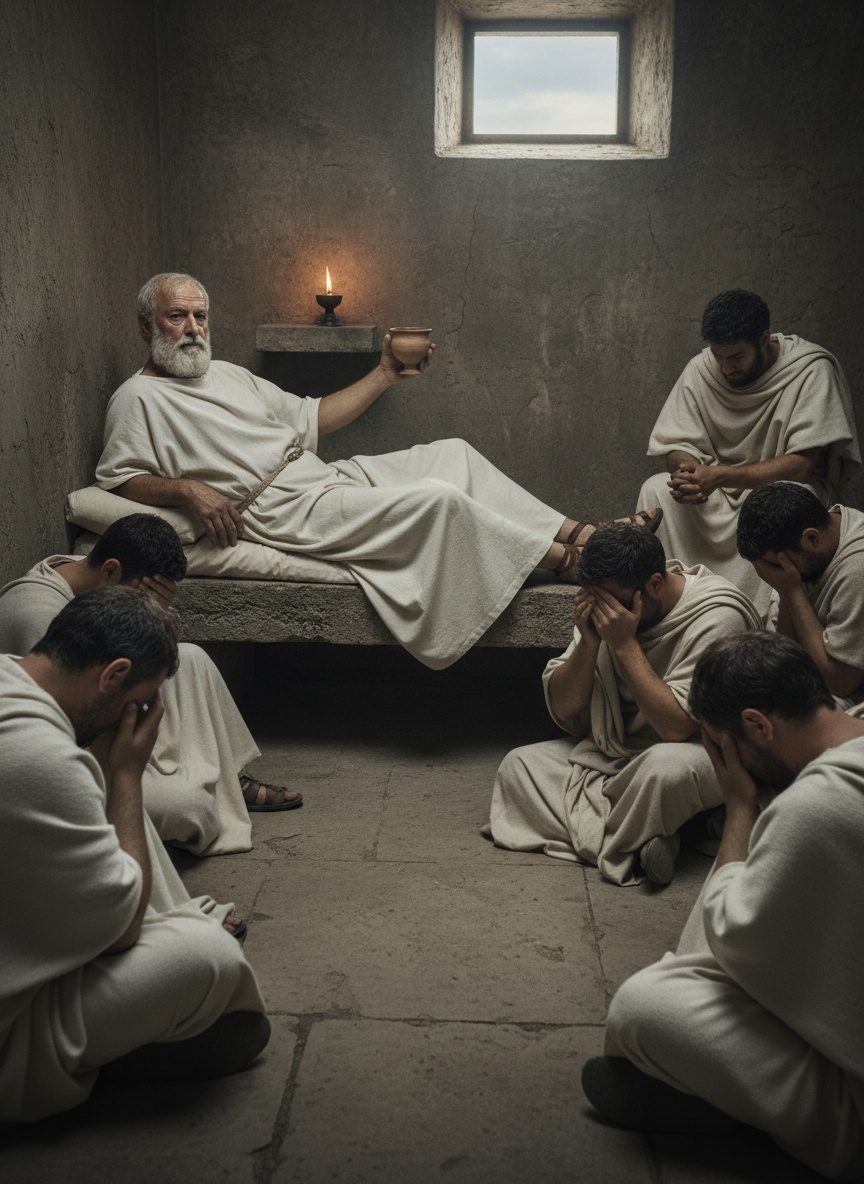
On the fateful day, despite being surrounded by disciples whose tears and desperation filled the room, Socrates accepted the cup of hemlock with serene hands. The bitter brew of poison, served so casually, was to be his departure from the world he knew so well. As he drank, his friends watched in horror and sadness, yet Socrates' disposition remained characteristically calm. He did not beg for forgiveness, nor did he issue plaintive farewells. Instead, he left them with thoughts of how to live well — a testament to his devotion to ethics and knowledge until the very end.
The Final Favor
In his last moments, Socrates turned to his faithful friend, Crito, with a peculiar request. He asked Crito to settle a debt on his behalf — a sacrifice he owed to the god Asclepius in the form of a rooster. To the uninitiated, it seemed a trivial favor amidst such gravity; yet, within the request lay a profound metaphorical gesture.
Asclepius, known as the god of healing, was to receive this offering because, to Socrates, death was the ultimate healing, the cure not from life’s physical ailments but from the misunderstandings of life itself. To Socrates, death was the release of the soul, a transition back into a state of pure knowledge and truth. Thus, the payment of this debt was not mere ritual — it was an acknowledgment of his steadfast belief that life was a preparation for the soul’s journey beyond.
The Legacy of Athenian Justice
The story of Socrates’ trial and execution remains one of the most poignant moments in philosophical history, a stark illustration of the conflict between the individual and the state, between freedom of thought and the constraints of society. His choice to accept death while remaining true to his principles embodies the ideals that have resonated through the ages: the courage to pursue truth and the integrity to stand by it regardless of the consequence. Socrates’ refusal to escape, even as the hemlock sealed his fate, serves as a powerful lesson on the nature of justice and morality.
As Socrates lay on his deathbed, with a calmness unexpected in the face of death, he left Athens with an irreplaceable philosophical inheritance — a call to question not just the world around, but the very essence of existence itself. This story, echoing through the corridors of time, has provided countless generations with the courage to seek truth unsparingly, a legacy that is needed as much today as it was over two millennia ago. In acknowledging the rooster owed to Asclepius, Socrates’ final act reminds us that even amidst certain endings, there exists a profound and hopeful transition to a place where knowledge knows no bounds, a quest that, once started, indeed has no end.