He was a scholar with no home but the road. It was the call of distant lands that had shaped Ibn Battuta's life, a man whose explorations would earn him the title of the greatest traveller of the medieval world.
The Endless Sands
The year was 1352, and Ibn Battuta stood at the edge of an ocean made of sand. The Sahara Desert stretched before him in an intimidating expanse, its shifting dunes an obstacle few dared to challenge. But for Ibn Battuta, the desert was but a corridor on his path to discovery. His journey had begun long before he reached the Sahara, traversing the Islamic world from Tangiers to Mecca, across the Middle East to the bustling trade routes of India and the far-off exoticism of China.
He had now set his eyes on a destination that had captured the imagination of traders and merchants across the known world—the Mali Empire. Reports of Mali's immense wealth, particularly its overflowing reserves of gold, had reached Iberia and beyond. The kingdom was said to glimmer with prosperity, ruled by a king who commanded both respect and curiosity. So, Battuta set forth, braving the arid expanse in search of the hidden heart of Mali.
The journey was onerous, and the desert was unforgiving. Temperatures soared beneath the relentless sun, and nights descended into chilling cold. Amidst the monotony of the sandscape, occasional caravanserais and oases offered brief respite. These were places where caravans would convene, exchanging news and goods. For weeks, Ibn Battuta endured the trials of the desert, until the shifting sands began to give way to the drumming rhythm of distant tom-toms, signaling his approach to a kingdom that was perennially in motion, like the shimmering dunes he had left behind.
A Sovereign Beneath the Sky
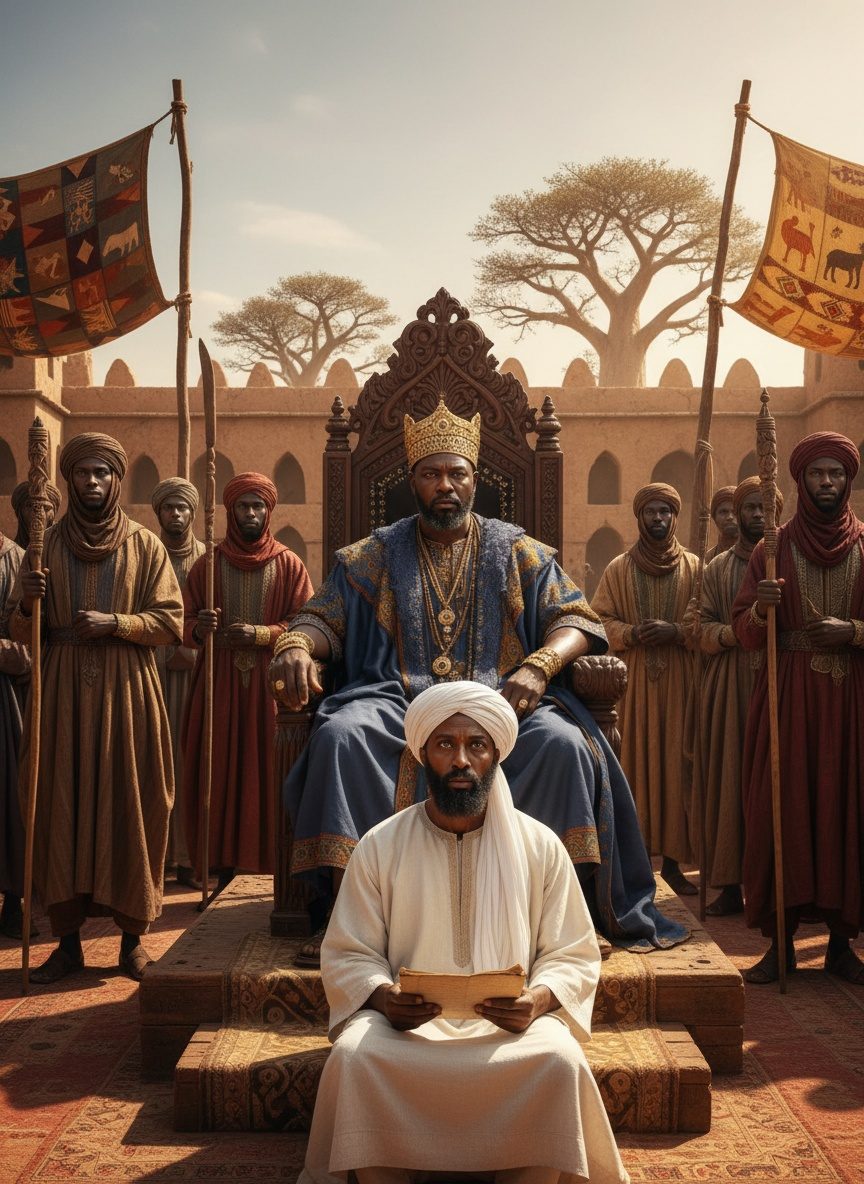
As Ibn Battuta entered the city of Niani, the capital of Mali, he found a society that thrived under the rule of Mansa Suleyman. Unlike the monarchies of Europe, where rulers secluded themselves behind fortress walls, Suleyman held his court beneath the vast, azure sky. Here was a king who eschewed the trappings of grandeur for a display of wealth that was both subtle and profound. Ornamented in layers of gold, Suleyman was the embodiment of his kingdom's riches, his presence a testament to Mali's abundance.
Yet, it was not just the material wealth that astounded Ibn Battuta. The king dispensed justice in the open air, his voice carrying over the assembled crowd as he adjudicated disputes and meted out commands. The court was an open forum, a place where the needs of the state were balanced with the needs of its people, blending governance with community in a way that was foreign to the traveller's experiences from distant empires.
Moreover, Mansa Suleyman's munificence extended beyond the customary bounds of his kingdom. He was known to shower hospitality upon guests and enemies alike, mirroring a broader ethos of generosity. Before the evening meals began, Mansa Suleyman would ensure that his subjects were fed, with granaries opening to supply the poorest. It was an act that both cemented his authority and fostered loyalty, a tangible demonstration of the symbiotic relationship between a benevolent ruler and his people. For Ibn Battuta, this was a story that deserved to be carried back to the corners of the globe he would later visit.
Bearing Tales of Gold
Ibn Battuta was not merely an observer; he was a chronicler, gathering tales as precious as the gold that adorned Suleyman's realm. The city of Niani, a hub of commerce and culture, was abuzz with energy. Markets overflowed with the sights and sounds of goods exchanged from every compass direction. It was a vibrant tapestry of human interaction, woven with threads of trade from the heart of Africa to the shores of the Mediterranean.
The very structure of the city reflected the empire's prosperity. Houses built of sun-dried bricks stood as markers of a civilization that thrived despite the harshness of its environment. Trade routes snaked from this center, connecting Niani with the fabled mines of Bambuk and beyond, outlining an economic network that was as vast as any other in the medieval world. It was this infrastructure that enabled Mali to stand as one of the wealthiest empires of its time.
As Ibn Battuta prepared to leave Mali and resume his wanderings, he carried with him the stories of a kingdom that had welcomed him with open arms. The riches of Mali were not just in gold, but in the spirit and resilience of its people. It was a land where hospitality knew no rival, and where justice was served under the open sky. Thus, the tales of this forgotten court would become part of the woven mosaic that was Ibn Battuta's legendary account—a chronicle that still astonishes explorers of history today.
Beyond the sands and beneath the stars, the Mali Empire of 1352 remains a lesson in leadership, community, and the enduring human spirit. Here was a civilization whose rhythms matched the pulse of nature itself, illuminating a path lost in time but resonant with lessons for our world today. Through Ibn Battuta’s eyes, we glimpse a world that continues to inspire, a reminder of the grandeur that thrives far beyond the horizons of our current kingdoms.