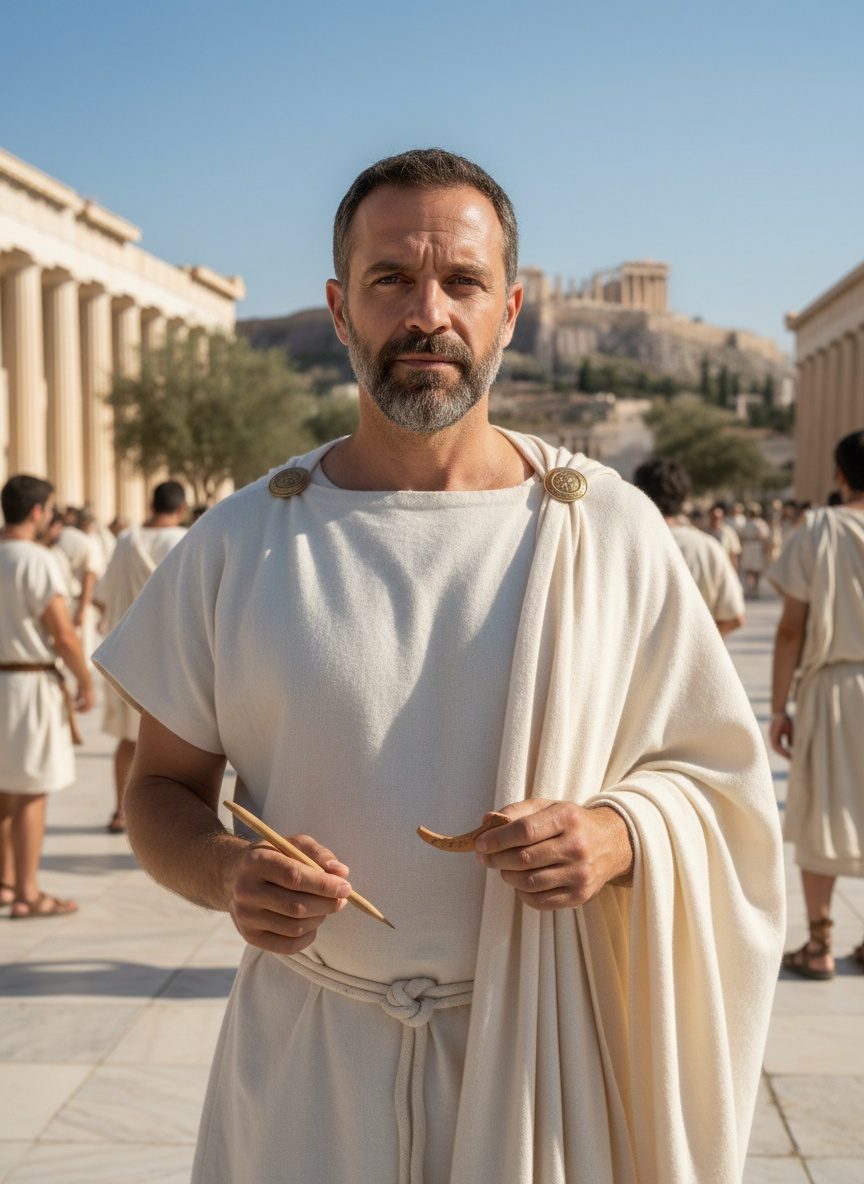
The early morning sun spilled over the Mediterranean, casting its golden glow on the white marble facades of Alexandria, illuminating a city that was a living testament to human intellect and ambition. The air was crisp and carried the aroma of the sea, mingling with the earthy scent of papyrus scrolls. The city was awake, bustling with scholars and merchants, the clamor of voices mixing with the cries of distant seagulls. It was a day like any other in c. 400 CE, in an era when Alexandria, with its towering lighthouse and the famed Library, stood as the epicenter of knowledge. Yet, amidst the daily bustle, there was something more—a palpable anticipation swept through the streets. Inside one of the city's grand lecture halls, all eyes turned to the open doors, waiting. A woman, whose name had become synonymous with intellect and reason, emerged to speak.
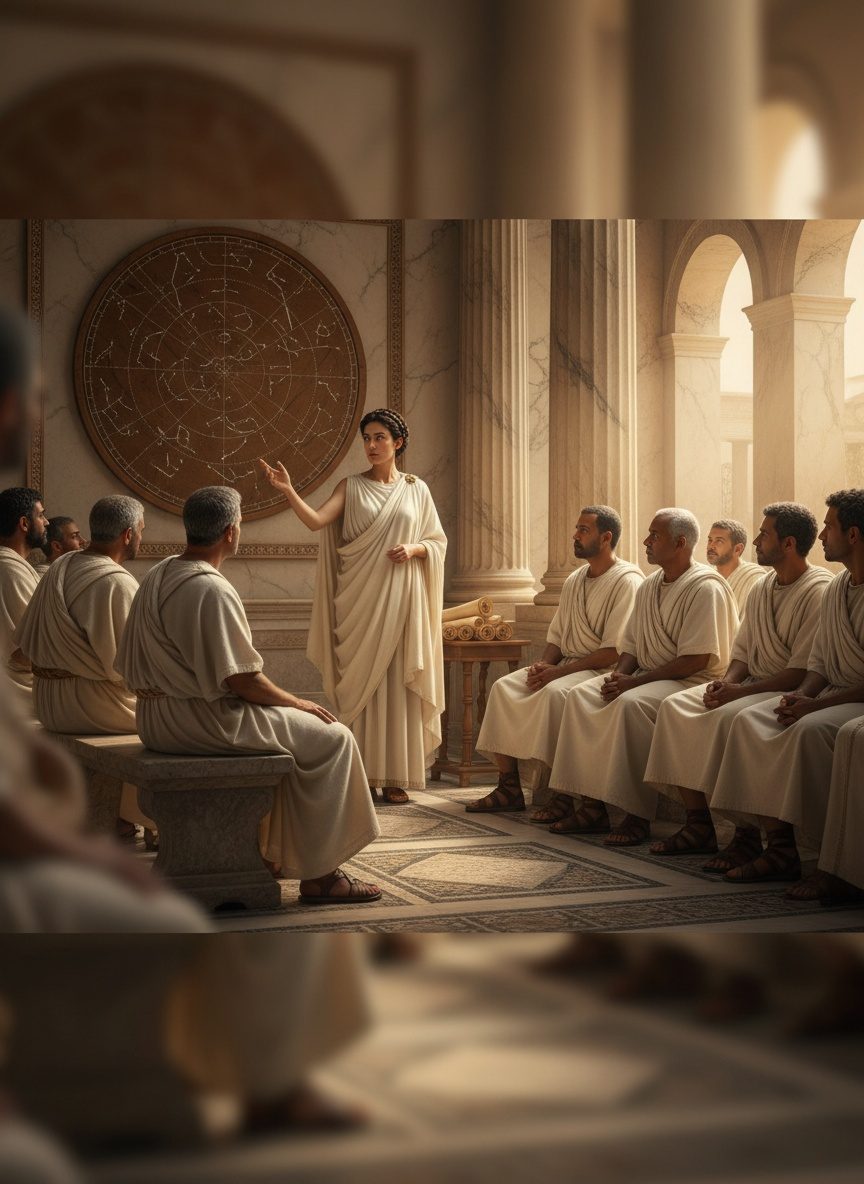
Hypatia, an embodiment of knowledge in flesh, stepped forward—a silhouette against the backdrop of eager listeners. Her presence commanded a unique respect in a time when the voices of women were often stifled, rendering her influence all the more compelling. This was Alexandria, the cradle of reason and inquiry, and here, in an age marred by the tumultuous decline of Roman power, stood a beacon of intellect. The gathered assembly of senators, philosophers, and governors leaned forward in silent anticipation, as if the very air held its breath.
Her teachings encompassed mathematics, astronomy, and philosophy, reflecting the towering intellectual heritage of her city, which had been crowned with the grand, albeit dwindling, Library of Alexandria. Hypatia's knowledge was not solely a litany of facts or theories. Instead, she wove together the cosmos and the mathematical heavens into a coherent tapestry, entwining Pythagorean musicality with Platonic ideals. She had the rare gift of giving abstract numbers a soul, and her students—from humble citizens to the most powerful men of her time—flocked to her lectures as if to drink from an eternal spring of wisdom.
Hypatia's lecture hall was a place where boundaries dissolved. Here, philosophical discourse flowed like the Nile, and minds met without regard for lineage or creed. In this shared pursuit, they found meaning amidst a crumbling empire. The sonorous cadence of her voice filled the room, transforming theoretical complexities into vibrant understanding. Her fame did not stem solely from her erudition but from the transcendent clarity she cast upon her subjects.
But Hypatia's teachings stretched beyond the theoretical; they challenged the divisions of the soul. As a Neoplatonist philosopher, she maintained that the pursuit of wisdom was akin to a spiritual exercise, a search for truth and harmony amidst the chaos of the tangible world. This quest was a balm for the existential weariness that often crept into the lives of those living at the edge of the ancient world's twilight.
Even against the youthful optimism that thrived within the lecture halls, a dangerous tension ebbed. The religious transformations shaking the empire's foundations did not leave Alexandria untouched. Pagan practices, once integral to the fabric of this storied city, were slowly supplanted by an ascendant Christianity. This ideological shift, nuanced and profound, too made its presence felt; for all the harmony Hypatia preached, the world around her was cleaved by passionate beliefs in flux.
Yet, in a testament to her persuasive oratory, students and scholars, pagans and Christians alike, found a shared respite in her classroom. Here, reason triumphed over dogma, and ideas could be contested in an echo of civil discourse. Within Hypatia's hall, the prevalent dichotomies that plagued her era found a neutral ground, highlighting her unique role in a community fractured by belief and politics.
But the intellectual sanctuary she fostered was not invulnerable to the disruptions beyond its pillars. As the shadows lengthened over Roman Alexandria, so too did the murmurs of discord grow. The fate of the Library, the heart of Classical knowledge, hung in uncertainty, representing not just the ebbing power of Rome but the systematic dismantling of ancient traditions in the wake of new ideals. No one knew that soon, the peace within these walls would itself be a relic of history.
And so, Hypatia endured, a keeper of treasures from an epoch steadily slipping into history's annals. Her profound legacy, far more than a mere collection of treatises or theories, encapsulated a defiant stand for enlightenment in an era resisting its decline. It was here, when confronted with the looming end of an age and the inexorable flow of time, that Edinburgh's voice rang clear as a clarion call of intellect amidst encroaching obscurity.
Even as she taught, Hypatia unwittingly penned the prelude to a heart-wrenching denouement—a sacrifice at the altar of change. Her story encapsulates not just an individual caught in the maelstrom of transformation but the perennial struggle for knowledge and truth against the current of history's tide. In telling it, we reflect not only upon the bygone glories of Alexandria but also on the resilience of the human spirit in seeking understanding amid the shadows of ignorance.