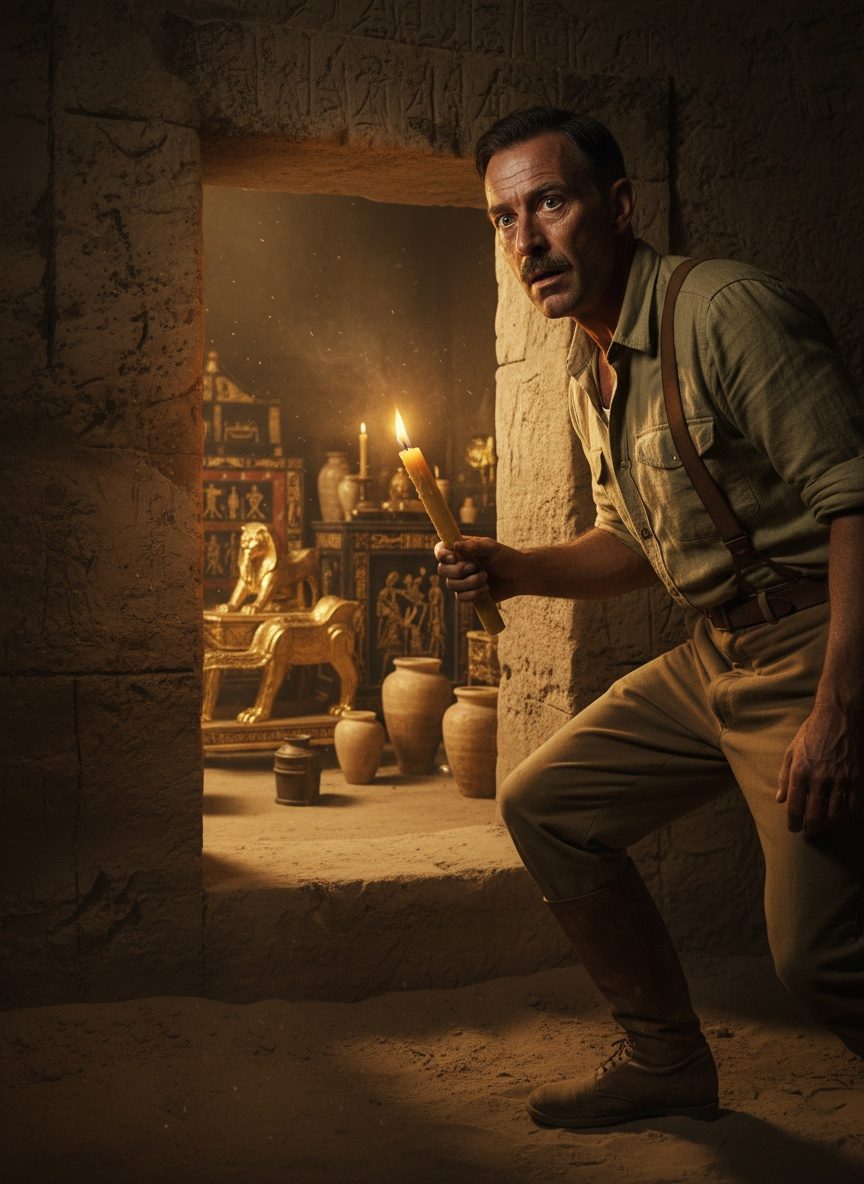
The candle flickered in Howard Carter's trembling fingers, casting dancing shadows on the carved outlines of the sealed doorway. The whispers of ancient hieroglyphs stood resolute against the crush of time, guarding secrets hidden from the world for over three thousand years. As Carter carefully pressed the light closer, a delicate glint caught his gaze—gold, rich and lustrous, lit up the silence of the tomb. It was a moment that arrested his breath, a discovery that defied the probabilities, leaving him awash with emotion. He had unearthed the burial chamber of a forgotten pharaoh, a discovery that would rewrite history.
The Struggle Beneath the Sun
Beneath the relentless Egyptian sun, Howard Carter's pursuit of King Tutankhamun's tomb began not with a triumphant shout, but rather the persistence of a whisper. Over five arduous years, he had combed the valleys of sand and stone in the Valley of the Kings, met with skepticism from many quarters, and faced dwindling resources. Carter found a steadfast patron in the British aristocrat, Lord Carnarvon, whose fortune fueled the mission. As they unearthed other tombs and artifacts, doubts continued to shadow their efforts—doubts that would cast any lesser spirit into despair.
Yet it was a fortuitous discovery by a water boy that changed the tides. Just as it seemed the excavation might be abandoned, the boy stumbled upon a stone step hidden beneath the desert’s cloak. It was the first step of a staircase leading deeper below the sands, ultimately unveiling a door sealed with ancient plasters and adorned with cartouches that bore the Anubis symbols. For the meticulous Carter, it was the whisper turned to a crescendo, a hint of what lay beyond—a resting place untouched by tomb robbers and unseen by human eyes for millennia.
Through the Candle’s Glow
With Lord Carnarvon summoned urgently from England, the final preparations to breach the tomb's defenses commenced. On a cool November morning in 1922, Carter and his small band of archaeologists began the patient work of opening the sealed door. With a careful hand, he chipped away fragments of history, each removed piece another step towards revelation. What emerged was a narrow passage filled with rubble, a deliberately constructed barrier against those who sought to trespass.
Back at the door that had stopped hearts and time, Carter meticulously widened an opening just enough to fit his cautious candle within. Expectation mingled with anxiety as he peered through, yet what greeted him dwarfed any possible apprehension. His eyes widened to the sight within, the flicker of gold that whispered of incredible wealth, of treasures undisturbed by the ages. Among them stood chariots and thrones, gold inlaid with lapis lazuli, and statues reigning in a splendor that encapsulated the divine aegis of Egypt’s mightiest era. Carter's emotions brimmed over, tears welling in acknowledgment of the historic and personal culmination. "Can you see anything?" Carnarvon pressed urgently from behind, to which Carter solemnly responded—the space beyond was 'wonderful.'
Secrets of the Tomb
With further excavation, Carter and his team uncovered an antechamber and later the burial chamber itself, encased in an embrace of resplendent wealth. Yet beyond the magnificent artistry and gold, it was the face of Tutankhamun himself that absorbed the world. Nestled within layers of protection, the youthful visage of a boy-king, cast in a solid gold mask, emerged from the depths of history with a shrouded smile and eyes that seemed to partake in ageless wisdom.
But more than treasures, Carter had unveiled a story—a narrative that reached back to the 18th Dynasty, a time of religious reform and political turmoil. Tutankhamun’s reign, though brief, spanned this epoch of change and restoration. The richness of the chamber went beyond mere opulence; it revealed a portrait of life and governance in an era demanding further understanding. Scholars, inspired by Carter's finds, started piecing together the puzzle of this pharaoh's legacy and his premature death that still spurs debates and curiosity today.
A Legacy Unearthed
The tomb of Tutankhamun, discovered against odds and skepticism, left a legacy that transcends the boundaries of Egyptology. It exposed the vibrancy and intricacies of a civilization that mastered art, governance, and spirituality long before it blended with the mists of myth and memory. For Howard Carter, it was the apex of a career that encountered both profound achievements and criticisms. His work, often tangled with the complexities of colonial patronage and the ethics of archaeological practices, remains a topic of reflection in the broader conversation about cultural heritage.
Yet, standing by the open tomb door that November morning, his heart surely outran contemplation. In his candlelit revelation, Carter invited the world to step across the threshold and spark a renewed fascination with ancient tales and truths still resting untold beneath desert waves. His moment of discovery illuminates the enduring human endeavor to connect with the past, to understand the perpetual dialogue between who we were and who we are. In those glimmering hieroglyphs lives a truth still intensely relevant—that history is a shared voyage into the depths of time, offering us wonder at each new turn.