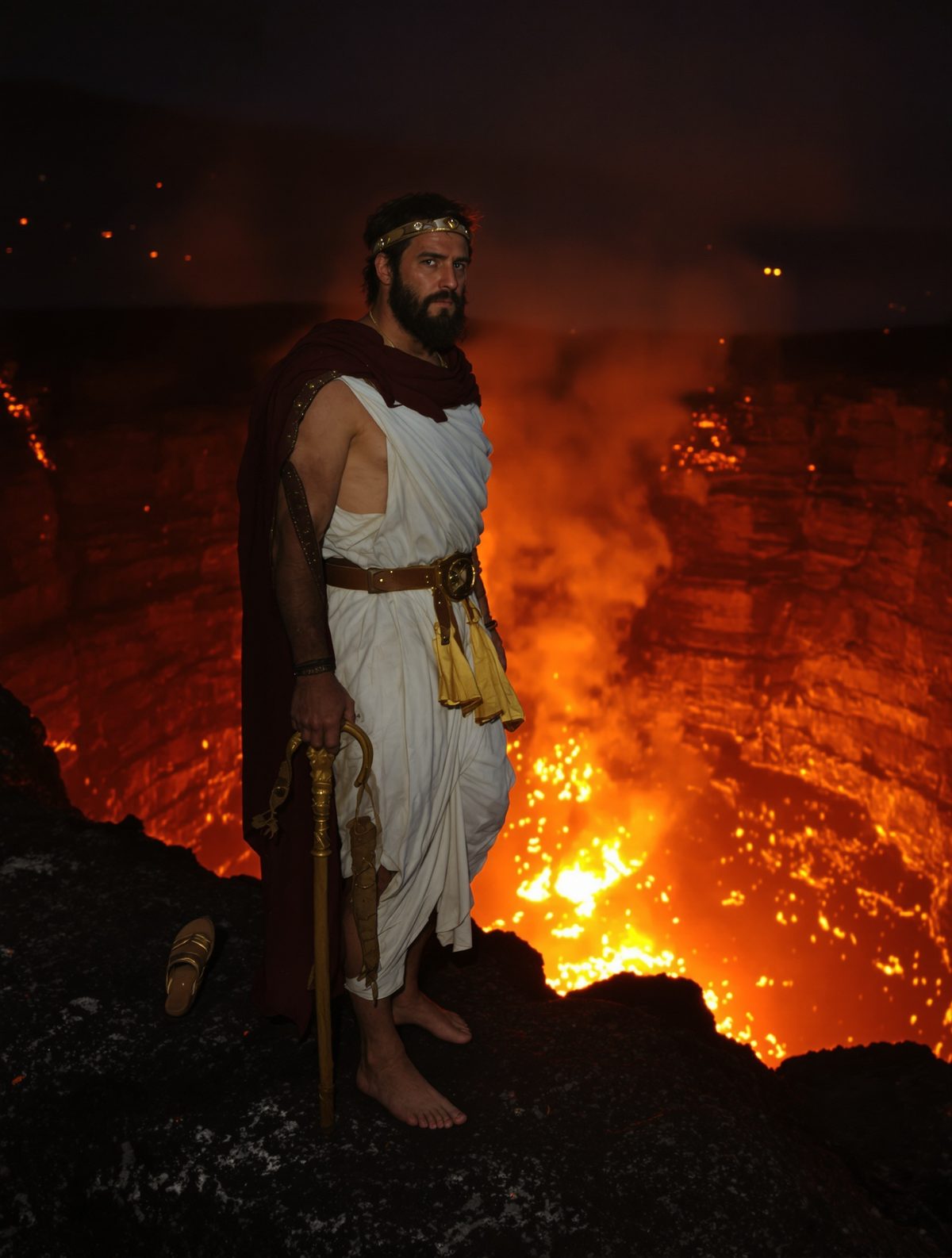
Picture this: You're a Greek astronomer in 134 BC, spending another routine night cataloguing the eternal, unchanging heavens above Rhodes. The stars have held their positions since time immemorial—everyone knows that. The gods placed them in their celestial dome at creation, and there they would remain until the end of days. Then suddenly, blazing in the constellation Scorpius where empty space existed just yesterday, burns a brilliant new star bright enough to see in broad daylight.
For most ancient observers, this cosmic shock would have sent them scrambling to the nearest temple, certain the gods were delivering an omen of war, plague, or imperial doom. But Hipparchus of Nicaea wasn't most observers. Instead of panicking, he asked a question that would revolutionize astronomy: If the heavens could surprise us once, what else might we be missing?
The Night the Universe Changed
That brilliant newcomer—what we now call a nova—shattered everything the ancient world thought it knew about the cosmos. For over a thousand years, Greek philosophers had taught that the celestial sphere was perfect and immutable. Aristotle himself had declared that while chaos might reign on Earth, the heavens were eternal and unchanging. This wasn't just astronomy; it was theology, philosophy, and the very foundation of how humans understood their place in creation.
Hipparchus, working on the island of Rhodes around 160-120 BC, had already established himself as the most precise observer of his generation. But witnessing this stellar birth drove him to an unprecedented conclusion: if astronomers were going to understand the heavens, they needed to map every single star with mathematical precision. Only then could they detect future changes in the cosmic order.
What happened next was nothing short of extraordinary. This one man, working without telescopes, photography, or any instrument more sophisticated than bronze astrolabes and wooden quadrants, set out to catalogue the entire visible universe.
Mapping the Unmappable
Hipparchus's star catalog wasn't just ambitious—it was methodical genius. Working night after night for years, he recorded the precise positions of 850 stars, dividing them into 48 constellations that we still recognize today. But his true breakthrough was inventing the magnitude system for measuring stellar brightness—a scale so elegant that modern astronomers still use a refined version of it 2,000 years later.
He classified stars into six categories: first-magnitude stars were the brightest (like Vega and Arcturus), while sixth-magnitude stars were barely visible to the naked eye. What makes this system remarkable is its mathematical foundation. Hipparchus didn't just say "this star is brighter than that one"—he created the first quantitative method for measuring cosmic luminosity. A first-magnitude star was roughly 2.5 times brighter than a second-magnitude star, which was 2.5 times brighter than a third-magnitude star, and so on.
But here's where it gets truly mind-blowing: Hipparchus achieved positional accuracy of about one degree for his stellar coordinates. To put that in perspective, he was measuring celestial positions more precisely than many star charts used by navigators well into the Renaissance period, 1,500 years later.
The Accidental Discovery That Rewrote Physics
While creating his star catalog, Hipparchus made an observation that accidentally revealed one of the universe's most subtle movements. Comparing his measurements to star positions recorded by earlier astronomers like Timocharis and Aristyllus 150 years before, he noticed something impossible: the stars appeared to have shifted relative to the equinoxes.
This wasn't observational error—Hipparchus was too careful for that. Instead, he'd discovered what we now call the precession of the equinoxes, a barely perceptible wobble in Earth's axis that takes 26,000 years to complete one cycle. The "fixed" stars weren't moving; our entire planet was slowly gyrating like a cosmic spinning top.
Think about the audacity of this discovery. In an age when most people believed the Earth was the stationary center of creation, Hipparchus used pure mathematical observation to detect our planet's motion through space. He calculated that this wobble moved the equinox about one degree every century—remarkably close to the modern value of one degree per 72 years.
The Master of Precision
Hipparchus's obsession with accuracy extended far beyond star maps. He measured the length of the year to within 6.5 minutes of the correct value, calculated the distance to the Moon using geometric parallax during lunar eclipses, and determined that our satellite was about 59 times Earth's radius away (the actual figure is 60.3).
Perhaps most impressively, he predicted the exact timing and visibility of solar eclipses centuries in advance. Using Babylonian eclipse records spanning 700 years, he developed mathematical models that could forecast these cosmic events with startling precision. When his calculations predicted a solar eclipse would be visible from the Hellespont on a specific date in 129 BC, skeptics gathered to watch his theory crumble. Instead, they witnessed the Moon's shadow sweep across the sky exactly as Hipparchus foretold.
He also revolutionized trigonometry, creating the first known table of chord lengths—essentially a primitive sine table—to solve astronomical problems. These mathematical tools allowed him to convert between different coordinate systems and calculate celestial positions with unprecedented accuracy.
The Genius They Tried to Forget
Here's one of history's great ironies: despite being arguably the most important astronomer of antiquity, Hipparchus's original works have almost entirely vanished. We know about his achievements primarily through the writings of Claudius Ptolemy, who built upon Hipparchus's foundation 250 years later to create the geocentric model that dominated Western astronomy for over a millennium.
Ptolemy's Almagest became so influential that it overshadowed its predecessor. While Ptolemy gave generous credit to Hipparchus, calling him "a lover of truth" and praising his observational precision, the original star catalog and most of Hipparchus's mathematical treatises were gradually lost as copies wore out and libraries burned.
Only one of his works survives intact: a commentary on a poem about constellations. It's like knowing Einstein only through his thoughts on limericks—a tragic loss for understanding one of history's greatest scientific minds.
The Star That Started a Revolution
That nova in Scorpius did more than just brighten the night sky—it ignited a scientific revolution that we're still living through today. When Hipparchus decided to map the entire heavens in response to a single unexpected star, he established the fundamental principle of modern astronomy: systematic observation over time reveals the universe's hidden patterns.
Every star catalog since then, from Tycho Brahe's Renaissance observations to the Hubble Space Telescope's deep field surveys, follows Hipparchus's template. When modern automated telescopes scan the sky nightly, searching for supernovae, asteroids, and other cosmic phenomena, they're essentially running his program on an industrial scale.
Even more remarkably, Hipparchus's magnitude system survived the transition to modern astrophysics. Today's astronomers still classify stellar brightness using his six-point scale, extended to accommodate both brighter objects (negative magnitudes) and fainter ones visible through telescopes. The star Vega, which he used as his reference point for first magnitude, remains the standard for calibrating stellar photometry.
Perhaps most profoundly, Hipparchus showed that the universe rewards patient, precise observation. That new star could have been dismissed as a divine mystery or a meaningless anomaly. Instead, it became the catalyst for humanity's first systematic survey of the cosmos—a reminder that sometimes the most important discoveries begin with a single, impossible thing blazing in the darkness, waiting for someone curious enough to map the whole sky just to understand what they've seen.