The iron pestles rose and fell with sickening thuds against flesh and bone, each blow designed to maximize agony while prolonging life. But instead of screams, something impossible echoed through the palace courtyard of Cyprus in 320 BC: laughter. Deep, genuine laughter that grew louder with each crushing impact.
The man being slowly ground to death was Anaxarchus of Abdera, one of ancient Greece's most brilliant philosophers. His executioner, the tyrant Nicocreon, had devised this particular torture specifically for him—a method so brutal that even hardened soldiers turned away. Yet Anaxarchus laughed as if he were watching a comedy in Athens's finest theater, delivering a final philosophical lesson that would echo through history: sometimes the greatest victory comes not from avoiding death, but from how you meet it.
The Philosopher Who Walked With Kings
To understand how Anaxarchus ended up in such a horrific situation, we need to travel back to the world of Alexander the Great. Anaxarchus wasn't some ivory tower academic—he was what we might call today a "public intellectual," a philosopher who moved in the highest circles of power and wasn't afraid to speak truth to authority.
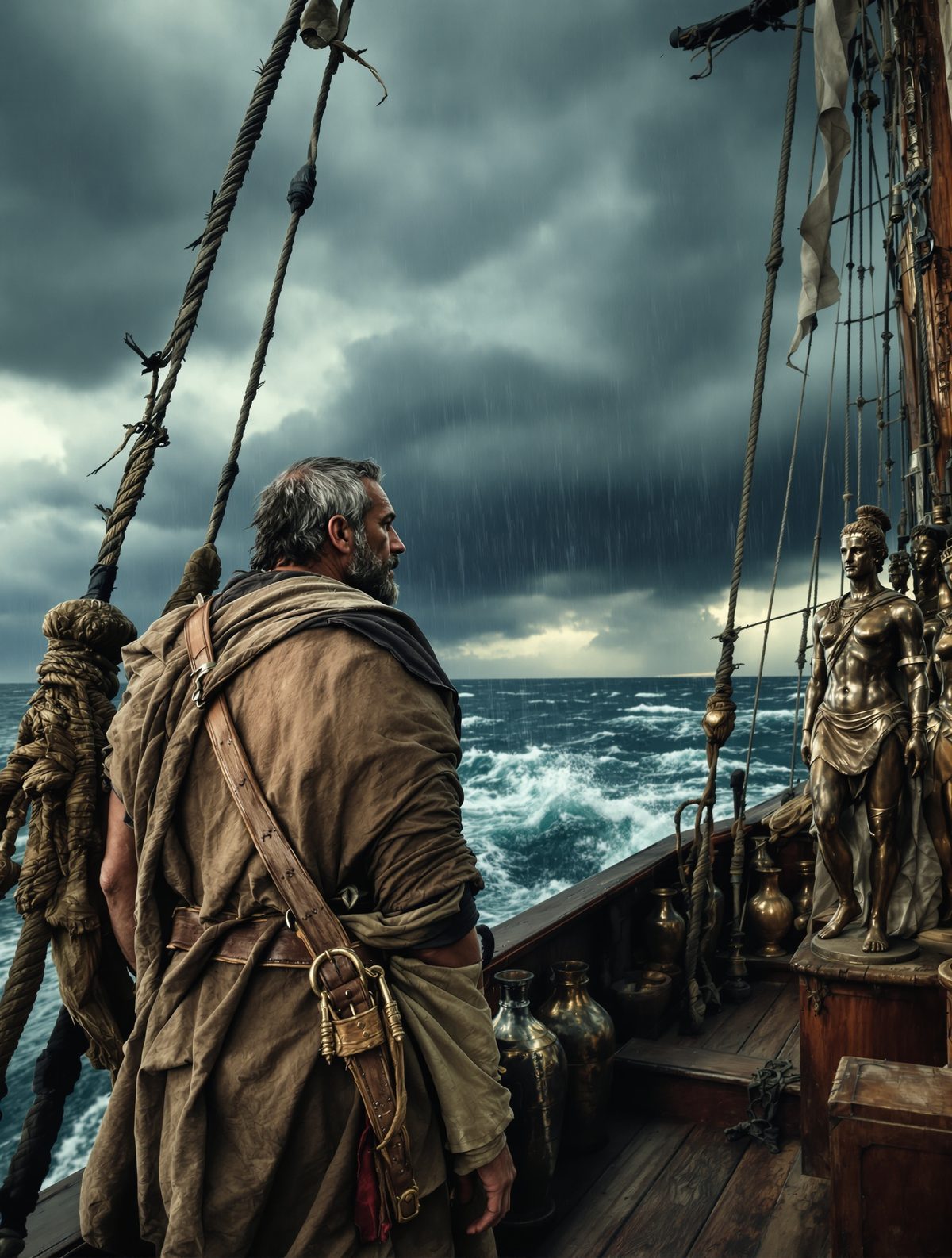
Born in Abdera around 370 BC, the same Thracian city that produced the famous atomist philosopher Democritus, Anaxarchus inherited a tradition of bold thinking. But while Democritus theorized about atoms in relative obscurity, Anaxarchus took his philosophy on the road—literally. He became one of Alexander's traveling companions, part of that extraordinary entourage that conquered most of the known world between 334 and 323 BC.
Ancient sources describe Anaxarchus as fearless in his honesty, even with the most powerful man on earth. When Alexander claimed divinity after visiting the oracle at Siwa in Egypt, most courtiers either enthusiastically agreed or kept silent. Not Anaxarchus. He reportedly told the young conqueror that if he truly was a god, he should act like one—with wisdom and restraint rather than the petty jealousies that plagued mortals.
This wasn't just philosophical posturing. When Alexander murdered his friend Cleitus in a drunken rage in 328 BC, the king was consumed with remorse. While others either condemned or excused the act, Anaxarchus offered a third path: he reminded Alexander that according to ancient belief, the actions of kings were inherently just because kings were placed by divine will. It was a pragmatic argument designed to free Alexander from paralyzing guilt so he could continue leading his army.
The Winds of Fortune Turn
For nearly a decade, Anaxarchus enjoyed the protection of the most powerful man in the world. But in 323 BC, everything changed. Alexander died suddenly in Babylon at age 32, and his vast empire immediately began fragmenting as his generals—the Diadochi—carved up territories and declared themselves kings.
Cyprus, that strategic island in the eastern Mediterranean, found itself under the control of Nicocreon, a local ruler who had managed to stay in power by carefully navigating the shifting alliances of the post-Alexander world. Nicocreon was everything Alexander wasn't: petty, vindictive, and obsessed with perceived slights to his dignity.
The historical record suggests that Anaxarchus and Nicocreon had crossed paths before, possibly during Alexander's campaigns when Nicocreon was still a vassal. Some sources hint that Anaxarchus had publicly mocked or criticized the Cypriot ruler, perhaps questioning his legitimacy or intelligence. In the fluid world of Alexander's court, such intellectual sparring was common. But now, without Alexander's protection, past insults became death sentences.
When Anaxarchus arrived in Cyprus—whether by choice or force remains unclear—he was immediately seized by Nicocreon's soldiers. The tyrant had been waiting years for this moment of revenge.
A Death Designed for Philosophers
Nicocreon didn't want just any execution for Anaxarchus. Crucifixion was too common, beheading too quick, poison too merciful. He wanted something that would specifically humiliate a man who prided himself on intellectual superiority. So he ordered his soldiers to bring iron pestles—the heavy tools normally used for grinding grain or spices in massive mortars.
The symbolism was deliberate and cruel: just as grain is slowly ground into powder, so would the philosopher be gradually reduced to pulp. It was execution as metaphor, death as philosophical statement. Nicocreon was essentially arguing that for all his high-minded theories about mind and matter, Anaxarchus was still just flesh that could be broken.
As the soldiers began their grim work, each blow calculated to inflict maximum pain without immediately killing, something extraordinary happened. Instead of begging or screaming, Anaxarchus began to laugh. Not the hysterical laughter of madness, but the genuine amusement of someone who had just heard an excellent joke.
Then he spoke the words that would make him immortal: "You pound the pouch of Anaxarchus, but not Anaxarchus himself."
With that single sentence, delivered as iron crushed his ribs and shattered his bones, the philosopher transformed his execution into a lecture. He was making the ultimate Platonic argument: that the physical body is merely a container, a "pouch" for the soul. The real Anaxarchus—his mind, his ideas, his essential self—existed beyond the reach of pestles and tyrants.
The Final Act of Defiance
Nicocreon was reportedly enraged by this response. Here was a man being literally ground to death, and he had the audacity to treat it as an intellectual exercise. The tyrant began threatening even worse tortures, promising to cut out Anaxarchus's tongue so he could no longer mock his captors.
It was then that Anaxarchus performed perhaps the most shocking act of defiance in recorded history. Rather than wait for his captors to cut out his tongue, he bit it off himself. The ancient historians disagree on exactly what happened next—some say he swallowed it, others that he spat it at Nicocreon's feet. But the most dramatic version, preserved by the historian Diogenes Laertius, claims that Anaxarchus spat his severed tongue directly at the tyrant, hitting him in the face with his own blood and flesh.
The symbolism was perfect: the organ of speech, the tool of philosophy, transformed into a weapon. Even in mutilating himself, Anaxarchus found a way to attack his tormentor. It was the ultimate statement that the mind could triumph over the body, that ideas could defeat brute force.
The soldiers continued their gruesome work until Anaxarchus finally died, but by then it didn't matter. He had already won. Instead of being remembered as a victim of tyrannical cruelty, he became the embodiment of philosophical courage. Nicocreon had sought to humiliate him but had instead created a legend.
The Philosophy Behind the Fury
Anaxarchus belonged to a school of thought called Democritean atomism, which held that everything in the universe—including human beings—was composed of tiny, indivisible particles moving through empty space. This might seem like abstract physics, but it carried profound implications for how one should face death.
If the body was just a temporary arrangement of atoms, and if the soul was either similarly atomic (and thus naturally immortal in its constituent parts) or entirely separate from physical matter, then death lost much of its terror. Pain was just sensation, fear merely an emotion, and both were ultimately illusions created by our misunderstanding of reality's true nature.
This wasn't mere intellectual posturing. Anaxarchus lived his philosophy so completely that he could maintain his beliefs even under the most extreme duress imaginable. His famous declaration that Nicocreon could pound his "pouch" but not his true self wasn't bravado—it was the logical conclusion of a lifetime spent thinking about the relationship between mind and matter.
Echoes Through Eternity
The story of Anaxarchus spread throughout the ancient world like wildfire. Here was proof that philosophy wasn't just idle speculation but a practical guide to living—and dying—with dignity. Stoic philosophers in particular embraced his example, seeing in it confirmation of their belief that external circumstances could never truly harm a person who maintained proper understanding and self-control.
But perhaps the most remarkable thing about Anaxarchus's death is how it inverted the traditional relationship between power and wisdom. Nicocreon had all the armies, all the weapons, all the apparent control. Yet it was Anaxarchus, broken and dying, who demonstrated true strength. The tyrant could destroy the body but couldn't touch the ideas, couldn't silence the laughter, couldn't prevent his victim from transforming torture into triumph.
In our age of authoritarianism and political persecution, when journalists disappear and dissidents face imprisonment or worse, the example of Anaxarchus remains startlingly relevant. He reminds us that the greatest victories are often moral rather than material, that how we face adversity matters more than whether we can avoid it, and that sometimes the most powerful response to brutality isn't resistance but laughter—the kind of deep, knowing laughter that comes from understanding something your tormentors never will.
Nicocreon died forgotten, his name preserved only because of what he did to Anaxarchus. The philosopher he tried to humiliate achieved a kind of immortality, his words still quoted more than two millennia later. In the end, the pestles ground away nothing that truly mattered. The pouch was destroyed, but Anaxarchus himself—his courage, his wit, his unshakeable conviction that the life of the mind transcends the fate of the body—remains unbroken.