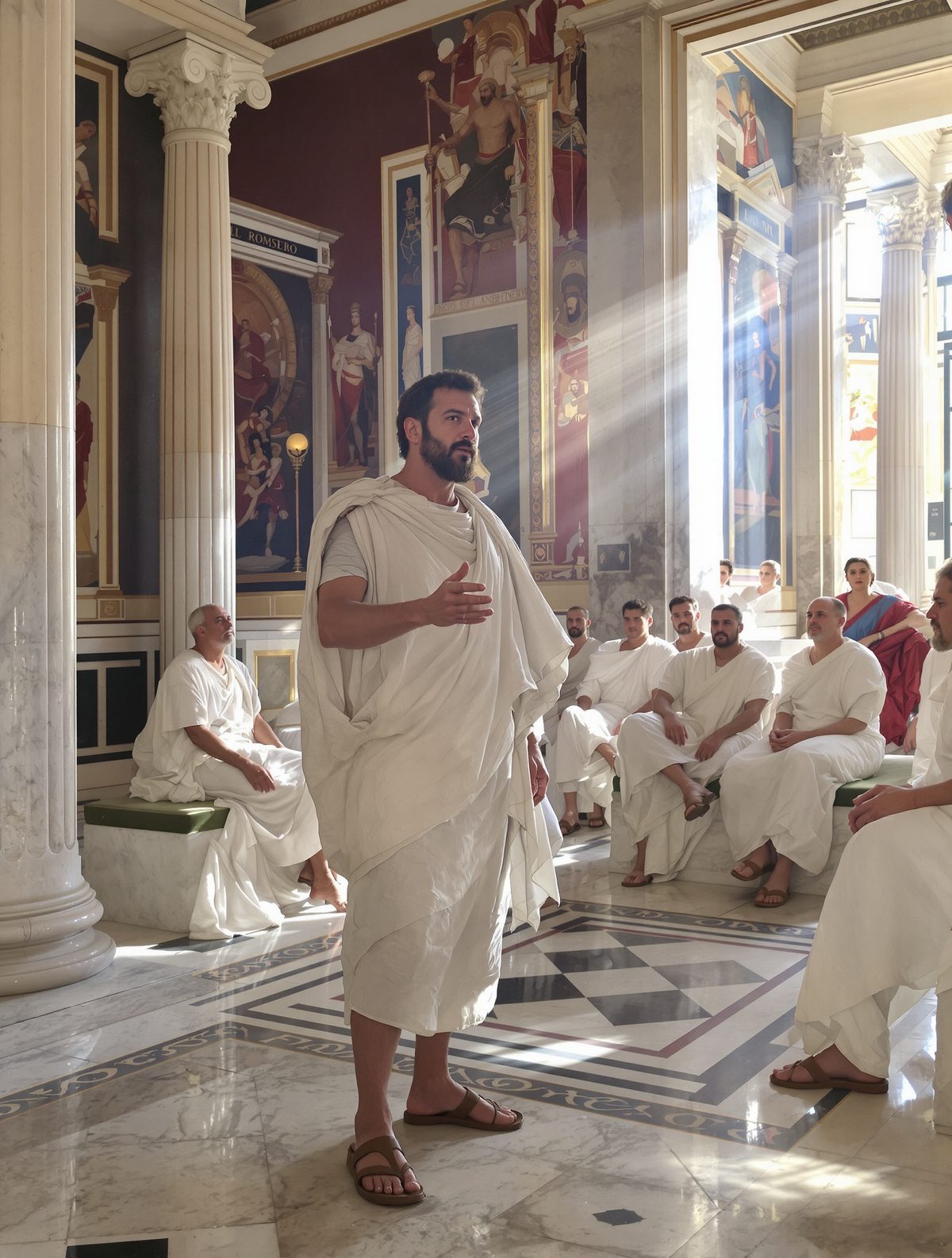
Picture this: you're sitting in ancient Athens around 440 BC, listening to a well-traveled Greek scholar regale an audience with tales from his journeys. He speaks with the authority of someone who has walked the battlefields of Marathon and Thermopylae, who has interviewed Persian generals and Egyptian priests. His voice carries the weight of meticulous research as he describes troop movements, political machinations, and the clash of empires. Then, without missing a beat, he casually mentions that Arabia is protected by flying snakes with wings like bats, and that somewhere in India, ants the size of foxes dig up gold dust.
Meet Herodotus of Halicarnassus—the man who invented the very concept of history as we know it, yet whose masterwork reads like a fever dream mixing documentary precision with mythical bestiary. This is the paradox of the "Father of History": a scholar rigorous enough to create an entirely new discipline, credulous enough to believe in phoenixes that build nests from cinnamon sticks.
The Revolutionary Who Invented Yesterday
Before Herodotus, the past was the domain of poets and myth-makers. Homer sang of gods and heroes, but no one thought to systematically investigate what actually happened and why. Then, sometime around 484 BC, Herodotus was born in Halicarnassus (modern-day Bodrum, Turkey), a cosmopolitan port city where Greek, Persian, Lydian, and Phoenician cultures mingled like spices in a marketplace.
Growing up in this cultural crossroads shaped Herodotus profoundly. Unlike most Greeks, who viewed foreigners as "barbarians," he developed an insatiable curiosity about other peoples and their customs. When he began writing his Histories around 440 BC, he opened with a revolutionary statement of purpose: to prevent "the great and wonderful actions of the Greeks and the Barbarians from losing their due meed of glory; and to put on record what were their grounds of feud."
Notice what's missing? No gods dictating events. No divine intervention. Just humans making decisions that led to consequences. Herodotus had just invented the idea that human affairs could be studied systematically. He created the word "historia," meaning "inquiry" or "investigation." History wasn't something that happened to you—it was something you could understand.
The Detective Who Walked Ancient Battlefields
Herodotus didn't just sit in a library and compile existing sources. He traveled obsessively, covering an estimated 1,700 miles throughout the Mediterranean and beyond. He interviewed Persian veterans of the Greek wars, Egyptian priests who claimed their records went back thousands of years, and Scythian nomads from the Black Sea steppes.
His detective work was revolutionary. At Thermopylae, he examined the battlefield where 300 Spartans had made their famous last stand in 480 BC. He counted the graves, measured distances, and interviewed locals who remembered the battle. When describing the massive Persian invasion fleet, he didn't just say "many ships"—he calculated that Xerxes' navy contained 1,207 triremes plus 3,000 smaller vessels, carrying over 500,000 men.
His account of the Battle of Marathon shows this same meticulous attention to detail. He traced the movements of the Athenian phalanx, noted that the battle lasted all day, and recorded that 6,400 Persians died while only 192 Athenians fell. He even preserved the story of Pheidippides, the messenger who ran from Marathon to Athens—though contrary to popular belief, Herodotus has him running from Athens to Sparta to request help, not collapsing after announcing victory.
The Gullible Genius and His Impossible Menagerie
But here's where Herodotus becomes fascinatingly, frustratingly human. The same scholar who carefully verified battlefield casualties also solemnly reported that cinnamon grows in Arabia, guarded by enormous birds that build their nests from cinnamon sticks. Clever Arabs, he explained, leave chunks of donkey meat near the nests. The birds carry this meat to their nests, which collapse under the weight, allowing the Arabs to collect the fallen cinnamon.
The flying serpents of Arabia were equally real to him. These creatures, he claimed, had wings like bats and would swarm into Egypt each spring if not for the noble ibis birds who fought them at the border. Herodotus swore he had personally seen piles of their bones and backbones near the city of Buto.
Then there were the gold-digging ants of India—creatures larger than foxes but smaller than dogs, who threw up gold dust while excavating their burrows. Indians, according to Herodotus, would ride their fastest camels to collect this gold, timing their raids for when the ants were underground during the heat of the day. Modern scholars suggest he may have been describing marmots or other burrowing animals whose digging actually did expose gold-bearing sand in certain regions.
When Ancient Fake News Meets Earnest Scholarship
Why did a brilliant investigator fall for such obvious nonsense? The answer reveals something profound about the ancient world. Herodotus lived in an age before the scientific method, before the distinction between empirical observation and hearsay testimony was clearly established. When an Egyptian priest told him that phoenixes visited Heliopolis every 500 years, carrying their dead fathers encased in balls of myrrh, Herodotus applied the same credibility standards he used for political intelligence.
Moreover, some of his "fantasies" contained kernels of truth that modern archaeology has validated. He described enormous pyramids in Egypt when most Greeks thought they were myths. He accurately reported that the Nile flooded annually (though he got the cause wrong), that the Black Sea was smaller than the Mediterranean, and that the Caspian was an inland sea rather than part of the ocean—all facts that contradicted popular Greek assumptions.
His account of the Persian postal system—where mounted messengers rode in relay, with fresh horses waiting at stations—seemed impossibly efficient to his Greek audience. "Neither snow nor rain nor heat nor gloom of night stays these courageous couriers from the swift completion of their appointed rounds," he wrote, providing the unofficial motto for the modern U.S. Postal Service. Except Herodotus was describing a real system that archaeologists have now traced across the Persian Empire.
The Persian Wars Through Greek Eyes
Herodotus's masterpiece remains his account of the Persian Wars (499-449 BC), the epic clash between the Greek city-states and the mighty Persian Empire. His narrative reads like a thriller, complete with larger-than-life characters: Leonidas and his 300 Spartans, the wily Athenian general Themistocles, the Persian king Xerxes who whipped the sea for destroying his bridge.
But even here, Herodotus couldn't resist embellishing. He claimed that Xerxes' army was so vast it drank rivers dry—specifically, that it numbered 1,700,000 fighting men plus an equal number of support personnel. Modern historians estimate the actual invasion force at perhaps 200,000 total. Herodotus also reported that the Persian fleet was destroyed by a divine storm at just the right moment—convenient for the Greeks, suspicious to modern readers.
Yet beneath the hyperbole lies genuine insight. Herodotus understood that this wasn't just a military conflict but a clash of civilizations. He portrayed the Persians not as monsters but as humans with their own customs and motivations. This cultural relativism was revolutionary in an age when most peoples considered themselves uniquely civilized.
The Father's Complicated Legacy
Herodotus died around 425 BC, probably never imagining that scholars would still be wrestling with his work 2,500 years later. His immediate successors were harsh critics. Thucydides, who wrote about the Peloponnesian War, pointedly avoided all supernatural elements and criticized historians who prioritized entertainment over accuracy. Cicero later dubbed Herodotus "the Father of Lies" as well as "the Father of History."
But here's the thing: Herodotus never claimed to believe everything he reported. Throughout his work, he uses phrases like "as the Egyptians say" or "according to the Persians." He was often simply recording what people told him, preserving a vast oral tradition that would otherwise have vanished. When he does express skepticism—as he does about claims that the sun once rose in the west—it's clear he possessed critical thinking skills.
Modern historians face the same challenges Herodotus did: incomplete sources, conflicting testimonies, the pressure to craft compelling narratives from fragmentary evidence. We have better tools for verification now, but we're still human beings trying to make sense of human behavior across vast gulfs of time and culture. In our age of "alternative facts" and viral misinformation, Herodotus's mixture of careful investigation and credulous acceptance feels remarkably contemporary.
Perhaps that's his greatest legacy—not the flying snakes or gold-digging ants, but the revolutionary idea that the past deserves systematic investigation, that human actions have consequences worth understanding, and that even our enemies have stories worth hearing. He may have believed in impossible creatures, but Herodotus also believed in something far more powerful: the importance of preserving human experience for future generations. In a world where truth and fiction spread at the speed of light, that mission has never been more vital.