Most have never heard of a dying man who changed the world from his deathbed. Yet his final gift is the very lens through which we view medieval history.
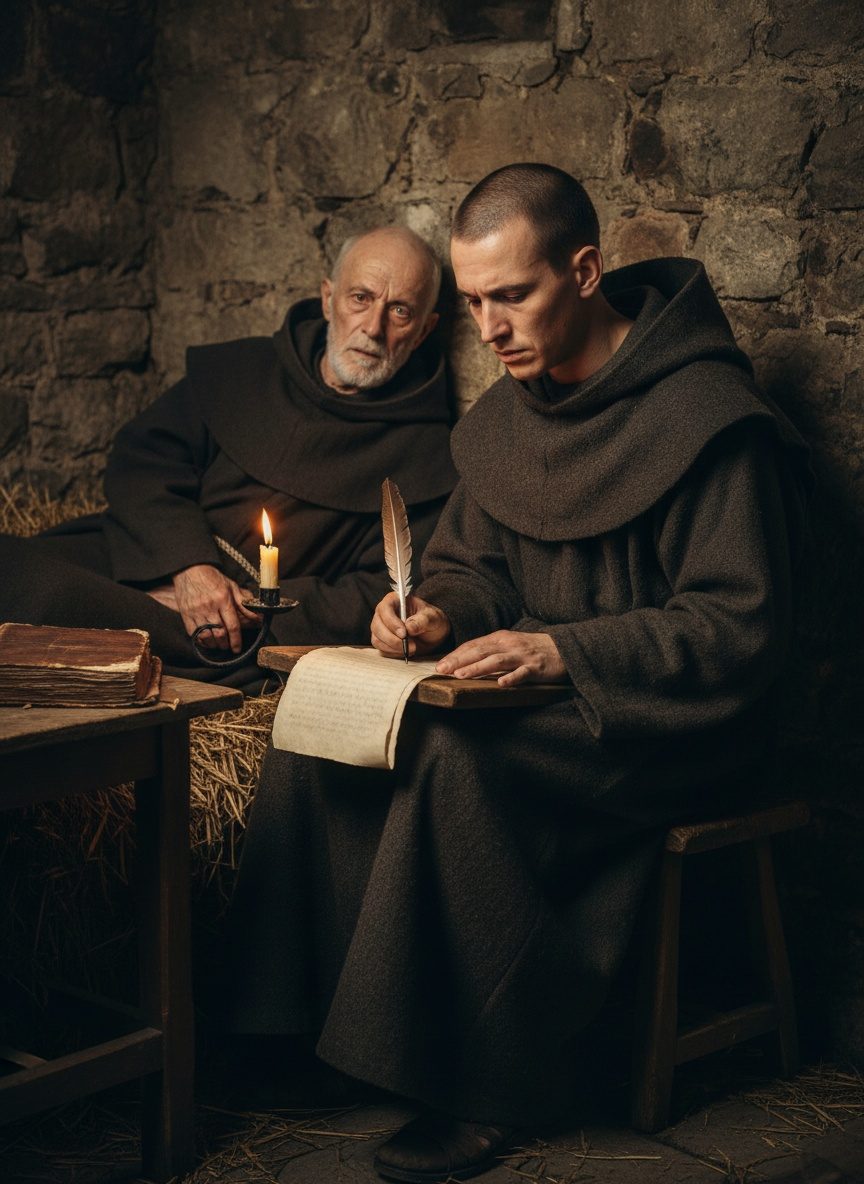
The year was 735 AD, and in the cold, echoing corridors of the Jarrow monastery in northeast England, an extraordinary scene was unfolding. Bede lay dying, an old monk whose frail body could do little more than whisper his last thoughts. Yet his mind was fervent, relentless. With each labored breath, he dictated words that would bridge the gap between an insular Dark Ages Britain and a greater European tapestry. Students gathered around him, their faces wet with tears as they transcribed his final masterwork. This was not merely the passing of a monk—it was a moment when history was captured even as it ebbed away.
Bede had spent more than sixty years entrenched within the stone walls of his monastic home, dedicating his life to learning. The monastery at Jarrow might have seemed a remote outpost of civilization on the wind-swept shores of Northumbria, but it was a hub of intellectual and spiritual enlightenment. Here, in the silence occasionally broken by the chant of psalms, Bede transformed Jarrow into a beacon of knowledge. His cell was a library unto itself, housing the collective wisdom found in every book he could procure. This scholarly zeal bestowed upon Bede the tools to pen works that would outlive stone.
The world outside his sanctuary was in tumult. In an era often mislabeled as the "Dark Ages," Europe was a patchwork of warring tribes and shifting alliances. Yet, within this tumultuous milieu, monasteries like Jarrow preserved the knowledge that could have otherwise been lost to chaos. It is from this crucible of strife and learning that Bede emerged, recognized by his contemporaries and posterity alike as a supreme intellectual force of his time. His life and work offered a singular glimpse into a world teetering between the twilight of antiquity and the dawn of a medieval era.
Bede's magnum opus, The Ecclesiastical History of the English People, completed at the twilight of his life, was a culmination of his lifelong devotion to chronicling history. This was not simply a narrative of events. Its pages carried the weight of a people seeking identity—a nascent England searching for its soul. Bede traced the trajectory of Christianity's growth, from its nascent roots to its flowering as a central cultural force, placing local events within a broader ecclesiastical and political context. It was, in essence, an unmatched synthesis of cultural history, offering readers then and now a bridge across time.
The work was groundbreaking in its methodology. Prior to Bede, historical accounts often blurred the line between fact and legend. Chronicle writers tended to embroider events with the fantastic, leaving truth shrouded in myth. Bede was rigorous, scrutinizing sources with caution and a critical eye. His insistence on corroborating stories through witness accounts and cross-referenced documents laid the groundwork for modern historiography. Scholars would later marvel at his methods which, while not entirely modern, marked a significant leap from the anecdotal narratives that preceded his time.
Bede never left Northumbria—an extraordinary fact when considered the breadth of knowledge and perspective he brought to his works. His understanding of far-off places and distant times was informed by an insatiable appetite for learning, one satisfied by countless hours poring over sacred texts and scholarly commentaries. In a world where travel was arduous and communication slow, Bede's cell was a nexus of information, serving as both compass and lighthouse in the murky seas of the medieval mind.
As his final day drew closer, Bede worked against time itself, dictating a translation of the Gospel of John from Latin to Old English. This undertaking was prophetic in its intent: making sacred texts accessible, bridging the divine and the everyday, rooted in the vernacular language of the people. It was an archetype of translational work that would echo through the ages, inspiring future religious and cultural transcriptions that brought texts from the cloisters to common tongues.
What made those final dictations more heart-wrenching was their setting—the thin veil between life and death, where every spoken word was akin to a precious bead added to a rosary, linking the sacred and the scholarly. Bede’s pupils, many of whom had studied under him for years, committed his dying words to paper with trembling hands. A scene of sorrow became a moment of creation as, with unwavering devotion, they ensured their master's voice would transcend his passing.
When he finally uttered his last sentence, one imagines the charged silence that followed—an absorptive moment where the mundane and the monumental meet. Bede’s physical presence ebbed, but his intellect and spirit burned brighter than before, captured in ink, his history eternal.
Bede’s writings not only unraveled the complexity of his own time but would become the singular narrative through which medieval England was viewed by successive generations. His impact lasted beyond the era that followed his, influencing the leaders and populations that arose in the subsequent years. The ripple of his contributions traveled far beyond the British Isles, informing European scholarship and thought.
In a modest cell, in a remote corner of England, a dying monk defied limits of both geography and mortality. Through his final victory over silence, Bede bestowed upon us not just a record of the past, but a method to understand it. His life and work remain a touchstone, reminding us of the unyielding power of knowledge even in the face of death. It is perhaps one of history's most profound testimonies to the timelessness of ideas—that within the fragile present moments of a life lay foundations strong enough to support the weight of centuries. For in understanding Bede, we find keys to our beginnings, and through his lens, we cast our gaze forward, pondering what histories will yet be written.