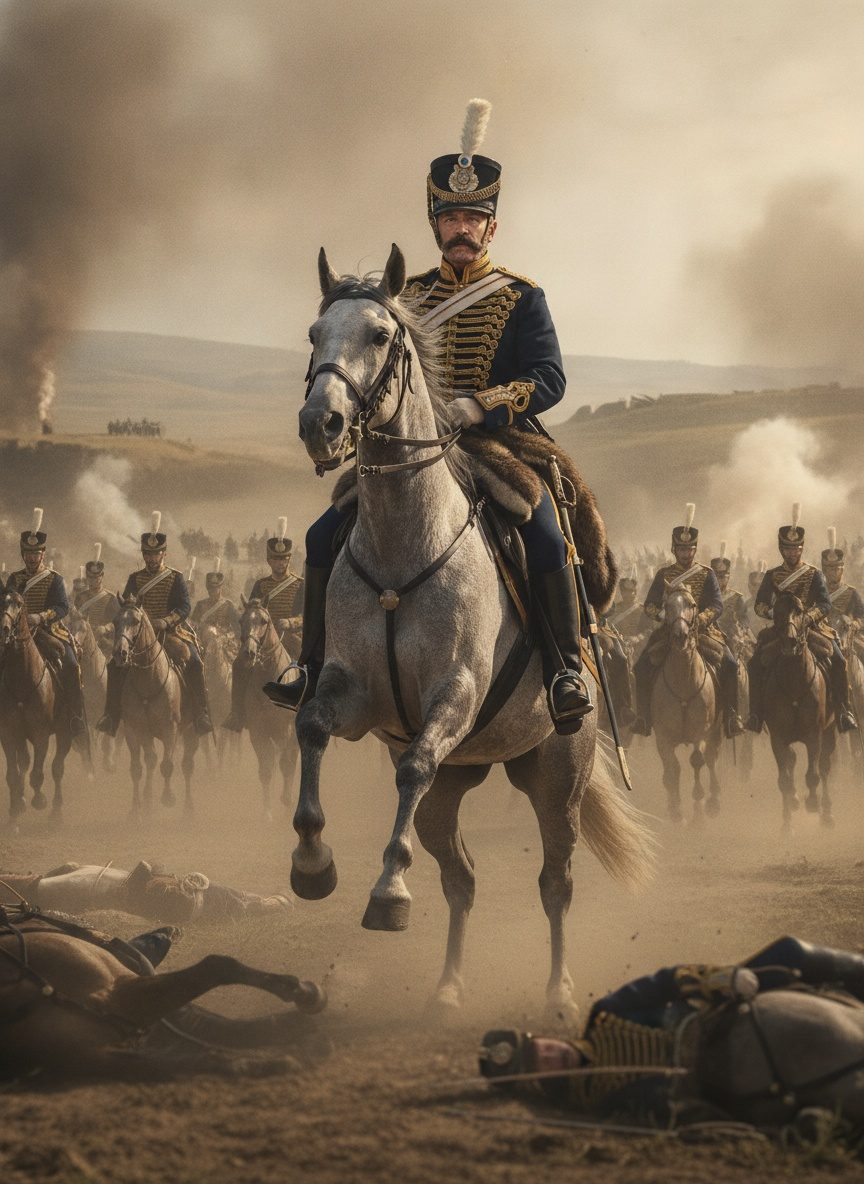
The ground trembled beneath the hooves of six hundred horses as they thundered through the valley. Cannonballs whistled through the air, smashing into earth, man, and beast, leaving trails of smoke and chaos in their wake. The air was thick with the acrid smell of gunpowder and the desperate cries of men. Amidst the cacophony, one could barely discern the commands, but the Light Brigade knew their task. They were charging — knowingly — into the maw of death.
The Fateful Miscommunication
The morning of October 25, 1854, dawned with a tense quiet on the Crimean Peninsula. The British forces were entrenched in conflict with the might of the Russian Empire, and the air was heavy with anticipation. The Hill overlooking the North Valley was lined with Russian artillery, an intimidating spectacle of power and strategy. It was here, amid the chaos, that an order was misinterpreted, setting the stage for one of the most ill-fated military maneuvers in history.
Captain Louis Nolan, a seasoned and passionate cavalry officer, stormed to deliver the command to Lord Cardigan, the leader of the Light Brigade. Whether through misunderstanding or miscommunication, Nolan's directive led Cardigan to believe that the task was to capture the Russian guns at the valley's end. All present knew it was suicidal — the valley was a death trap, flanked on three sides by Russian artillery. Yet, tradition and a rigid adherence to orders saw the line formations drawn and the command given.
The Courage of the Ride
The brigade, a splendid spectacle in their brilliant uniforms, moved out with the precision of a choreographed dance. They charged straight into the valley, sabres drawn and hearts steeled against the inevitable. What followed was an awe-inspiring display of courage where each man became a warrior poet, writing stanza after stanza in the annals of military valor.
The Russian gunners, bewildered by the audacity of the charge, could scarcely believe it themselves. Their closer proximity allowed every round to find deadly purchase. Halfway into the charge, the once-formidable six hundred had been reduced to fewer than two hundred. Yet they pressed on, every inch of progress bought with blood and unyielding spirit.
The Teeth of the Guns
They reached the guns. All around them, Russian soldiers, aghast at the sight, scarcely had time to ready their bayonets. In that moment, the Light Brigade demonstrated why they were feared and respected. They slashed and shot, their horses trampling over caissons and dead bodies alike. Few engagements in military history have captured the extremity of human courage, madness, and tragedy as much as this moment atop the Russian guns.
Then came the impossible part — retreat. Collectively bewildered by the reality they faced, the soldiers turned back, retracing their steps through the valley of destruction. Those who survived rejoined their lines bloodied but alive. They had faced hell and clawed their way back out.
The Aftermath and Reverberations
Of the six hundred men who set forth, barely a handful returned unscathed. The charge had led to the deaths of over one hundred soldiers and countless horses. Controversy erupted immediately. How could such an order be given? How could it be executed without question? Lord Cardigan, unscathed and discontented, claimed his innocence amidst questions of command confusion that stretched up to the ranks of Lord Raglan, the British commander in the Crimean War.
Despite the strategical failure, the charge was hailed as a testament to the bravery of the British cavalry. Alfred Lord Tennyson immortalized their endeavor in his poem "The Charge of the Light Brigade," capturing the harrowing mantras which history would echo: “Theirs not to make reply, Theirs not to reason why, Theirs but to do and die.”
Why This Story Matters
The Charge of the Light Brigade stands not only as a historical curiosity but as a stark reflection on the nature of military command, valor, organizational flaws, and the often-senseless loss of life in war. While strategy and mission form the backbone of military operations, the implications of rigidly following orders — without question or understanding — cannot be understated. This story where six men remained to mount a charge captures the tragic elegance of human courage against the grim backdrop of misguided command.
As we remember this astonishing act of disciplined bravery, we're reminded of the profound consequences that can arise from miscommunication and the perilous courage of those who serve on the front lines, often under inexplicable circumstances. In every cannonball, in every charge, lies a tale waiting to be told — a testament to the haunting beauty and brutality of war.