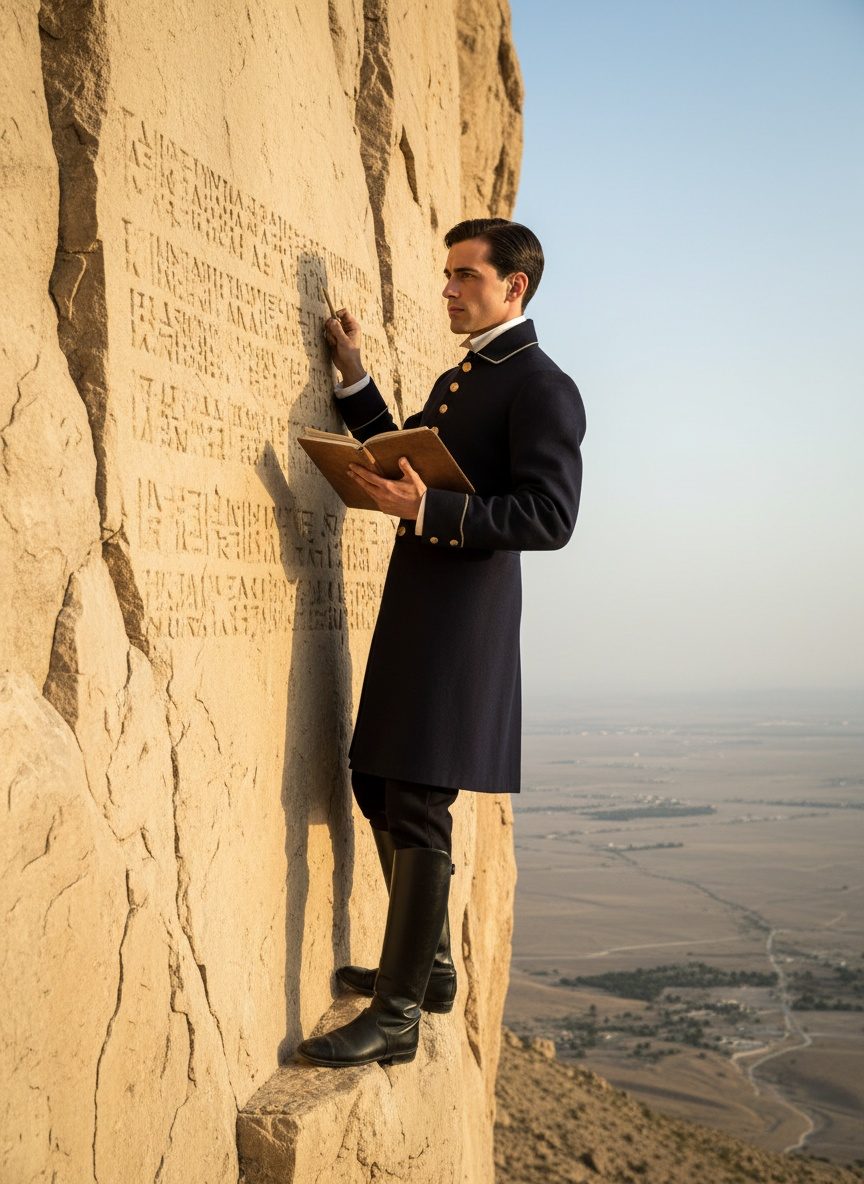
The air trembled with the heat of the Persian sun, cascading down a near-vertical cliff. The rugged escarpment of Behistun loomed imposingly in western Persia, its craggy face a sentinel of secrets buried in stone. Below, the earth fell away sharply, 340 feet to the valley floor, where silences stretched unbroken except for the distant wail of wind across the rocks. It was here, in this wild and forbidding place, that the ancient words of Darius the Great lay in waiting—words that had been silent to the world for two millennia. It was here, too, that a solitary figure clung precariously to the cliffside, locked in a life-or-death embrace with history itself. The young British officer, Henry Rawlinson, was about to unlock a secret that would change the understanding of a civilization.
A Race Against Time and Terrain
In 1835, the vast expanse of the Persian Empire's rocky inheritance was a land of mystery to outsiders. Yet this sense of the unknown was what drew Henry Rawlinson to the towering cliff of Behistun. The young officer was not just a soldier; he was an adventurer in pursuit of ancient lore. Armed with grit and an insatiable thirst for knowledge, Rawlinson set his sights on an audacious goal: to transcribe the inscriptions etched into the cliff by order of Darius the Great. These inscriptions had puzzled and tempted historians since the days of antiquity, and they were akin to a Rosetta Stone for cuneiform script. Each sweep of Rawlinson's quill was a brush against history, a painstaking attempt to decode the edicts of an ancient king.
Without the modern safety measures of ropes or harnesses, he faced gusting winds without the slightest margin for error. Every careful foothold on the narrow ledges was a gamble with the gods of fate. The cliff itself was unfriendly terrain, its rigid, sun-baked surface providing little comfort to bare skin grappling for stability. The higher Rawlinson climbed, the fainter became the sounds of the world below, displaced by the beating of his heart and the scrape of rock against his tools.
Transcribing the Past: Word by Word
Perched high above the valley floor, a makeshift platform salvaged from the wilderness became Rawlinson’s bastion of discovery. The inscriptions were scrawled in three different scripts: Old Persian, Elamite, and Babylonian. With each line he meticulously copied, Rawlinson stepped further back in time. The challenge wasn't just the language, but piecing together the narrative that unfolded beneath his fingertips with artful precision.
The magnitude of the carvings was nearly as intimidating as their location. Monumental reliefs portrayed Darius the Great beside his captives, emblematic of his empire-spanning victories and supremacy. But it was the accompanying text that held the key to understanding that empire—the epic tale of its conquests, rebellions, and sovereignties told directly from the mouth of their greatest ruler. Rawlinson knew these inscriptions could illuminate the shadowed corridors of Persian history; deciphering such a text was akin to summoning a lost empire from the ether of forgotten time.
Unveiling the Ruler's Chronicle
Each character copied, each line transcribed, amounted to a labor over many days, weeks, and months. Rawlinson faced not only the dangerous physicality of the task but also the daunting intellectual puzzle of interpreting these ancient languages. Yet determination warred on his side. He worked with disciplined obsession, sometimes perched for hours against the unyielding rock, shading sections to make the faint carvings stand out and coaxing details from the raw stone.
The inscriptions of Darius were more than merely a royal proclamation; they encapsulated the complexities of the Persian Empire at its zenith. They revealed much about the governance, culture, and psyche of a civilization that had shaped a sizable portion of the ancient world. Rawlinson was relentless in his pursuit, as if he had bound his soul to the stone above the chasm—to abandon the quest was to unmake all the wonders he sought to uncover.
The World Translated
Henry Rawlinson's daring efforts were not in vain. By copying and eventually translating the Behistun inscriptions, he contributed a cornerstone to the study of ancient Mesopotamia and the Near East. As the Western world began to glean understanding from these texts, the narratives they shared filled gaps in human history, offered profound insights into the reign of Darius the Great, and cultivated appreciation for the sophistication of the Persian Empire.
In the precipice between known and unknown, Rawlinson had not simply bridged a chasm of rock, but a chasm of time. His hands, though kiss-marked by the cliff's resistance, had delivered a narrative that transcended the ages. One young officer’s fearless devotion had handed the annals of a millennia-old king back to the world. This story matters because it reminds us that behind every stone and inscription of our past is a story waiting for someone fearless enough—or perhaps foolish enough—to listen. It wasn't just a climb; it was a reconnection with the essence of humanity's shared story, written in stone and carried forth on the winds of time to those who dare to truly see.