The Inca Empire never knew the horse. Yet, it galloped information at lightning speed across the vast Andes. In 1500 AD, perched on spine-tingling altitudes, this sprawling empire wove together cities, cultures, and communities without the convenience of a written language, horses, or wheels. Instead, the Inca relied on the chasquis, their fleet-footed messengers, to connect the remotest corners of their civilization. One such chasqui, an anonymous hero without whom the Empire's daily operability might stagger, remains etched in the legends echoing through these grand mountains.
The setting was nothing short of astonishing. The Andes, the world's longest continental mountain range, served as the spine of the Inca Empire, which stretched over 2,500 miles. At its height, this empire was home to some ten million subjects, sprawling from modern-day Colombia to Chile, encompassing arid deserts, lush rainforests, and frigid highlands. The very idea of coordinating an empire that large would be a colossal challenge even today. But for the Incas, who lacked the wheel and the horse, it was a triumph of human ingenuity and endurance.
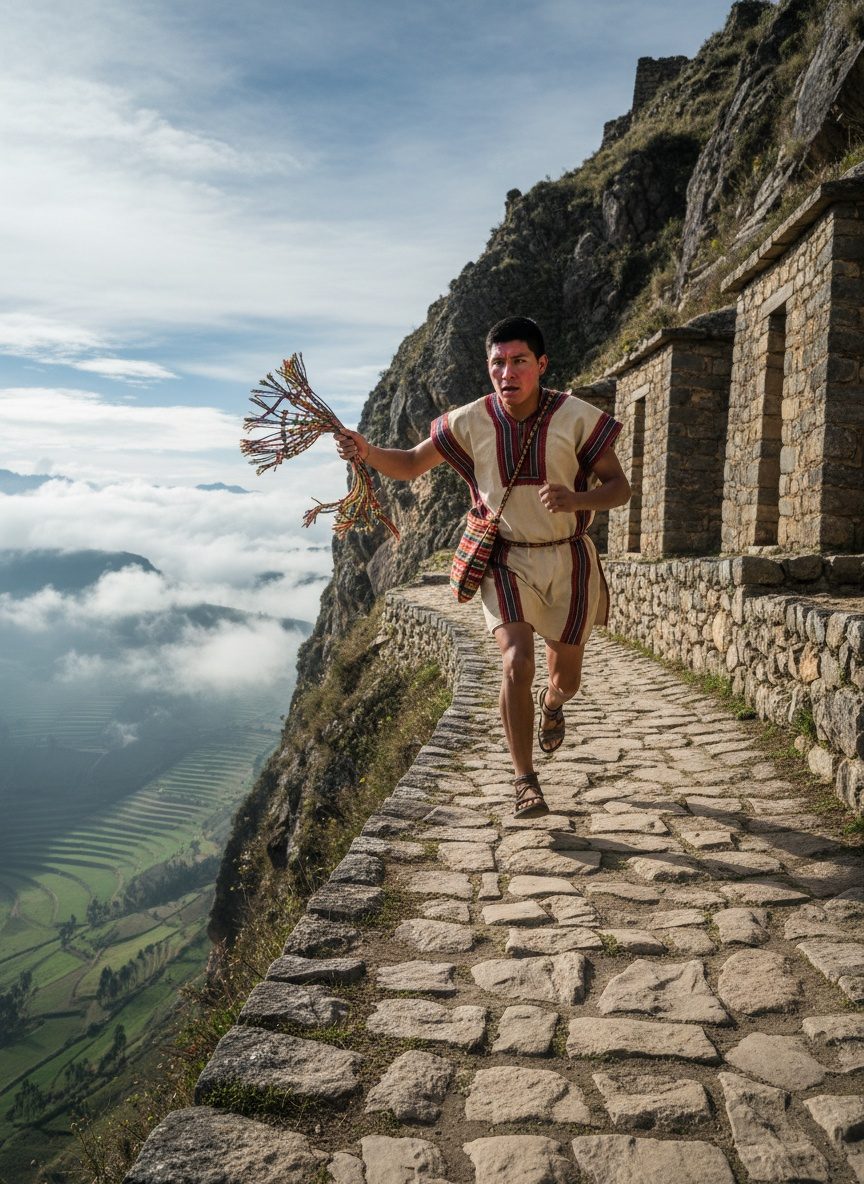
The chasqui runners were the lifeblood of this vast network. Young, disciplined, and accustomed to the rarefied air of high altitudes, they formed an elite cadre of messengers trained from a young age to run with speed and stamina through the Empire’s intricate system of roads known as the Qhapaq Ñan. This vast network, as wide as 24,800 miles, connected the mighty cities of Cuzco and Quito, as well as hundreds of smaller towns and villages. Each chasqui station lay within a few miles of the next, perched precariously on high peaks or nestled in hidden valleys, radiating the network’s pulse through the empire.
At the center of this system was the emperor, or the Sapa Inca. His palace in Cuzco, the empire's heart, buzzed with activity as missives, demands, and tidings flowed in and out ceaselessly. One such message might contain a quipu, an intricate assembly of knotted cords used for record-keeping and communication. The chasquis, versed in the readable textures and sequences of knots, translated the tactile language as they ran. With remarkable memory and precision rivaling modern-day digital applications, these runners ensured the emperor's orders traversed the unyielding terrain swiftly.
The chasquis themselves were marvels of endurance and commitment, sprinting day and night, through storms or under the golden Andean sun. Each runner, a living cog in the mechanism of empire control and operation, embodied a legacy of physical and mental fortitude. They navigated the narrow trails, where sheer drops threatened with even the smallest misstep, all for the sake of delivering messages so quickly that it seemed the mountain winds themselves carried the words.
Imagine the heart-pounding handover. A chasqui, having run breathless over jagged paths and lackluster shrubbery, arrived at the next tukuyricuy (relay station). There, another eager young messenger awaited, coiled with anticipation. Adrenaline surged as the quipu was swiftly exchanged. No words, only the nod of understanding before the journey resumed. Thus, in an astonishing feat of relay, a message could traverse the whole of the Incan lands within days, achieving what seemed impossible without beasts of burden or any form of drawn carriage.
Without a written language, these messages faced the challenge of maintaining accuracy. Here emerged the critical role of the quipu, the knotted threads of multi-colored wool or cotton, meticulously arranged, each variation of twist and color coded with meaning. The chasquis received rigorous instruction in quipu literacy, their deft fingers memorizing the complex conversations bound into the threads. Thus, each runner's role extended beyond mere messenger to that of an animated decipherer, ensuring each piece in the silent dialogue reached its recipient undistorted.
This system was so efficient, the Spanish chroniclers, upon their arrival, marveled at the Inca's administrative prowess. Even the Spanish—used to systems that relied heavily on the horse—were astonished by the rapid relay of information unassisted by four-legged transportation or formal written documentation. Through the chasqui, the flow of data and decision-making was unbeatable, a marvel of human performance that defied the towering trepidations of the Andes.
Today, the chasqui might appear as ghostly apparitions, fading into the mist of mountain legends and ancient stones. Yet, their legacy speaks to the inexhaustible ingenuity of the Inca civilization. It reminds us that the empire achieved herculean management through the simplest, purest human powers—endurance, memory, and a resolute commitment to connectivity. These runners, though unsung and unnamed, encapsulate the spirit that carried a realm through epochs, a legacy as rugged and enduring as the mountain corridors they raced along. In their shade, the message remains clear: where there is a will—and a network of runners—conquering the impossible is merely a sprint away.