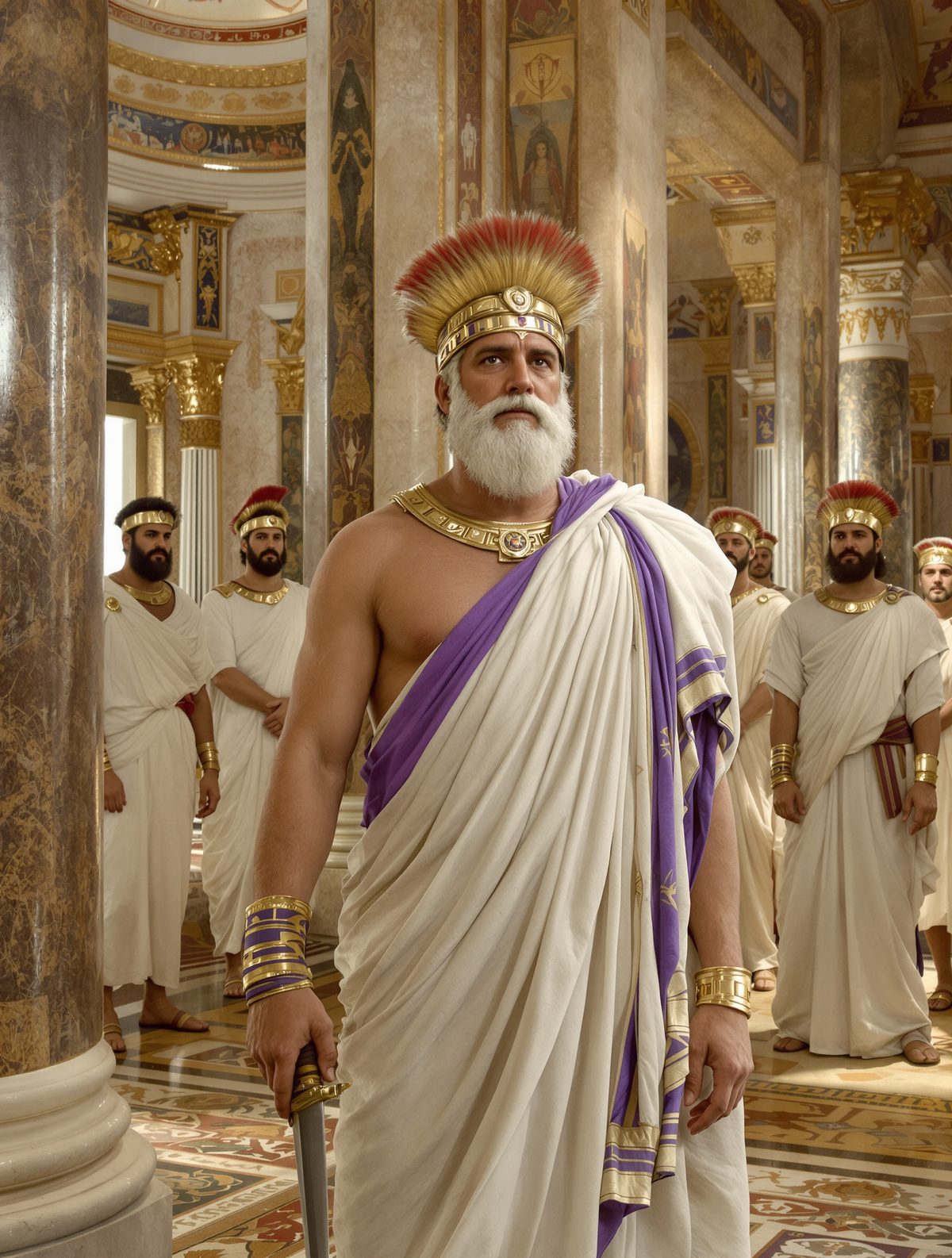
In the bitter winter of 1034, a fifteen-year-old Norwegian prince crouched in the frozen forests of his homeland, watching smoke rise from distant villages put to the sword by his enemies. Harald Sigurdsson had lost everything—his half-brother King Olaf II lay dead on the battlefield of Stiklestad, his claim to the throne was worthless, and powerful enemies wanted his head on a spike. Most teenagers in his position would have surrendered or died trying to reclaim their birthright. Instead, Harald made a decision that would reshape the medieval world: he would flee to the glittering capital of Byzantium and become the deadliest Viking in the Emperor's service.
What happened next reads like the most outrageous historical fiction, except every blood-soaked, gold-laden detail is true. This teenage exile would spend the next eight years carving a legend across three continents, serving three different emperors, and accumulating enough wealth to buy a kingdom. When he finally returned to Norway, he wouldn't come as a beggar seeking scraps—he'd come as Harald Hardrada, "the Thunderbolt of the North," with a fleet of warships and a reputation that made grown men wet themselves.
The Young Wolf Flees North
Harald's journey began with one of medieval Europe's most audacious escape routes. After the disaster at Stiklestad, where his half-brother's attempt to reclaim Norway ended in catastrophic defeat, the teenage prince fled east through the wilderness of Kievan Rus. This wasn't some leisurely royal progress—Harald and his small band of loyal followers were hunted men, traveling through territory controlled by Slavic tribes and rival Norse warlords who would have happily delivered his head to his enemies for the right price.
The route itself tells us everything about Harald's character. Instead of seeking refuge in the familiar courts of Denmark or Sweden, he chose the most dangerous path imaginable: down the treacherous river systems of Eastern Europe, through the domain of Prince Yaroslav the Wise of Kiev. Here's what most history books don't tell you: this journey of over 1,200 miles would have taken months, with the constant threat of river pirates, hostile tribes, and the brutal onset of a Russian winter that could kill you just as efficiently as any sword.
By 1034, Harald had reached Kiev, where he spent several months in the court of Yaroslav—himself a fascinating character who was busy transforming Kiev into one of medieval Europe's great power centers. But even the splendor of Kiev wasn't enough for the ambitious young Viking. Harald's eyes were fixed on an even greater prize: Miklagard, the "Great City" that Vikings called Constantinople, where the Byzantine Emperor commanded the richest empire in the Christian world.
Into the Golden City
When Harald's longship first rounded the great chain that protected the Golden Horn and he laid eyes on Constantinople in 1035, he was seeing something that would have stopped any medieval visitor dead in their tracks. The city housed nearly half a million people—making it roughly fifty times larger than London at the time. The Hagia Sophia, completed five centuries earlier, remained the largest enclosed space in the world. The streets were paved with stone, the palaces glittered with gold mosaics, and the markets sold silk from China and spices from India.
But Harald wasn't there as a tourist. He was there to join the Varangian Guard, the Emperor's elite unit of Viking and Anglo-Saxon warriors who served as both personal bodyguards and shock troops. Here's what makes this story even more remarkable: the Varangians were essentially the medieval world's version of the Foreign Legion, except they were paid in actual gold and had the legal right to loot enemy treasures.
The timing of Harald's arrival couldn't have been more perfect. Emperor Michael IV was dealing with rebellions across his vast territories, and he needed warriors who were both utterly reliable and absolutely lethal. The Varangians fit the bill perfectly—they were foreigners with no local political connections, they fought with a berserker fury that terrified enemies, and their concept of loyalty was refreshingly simple: as long as you paid them and pointed them toward the enemy, they would fight to the death.
The Sicilian Crucible
Harald's first major campaign took him to Sicily, where the Byzantine Empire was trying to reclaim territory from Arab rulers who had controlled the island for over two centuries. This wasn't some genteel medieval conflict with knights prancing around in tournaments—this was brutal, no-quarter warfare in the Mediterranean sun, where a single mistake could leave you feeding the fish.
The Sicilian campaign revealed Harald's tactical genius for the first time. While other commanders relied on traditional siege warfare that could drag on for months, Harald developed innovative strategies that combined Viking aggression with Byzantine engineering. At the siege of Syracuse in 1038, he reportedly used a trick that would have made his Viking ancestors proud: his men captured birds that nested in the city, tied burning tinder to their feet, and released them to fly back to their nests, thereby setting the city's wooden buildings ablaze from within.
But here's the detail that really shows Harald's character: according to the chroniclers, he didn't just participate in these sieges—he often led from the front, swinging his massive two-handed axe alongside common soldiers. For a man who would eventually be crowned king, this kind of personal courage was both politically shrewd and genuinely inspiring. His men didn't just follow him because he was their commander; they followed him because they had seen him split enemy skulls with his own hands.
From Sicily to the Holy Land
After three years of Mediterranean warfare, Harald's reputation had grown to legendary proportions. So when Emperor Michael IV decided to launch a campaign in the Holy Land to protect Christian pilgrims and Byzantine interests, guess who got tapped for the expedition? Harald and his Varangian warriors found themselves marching through the same landscapes where Christ had walked, except now they were there to kill anyone who threatened Christian access to the holy sites.
The Jerusalem campaign of 1041-1042 was Harald's masterpiece. Unlike the Crusades that would follow fifty years later, this wasn't a massive European invasion—it was a precisely targeted military operation designed to secure specific objectives with minimal fuss. Harald's forces moved with lightning speed through the Levant, capturing strategic fortresses and eliminating Arab raiders who had been harassing pilgrim routes.
Here's where the story gets really interesting: Harald didn't just fight his way through the Holy Land—he also became incredibly wealthy doing it. Byzantine military law allowed the Varangian Guard to keep a substantial portion of any treasure they captured, and the Holy Land was packed with wealthy cities that had grown fat on trade route profits. By the time Harald's Middle Eastern adventure was over, he had accumulated enough gold to finance his own private army.
The Three Emperors and a Fortune in Gold
During his eight years in Constantinople, Harald served under three different emperors: Michael IV, Michael V, and Constantine IX. Each transition was a masterclass in Byzantine palace intrigue, complete with assassinations, coups, and enough backstabbing to make Game of Thrones look like a children's tea party. Through it all, Harald managed not just to survive but to prosper—a remarkable achievement that speaks to his political intelligence as much as his military skills.
The most dramatic imperial transition came in 1041-1042, when Emperor Michael V tried to exile the Empress Zoe, who was both the previous emperor's widow and one of the most powerful women in Byzantine history. Harald found himself in the middle of a civil war that literally tore Constantinople apart, with different factions controlling different quarters of the city and street fighting raging for weeks.
Here's the part that shows Harald's true genius: instead of picking the wrong side and ending up dead, he positioned himself as a reliable military asset to whoever emerged victorious. When the dust settled and Constantine IX took the throne (after marrying the restored Empress Zoe), Harald was not only still alive but richer and more powerful than ever.
The Return of the King
By 1042, Harald had accomplished something unprecedented: he had served in the Byzantine Empire's most elite military unit for eight years, accumulated a personal fortune that rivaled that of kings, and gained military experience across three continents. But perhaps most importantly, he had transformed from a teenage exile into one of the most formidable warriors of his age. Standing nearly seven feet tall (according to contemporary accounts), scarred by countless battles, and possessed of a strategic mind that had outwitted enemies from Sicily to Jerusalem, Harald Sigurdsson was ready to reclaim his birthright.
When Harald finally departed Constantinople in 1043, he took with him not just his personal treasure but also a small army of loyal Varangian veterans who had chosen to follow their former commander rather than remain in imperial service. The teenage exile who had fled Norway nearly a decade earlier was returning as a force of nature who would soon earn the nickname "Hardrada"—literally "hard ruler" or "stern counsel."
What makes Harald's story so compelling isn't just the adventure and violence—it's the way it illustrates how the medieval world was far more connected and cosmopolitan than most people realize. This Norwegian Viking didn't just raid monasteries and burn villages; he served in the armies of the Byzantine Empire, fought alongside Greeks and Bulgarians and Armenians, learned to speak multiple languages, and absorbed military techniques from three different continents.
Harald Hardrada would go on to rule Norway for twenty years, launch the last great Viking invasion of England, and die fighting at the Battle of Stamford Bridge in 1066—a battle that historians mark as the end of the Viking Age. But none of that would have been possible without those eight transformative years when a teenage exile reinvented himself as the deadliest warrior in the Byzantine Empire. In an age when most people never traveled more than a few miles from their birthplace, Harald Sigurdsson proved that sometimes the best way to claim your destiny is to travel to the other end of the world and earn it with your sword.