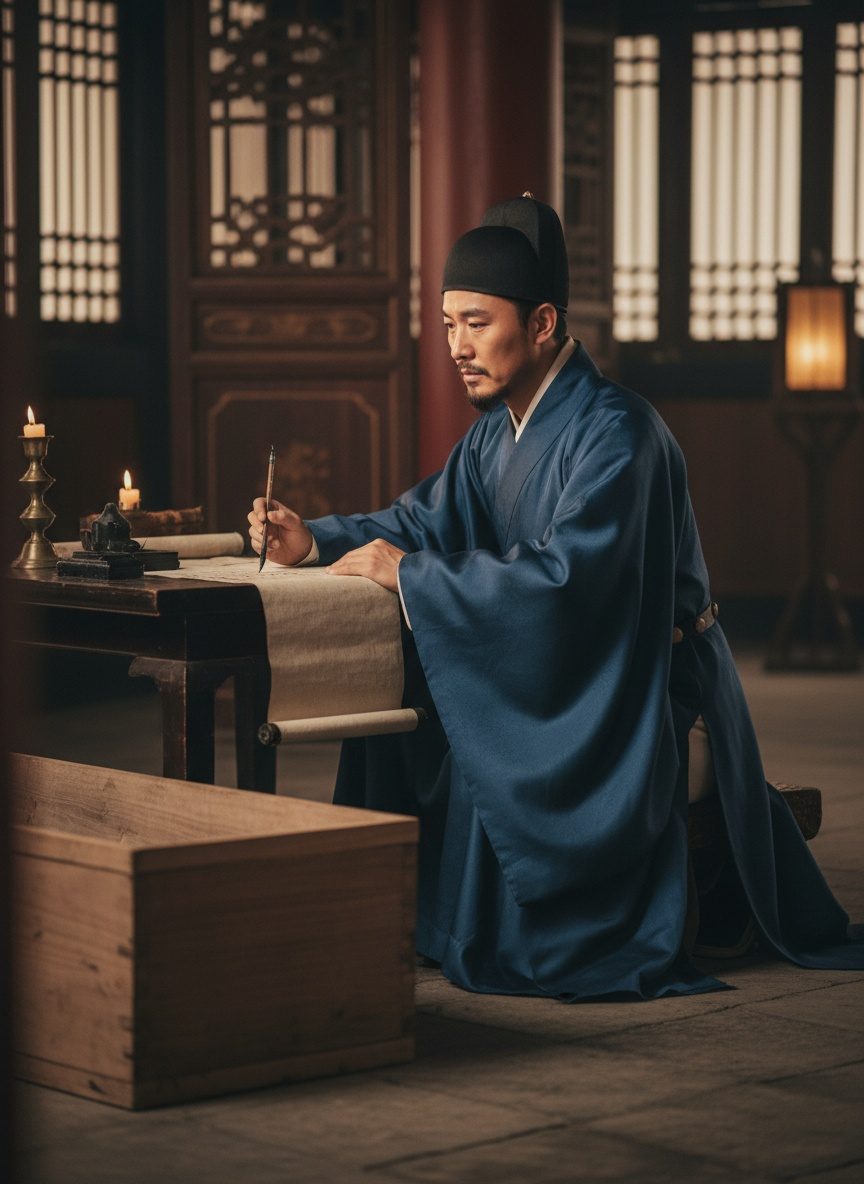
Hai Rui stood before the ornately carved throne, his heart pounding in rhythm with the silent, weighted breaths of the imperial court gathered around him. He could feel the chill in the grand hall of the Forbidden City, the cold stone seeped with centuries of tension and power struggles. Each word he spoke carried the weight of an entire nation; for this was a courtier's death wish. In Hai Rui's trembling hands, he held a letter—the condemnation of a lifetime, addressed to the Jiajing Emperor himself. He had already said his goodbyes, purchased his own coffin, and prepared for the inevitable. Yet, as he began to read, the emperor’s eyes did not blaze with fury. Instead, they shimmered with an unexpected glimmer of tears.
The Plunge into Audacity
In the darkened corners of the Ming Dynasty’s vast imperial bureaucracy, the name Hai Rui began to resonate with unprecedented courage and audacity. How did a minor official stand up to one of the most imposing rulers of his time—a ruler who had become notorious for his harsh cruelty and neglect of the state's affairs? What Hai Rui perceived was not shaped by ambition, but by a disdain for the systemic corruption and the suffering it engendered amongst the citizenry. As the years ticked away into Jiajing’s lengthy rule, the emperor had increasingly retreated from governance, entrusting power to a parade of eunuchs and corrupt officials.
Hai Rui made an unorthodox choice for an official of his standing. He bought a coffin, a stark symbol of defiance and an acceptance of his fate. The purchase was symbolic, communicating to his family a final farewell. Facing possible execution for criticizing the emperor was not unprecedented, yet Hai Rui persisted, driven by a deep-seated belief in Confucian ideals and the notion of righteous governance.
Those who sailed these treacherous waters before him rarely survived the undertow of imperial wrath. Hai Rui, however, seemed unperturbed by the ghostly whispers of predecessors who had dared to challenge autocratic tyranny. Steeled by resolve, his words were sharper than even the emperor’s most feared swords. He critiqued the Jiajing Emperor's abandonment of his duties and the unchecked corruption that festered under his reign. To the courtiers who witnessed this audacious spectacle, it was as if Hai Rui’s document was ablaze, its searing truths a beacon of integrity—or an obituary of imminent death.
Tears of the Dragon
The tension was palpable among the aristocrats, ministers, and eunuchs as Hai Rui spoke. Each syllable landed like a tremor, rattling the very foundations of the Forbidden City. Those who had thrived in shadows now found the light piercing their veneer of power. But what no one anticipated was the reaction of the Jiajing Emperor, a sovereign historically known for his aloofness and cruelty.
As the emperor fixated on Hai Rui's letter, an unfamiliar emotion overwhelmed the hall—tears. The tears were not of rage but rather of a profound, unbidden reconsideration. This vulnerable display shifted the paradigm, catching even the most astute court observers off guard. Beyond the disturbance, this was a moment of cathartic realization; the emperor was confronted with an unvarnished reflection of his waning virtue. In this rare vulnerability, the emperor saw the specter of his neglected empire, echoing Hai Rui's criticisms like a haunting melody.
To Hai Rui’s astonishment and against the tide of deadly traditions, the emperor spared his life. Hai Rui was neither jailed nor executed. This reprieve was unheard of—a man criticized the highest power in the land and survived. The court buzzed with incredulity, their assumptions of imperial retribution upended. Yet, beneath the emperor's teary-eyed grace, perhaps lay a shrouded acknowledgment of the truth within Hai Rui's indictments.
The Tale that Survived the Dynasty
Word of this extraordinary episode spread rapidly, solidifying Hai Rui's name in the annals of history. Equally astonishing was the persistence of the emperor’s tears—an enduring narrative within China's rich tapestry of imperial folklore. It transformed Hai Rui from a humble official into a symbol of conscience, integrity, and the perennial struggle against moral decay within the hearts of rulers.
Hai Rui’s actions prompted subsequent generations of politicians, scholars, and reformers to contemplate the real weight of speaking truth to power. Here was a lesson learned under the shadow of certain death: that sometimes, the immovable could be touched by the immaterial—the human conscience. His bravery, etched into the collective memory of the Chinese people, served as an ancient torch illuminating the path for courage against tyranny.
As we consider Hai Rui’s extraordinary gamble, it challenges us as well: to reflect on leadership and accountability within our shifting modern landscapes. The tale of Hai Rui reminds us that history, so often seen through the lens of power and conquest, is also built upon bravely articulated truths. It whispers the crucial reminder that speaking up against inequity is not merely an act of rebellion but a service to the principles that bond humanity. This moment of bravery in Ming Dynasty China is a call to each of us to confront complacency and power with integrity, whenever and wherever they arise.