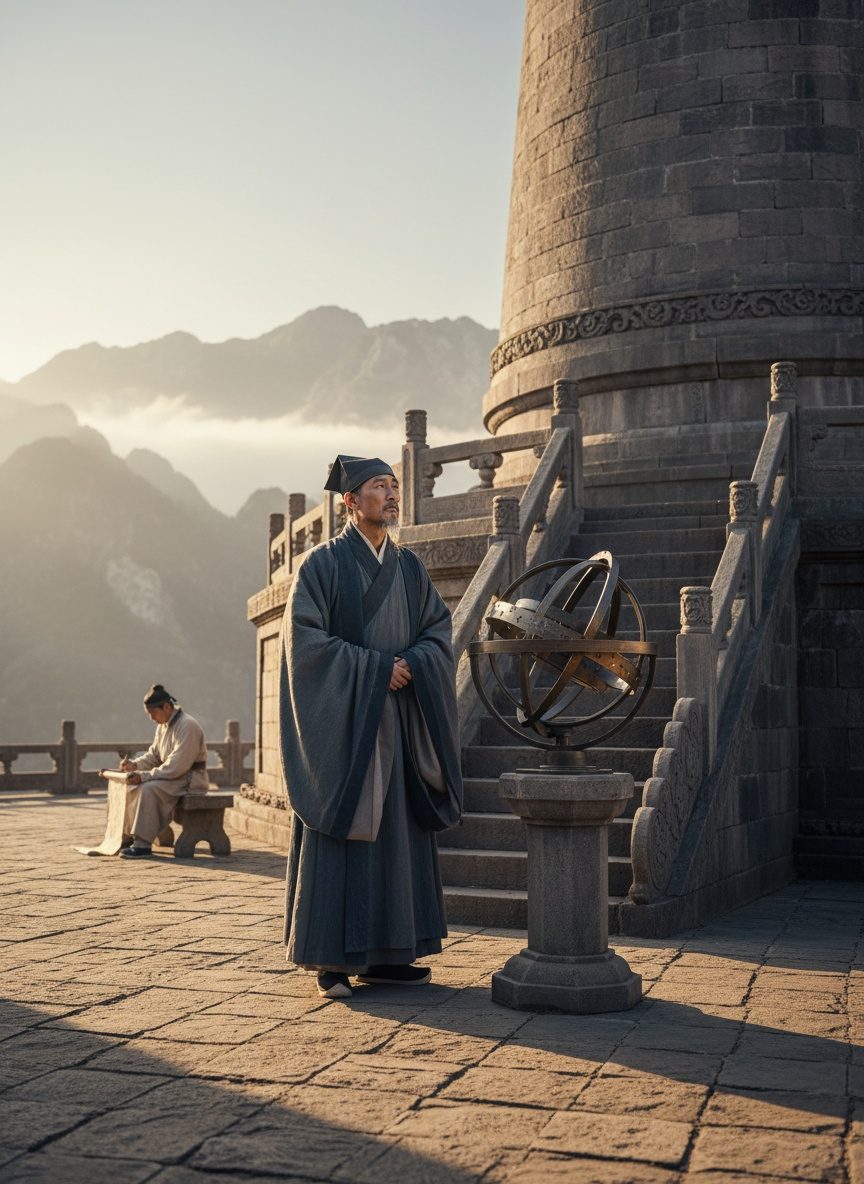
The morning air on the northern Chinese plain was crisp and clear, with a fine mist rising as the first beams of sunlight pierced through the arboreal canopy. Amidst this tranquility, a singular figure stood silently on one of the grand observation towers. Coarse, stone walls surrounded him as he peered through ingeniously crafted instruments of brass and wood. It was the year 1280 AD, and beneath the shadow of Kublai Khan's sweeping empire, Guo Shoujing prepared to defy the very heavens. Charged with an astronomical challenge that would test even the boldest innovator, he aimed to recalibrate time itself for the vast Mongol realm.
A Mandate from the Khan
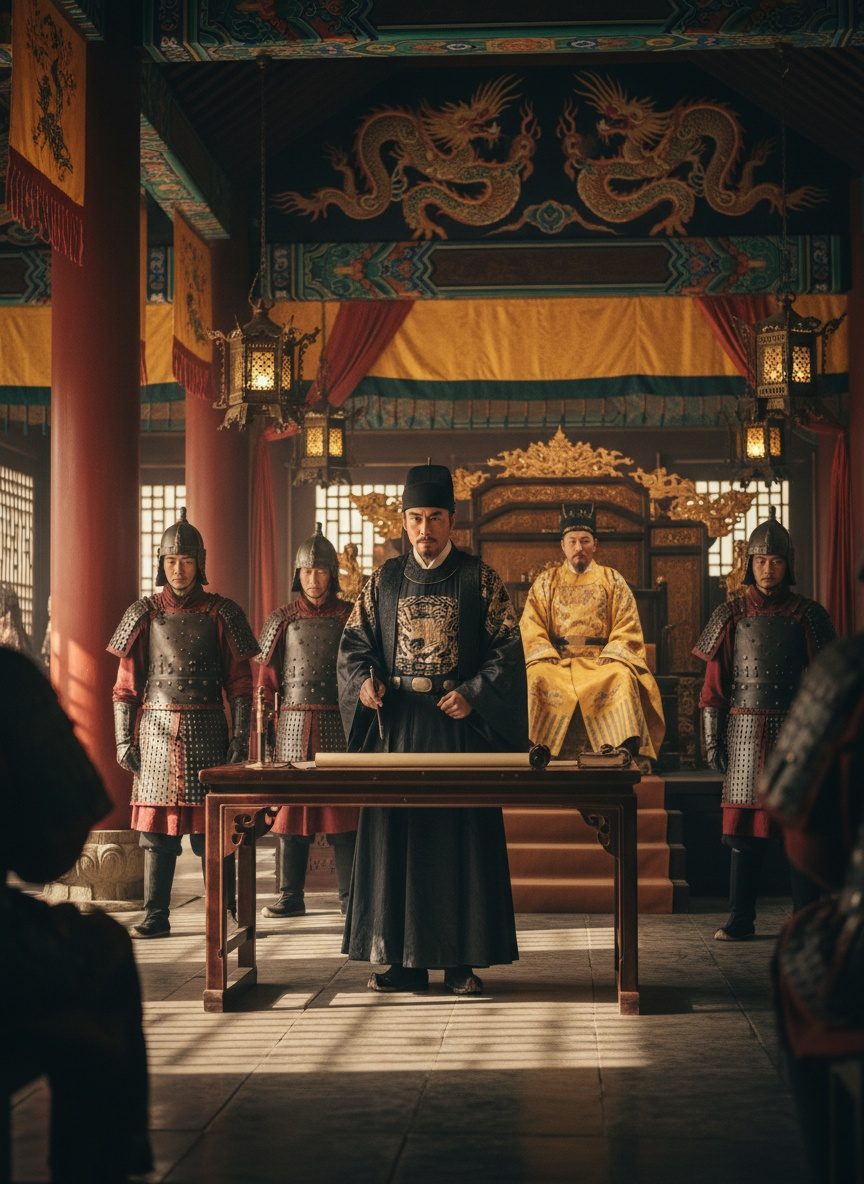
Legendary for extending the Mongol Empire across continents, Kublai Khan was not a ruler to accept the ordinary workings of the universe without scrutiny. His dominion stretched from Europe to the Asian hinterlands, yet the calendar that marked his empire's days proved unreliable for agricultural and religious purposes. This small imperfection in cosmic organization would not stand. Thus, a new mandate arose: create a calendar accurate enough to reign over both land and the inexorable river of time.
Enter Guo Shoujing. More than merely an astronomer, he was a polymath whose talents traversed mathematics, engineering, and the natural sciences. Guo Shoujing accepted the mandate with little hesitation, embracing this near-impossible quest to recalibrate the movement of heavenly bodies across a land whose cultural and geographical tapestries were as complex as its celestial skies.
The Journey Across a Star-Strewn Empire
Guo Shoujing embarked on an extraordinary expedition, visiting twenty-seven observation stations strategically placed across imperial China. From granite shores to arid deserts, he and his team meticulously measured the sun's position at each location. Travel was arduous, but the juxtaposition between geography and the grandeur of the mission propelled him forward.
His instruments, too, were unprecedented in their innovation. Among them was the simplified armillary sphere, a construction of rings that mimicked the circles of the heavens, allowing him to track celestial bodies with unprecedented precision. Then there was the gnomon, a simple yet profound vertical sundial used in calculating the solstice. Each station’s apparatus stood like an ode to human ingenuity, each measurement a whisper to the cosmos.
A Measurement Few Else Could Match
Guo Shoujing's calculations shattered all expectations. By arranging his measurements into a coherent system, he determined the solar year to be precisely 365.2425 days—a number that would remain unmatched by any in the West for another three centuries. Such precision not only astonished his contemporaries but set a standard that modern calculations would affirm with only the smallest of corrections.
This calibration was not merely an achievement in mathematics; it was an assertion that the universe held patterns of incredible regularity awaiting discovery by a deft human intellect. By intertwining empirical observation with sophisticated theory, Guo Shoujing created the Shoushi Calendar, a corrected timekeeping system whose applications extended far beyond astronomy. It regulated festivals, dictated agrarian rhythms, and synchronized the empire under a unified temporality.
The Quiet Echo of Cosmic Mastery
Today, as we contemplate the magnitude of Guo Shoujing's contribution, it is easy to overlook how his legacy was almost lost to obscurity. Over time, new regimes and ideologies turned the pages of history, and even such monumental achievements faced the dust of neglect. Nonetheless, his work laid a foundation that inspired future generations of astronomers and mathematicians around the globe.
Guo Shoujing's struggle with a world of inaccuracies turned into a sublime testament to human potential: the capability not merely to understand the stars but to quantify them, to pull order from what seems chaotic. As we navigate our own era of rapid expansion and technological advancement, it is worth recalling those who first dared to measure the sky, challenging even the sweeping tides of an emperor’s dominion. By measuring the immeasurable, Guo Shoujing ensured that the cosmos could continue to guide us, from the Yangtze to the Yellow River, echoing across the march of time and empires.