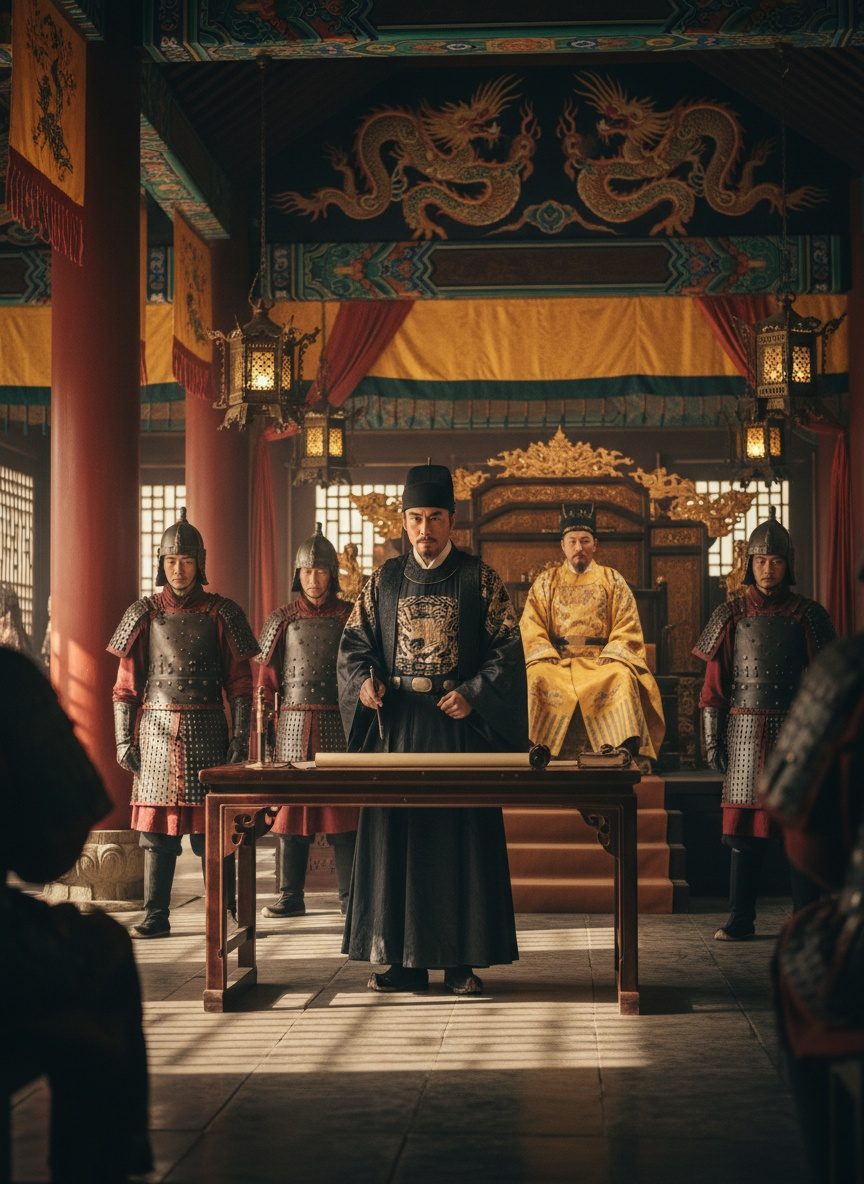
Fang Xiaoru’s name is unfamiliar to most in the West. But in 1402 China, he stood at the crossroads of treachery and courage.
The Siege of the Throne
In 1402, China's imperial heart was a battlefield awash with betrayal and ambition. The usurper, Zhu Di, had wrested the throne from his nephew, setting the Ming Dynasty ablaze with conflict. Zhu Di, the powerful Prince of Yan, had emerged victorious from a brutal civil war known as the Jingnan Campaign. He was now Emperor Yongle, yet his rule would remain shadowed by the stench of treason unless formally sanctified. And for that, he needed the service of Fang Xiaoru, the preeminent scholar of his time.
Fang Xiaoru was not just a scholar; he was a beacon of integrity, a man whose moral compass was renowned throughout the land. With command over words that could calm a storm of chaos, he was summoned to lend legitimacy to Zhu Di's coup. But the task was not simply to pen a few placating lines. Fang was asked to justify the unjustifiable, to twist history into a tale that would absolve the bloodshed and secure the new emperor's claim.
The new dawn Zhu Di envisioned began with a proclamation, but Fang Xiaoru, summoned to craft it, stood firm in his principles. It was not mere obstinacy. It was an act of defiance against a backdrop of peril—a challenge shouted into the jaws of the dragon. With his position deeply rooted in the loyalist camp of the ousted emperor, Fang Xiaoru refused to betray his conscience—or his allegiance. In a moment where survival instinct alone could have clouded judgment, Fang’s mind was unyielding, his pen uncompliant.
The Unwritten Proclamation
The unspoken tension within the imperial court was thick as summer haze. Zhu Di's demand was explicit: he needed Fang to write the words that would erase the stain of his usurpation. Yet, Fang’s silence screamed louder than any proclamation could—a silence that destabilized more than a throne; it shook the very essence of mortality and legacy.
The emperor wielded more than power; he wielded the lives of Fang's family, vowing the annihilation of ten generations should his demands be denied. For Zhu Di, subduing Fang was not merely about obtaining reluctant service; it was about breaking the spirit of dissent, publically absorbing its most formidable critic. He saw in Fang not just a single man, but a symbol whose acquiescence would signify the end of resistance.
Every brush stroke Fang could have made was, in reality, a battle against history itself. His ultimate defiance arrived in two resolute characters: jian (*usurper*). Then Fang did what any man forced between integrity and submission might fear most: he stopped. He laid down the brush and refused to complete what could have been his last act. In those sacred moments, Fang’s choice to sacrifice everything for a principle proved that the battle lines did extend beyond physical warfare into the soul’s realm.
The Execution of Integrity
Men have been executed for crimes less severe, while others for greater atrocities have met softer ends. But Fang’s punishment was designed to echo through eternity, a grisly message to all who dared challenge the emperor’s command. Zhu Di held true to his threat—the slaughter of Fang Xiaoru’s kin began with the swift finality of sword and silence. Here lies the heart-wrenching agony of choice, where one soul’s defiance becomes a fate shared unjustly by many.
Yet in this unspeakable act, Fang Xiaoru achieved absolute victory. His refusal and its consequent sacrifice etched his story into the annals of time more permanently than any ink. He had transformed from a man into an indestructible idea: that there are truths, sacrifices, and principles that no power can truly extinguish. Concession and compliance would have brought him survival, but instead, his resistance granted him an eternity of respect and remembrance.
Fang’s stand at the crossroad of life and legacy ignited a moral flame, the illumination of which continues to burn bright centuries on. Zhu Di’s reign, steeped in blood and legitimacy’s fragile veneer, teaches us a vital lesson about the power dynamics of integrity. It reminds us that legends are often borne of unwavering fidelity to one’s beliefs, and that courage, unadorned by power or position, manifests in its purest form through the steadfast defiance of tyranny. Fang Xiaoru reminds us that even in the depths of darkness, a single act of defiance can echo through history, a constant and unyielding reminder of the power of the human spirit.