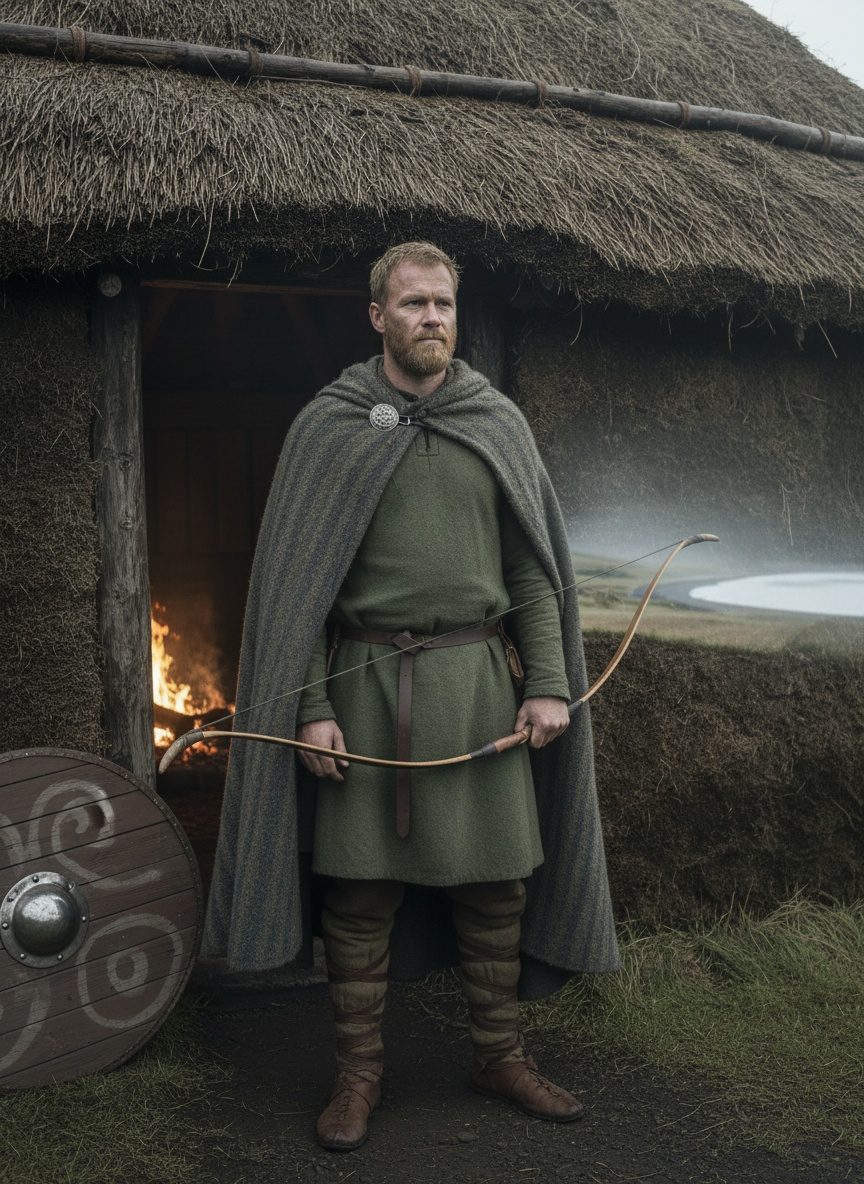
Gunnar of Hlíðarendi is famously remembered in Iceland. His laughter rang out in defiance of a fate that loomed close.
Iceland, around 990 AD, was a land both fiercely independent and intricately bound by codes of honor and law. Its settlers were a blend of Norse explorers and farmers, people forged from hard climates and hard decisions. Among them stood Gunnar Hámundarson, the most celebrated warrior of his time. Renowned not just for his unmatched prowess with weapons, Gunnar was also known for his striking good looks and the grace with which he moved—his skillfully woven tunic a blur when his halberd was in hand. To many, he seemed blessed by the gods themselves.
Legend holds that Gunnar was a man of extraordinary talents, able to leap his own height in full armor and strike ten arrows without missing. Those who did not know him would whisper tales of his charm and affability, qualities that made him both a beloved leader and a feared adversary. His home in Hlíðarendi, a prosperous farm nestled in a sweeping valley, was not only his sanctuary but also his fortress, a symbol of the life he had built and the fortune he had amassed. Yet beneath the veneer of tranquility, a storm brewed.
The drama unraveling around Gunnar was born from a web of allegiance, betrayal, and the weighty demands of Viking law. In Iceland, justice was dispensed in a formalized system of courts known as the Althing, a gathering where disputes were settled and oaths solemnized. When rivalries ignited and blood was spilled, the law decreed action. For Gunnar, it was this unyielding law that sent him to the brink.
Exiled for his involvement in an escalating feud, Gunnar was sentenced to leave Iceland, a land as much a part of him as he was integral to its stories. The verdict seemed straightforward; Iceland was a realm of exile, a common fate where conflicts were resolved not by endless slaughter—though bloodshed was far from unusual—but by granting combatants the space to feud no more. Except this time, the island would lose one of its most illustrious inhabitants.
With that decree, neighbors and acquaintances gathered for his farewell. Saddled with the weight of enforced departure, Gunnar rode toward the ship that would carry him away. As he and his loyal steed made their way, an errant stone beneath the horse's hoof caused it to stumble. Gunnar turned, his gaze scaling the hills and falls of his land, and it was in that quiet glance back that history caught its breath. "Lovely is the hillside," he mused—words that clung to the Icelandic sagas like the mist upon those very fields.
In that moment, laughter bubbled forth, a sound incongruous with the gravitas of his situation. His laughter was not of amusement but the laugh of a man who had beheld beauty as destiny pulled him onwards. At the core of Gunnar's decision lay a simple truth: the connection to his land was a love story too profound to budge for law or logic. Sentenced to leave, foretold to perish, he chose instead the call of his hearth.
The consequences were inevitable. Gunnar returned to his farm, to the rolling hills and the austere beauty that was Hlíðarendi. Alone, he prepared to face the retribution his choice demanded. Those around him warned of the impending tide, yet Gunnar, ever resolute, refused to slip quietly from the saga of his own life. Instead, he languished beneath its high stakes, content in the company of the landscape that had shaped him.
The dawn that followed was punctuated by the clamor of weapons as enemies descended upon Gunnar’s home. Accounts from the sagas place dozens outside his doors. The ensuing battle was one last blaze of valor. Gunnar, armed with his legendary halberd, fought with a ferocity that made his enemies think twice about approaching. His weapon sang through the air, marking him again as Iceland’s greatest warrior despite the odds stacked high against him.
Yet, even the most accomplished warrior can bend beneath the weight of overwhelming numbers. Gunnar's defense was as prodigious as any tale born from the age of Vikings. He tensed, a coiled spring letting loose his prowess in flurries of intent. Each strike was lethal, a testament to skill honed through years of unavoidable conflict. Surrounded, with arrows and blades piercing both his flesh and his fate, Gunnar's laughter faded finally to silence.
The land itself seemed to mourn, the hills draped in early morning mist serving as witness and shroud. The winds carried whispers of what was lost with Gunnar’s departure, a time cradled between the echoes of heroic accomplishment and the real-world collapse of one man's unbending allegiance to heart and home. The tale, already mythic, swam through ages and is recounted still, a narrative woven with threads of love, honor, and the immutable call of one's origin.
It is perhaps this story of Gunnar of Hlíðarendi, more than any other, that arouses reflection on the essence of choice and sacrifice. In a world where duty often pressed harshly against desire, Gunnar chose not to relinquish what he cherished most. His was a stand that time would weave into the fabric of Icelandic identity, a story about the choices that craft who we are and the quiet courage it takes to choose the path less trodden—even when the stakes are life itself.